
Marion County issues federal legislative priorities
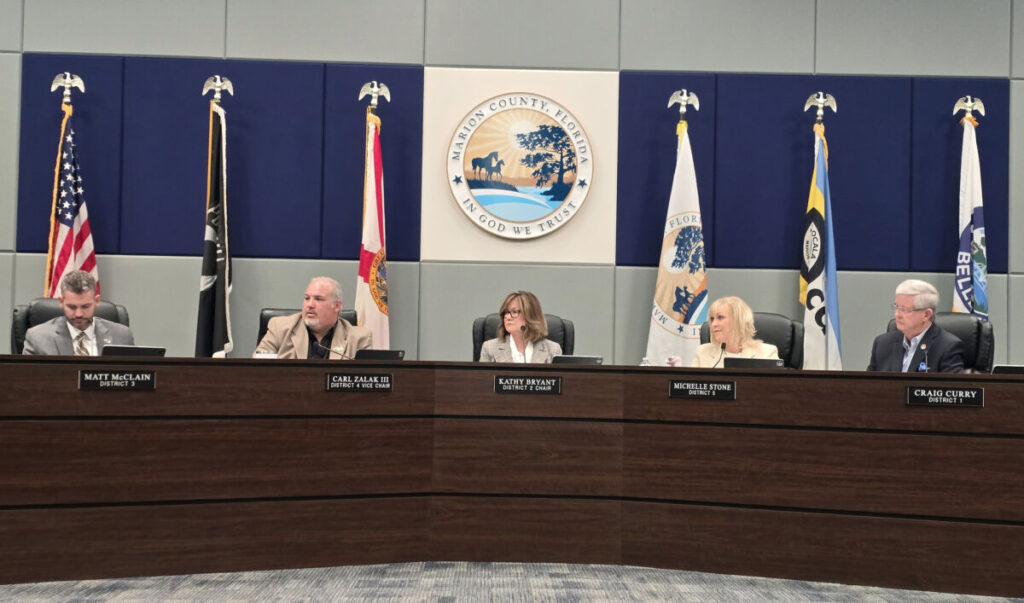
The Marion County Commission meets in the McPherson Governmental Complex in Ocala, Fla. on Tuesday, February 18, 2025. [Bruce Ackerman/Ocala Gazette] 2025.
Marion County commissioners have created a list of priorities to request federal legislators to attend to in the coming congressional session—including mitigating local costs for inmate medical care.
Over the coming legislative session, the county commissioners have three requests for its House and Senate representatives.
Medicaid Inmate Exclusion Policy
Marion County requests that delegate members support Medicaid aligning with Medicare’s definitions of continuing versus suspending coverage for pretrial and reentry populations.
Among the county’s most pressing requests is the Medicaid Inmate Exclusion Policy, which commissioners say has placed undue financial strain on local governments and taxpayers by extension.
“Just the fact that when you are arrested, you lose all of your availability to (Medicaid) funding for medical care, and then the citizens have to cover that medical care, is just not right,” said Commission Chair Kathy Bryant.
In November 2024, the Centers for Medicare & Medicaid ruled that Medicare’s benefits would be extended to individuals who are awaiting trial, on parole or probation, or residing in halfway houses.
“This important update ensures these individuals can maintain access to Medicare benefits, supporting better health outcomes and smoother transitions back into the community,” according to the National Association of Counties.
Marion County requests that delegate members support Medicaid’s definitions and align with Medicare’s changes of continuing versus suspending coverage for pretrial and reentry populations, according to its legislative priorities.
“This costs us millions of dollars every year just here in Marion County,” Bryant said. “Statewide, this is a huge expense to many counties, and I think it’s extremely important when we are working so hard to be good stewards of tax dollars.”
In Fiscal Year 2024-2025, counties in Florida will collectively contribute $367.4 million, of which Orange County will contribute $24.4 million, according to the Florida Association of Counties.
“Even if a portion of the additional costs were passed on to the counties, Medicaid reimbursement rates are most likely less than what counties are currently paying for hospitalization,” wrote FAC.
Orange County’s average daily inmate population is about 2,377, in comparison to Marion County’s average population of 1,600 to 1,700.
Marion County Legislative Manager Matthew Cretul wrote in these priorities that the Medicaid Inmate Exclusion Policy creates a “double standard,” and that the federal policy preventing persons who have been released from custody to benefit from Medicaid “results in higher rates of recidivism, increased healthcare costs, and poorer health outcomes for residents.”
Counties nationwide are urging legislators to support bills such as The Reentry Act and The Due Process Continuity of Care Act to expand provisions of Medicaid payment and provide grant funding to states to implement the repeal of the Medicaid Inmate Exclusion Policy.
“Across our nation, 7.6 million people cycle in and out of local jails each year, nearly 70 percent of which are pre-trial detainees,” according to the National Association of Counties. “The number of individuals being detained pre-adjudication has grown tremendously in the past several decades and paralleled the number of individuals in local jails that are experiencing mental illness and serious mental illness, often with co-occurring substance use disorders.”
Tax-Exempt Status of Municipal Bonds
Marion County requests delegate members oppose efforts to eliminate or limit the tax-exempt status of municipal bonds.
“Tax-exempt bonds are a critical tool for counties that facilitate the budgeting and financing of long-range investments in the infrastructure and facilities necessary to meet public demand,” Cretul wrote.
To avoid putting the cost of raising capital on the taxpayer, the county asks Congress to advocate for the continued tax exemption of municipal bonds.
In doing so, the county would have to “reduce spending on the roads and bridges that counties are responsible for, decrease economic development, higher taxes, or higher user fees,” according to the legislative priority.
“In 2025, the tax cuts are expected to sunset back to 2017 levels,” Cretul said. “We are asking our legislative delegation to advocate to continue to keep those tax cuts in place, to allow this municipal bond to continue to be tax exempt.”
US DOT Funding Related to Road Projects
Marion County requests its delegate members support funding programs that are focused on roadway improvement and expansion programs.
With traffic concerns on Interstate 75 worsening as the county’s population grows, Marion County and the city of Ocala are working to develop “parallel and alternative corridors” to I-75 and other major state roads.
“Not only are more than 300 people moving into the county each week, but I-75 also carries over 100,000 vehicles daily through the county, 25,000 of which are trucks and tractor trailers,” Cretul wrote.
The county wishes to continue receiving federal funding for road projects. Through the Safe Streets and Roads for All Program, the county received $20 million to improve Maricamp Road.
“We’re just asking, as we understand the need for road projects, that the federal government recognizes that need,” Cretul said.

Support community journalism
The first goal of the Ocala Gazette is to deliver trustworthy local journalism so corruption, misinformation and abuse are not hidden from the public or unchallenged.