
Marion County Firefighters bargaining
Proposed $20K raises, 42-hour work week geared to boost staffing.
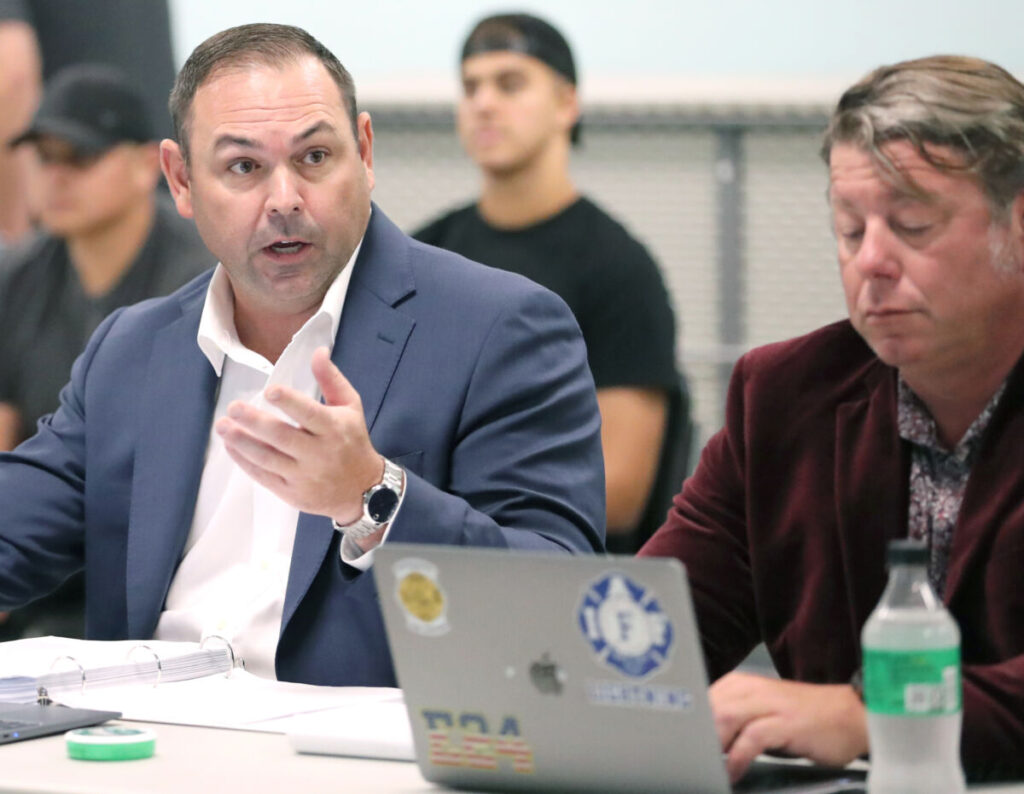
Rolin Boyd, the president of the Professional Firefighters of Marion County (IAFF Local 3169), left, speaks as Joe Romani, right, also of the IAFF Local 3169, right, listens during a Collective Bargaining Agreement meeting for Marion County Fire Rescue with the Marion County Board of County Commissioners at the Marion County Wellness Center in Ocala, Fla. on Tuesday, May 12, 2026. [Bruce Ackerman/Ocala Gazette] 2026.
|
Getting your Trinity Audio player ready...
|
Editor’s note: This article was amended following the May 12 bargaining session.
For months, negotiations between Marion County Fire Rescue (MCFR) and the Professional Firefighters of Marion County (IAFF Local 3169) seemed hopelessly stalled by financial realities. Just weeks ago, county officials warned that an $8 million general fund deficit meant the county could not afford to improve firefighters’ 56-hour-a-week work schedules while simultaneously offering the pay raises needed to fill vacancies.
But during a pivotal bargaining session on May 7, which continued on May 12, the county reversed course and unveiled a $60 million proposal that delivers on both fronts.
In a surprising breakthrough, the county presented a short-term “bridge” contract that provides an immediate $20,000 base pay increase for all current employees upon ratification. This will be followed by a three-year contract that officially commits the department to transitioning to a 42-hour workweek (24 hours on, 72 hours off) by September 2029.
“This is more than a contract proposal. It’s a commitment,” Fire Chief James Banta told union negotiators that morning.

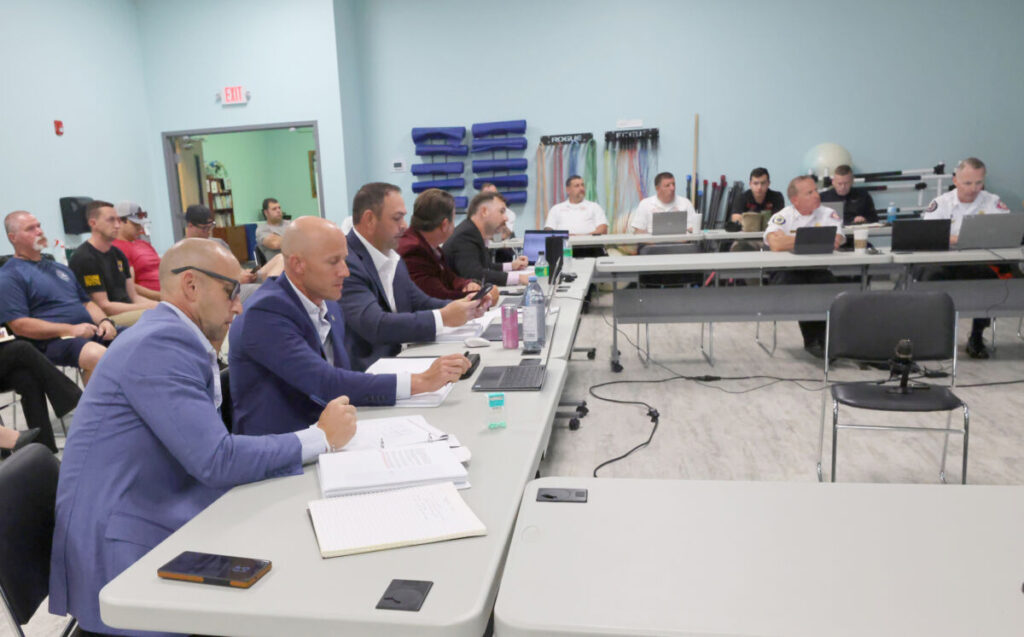
Deputy Chief Robert Graff, right, listens during a Professional Firefighters
of Marion County (IAFF Local 3169) Collective Bargaining Agreement
meeting for Marion County Fire Rescue with the Marion County Board
of County Commissioners at the Marion County Wellness Center in Ocala,
Fla. on Tuesday, May 12, 2026. [Bruce Ackerman/Ocala Gazette] 2026.
“A commitment fully supportive of our county commission, county administration, to invest in the people that serve this community… It also represents a reset, one that strengthens our workforce, stabilizes this organization and positions Marion County Fire Rescue for long-term success,” Banta said.
The reversal on rest and pay
The sweeping proposal marks a dramatic shift from the county’s posture earlier this spring.
During an EMS Advisory Board meeting earlier this year, MCFR Deputy Chief Robert Graff expressed skepticism about reducing the 56-hour workweek, questioning whether firefighters would actually use the extra time off for recovery and stating, “There’s not enough data yet to show whether it’s a 42-hour week or 48-hour week.”
By the March 11 bargaining session, Assistant County Administrator Amanda Tart walked back the county’s initial willingness to implement a schedule reduction. Facing a severe budget deficit, Tart suggested the county might have to abandon the schedule change to focus limited funds on raising base pay.

Firefighters of Marion County (IAFF Local 3169) Collective Bargaining
Agreement meeting for Marion County Fire Rescue with the Marion
County Board of County Commissioners at the Marion County Wellness
Center in Ocala, Fla. on Tuesday, May 12, 2026. [Bruce Ackerman/Ocala Gazette] 2026.
“I don’t want to take and spend all of our efforts on a schedule change and all of our financial resources toward the schedule change, and one, not be able to recruit for those positions because we can’t afford to do the schedule change and the money,” Tart explained in March.
The new May 7 proposal acknowledges that both are necessary to stop the bleeding.
As previously reported, Marion County was investing more than $50,000 for every firefighter recruit in payroll for the 10 months’ worth of training. Although those recruits signed contracts to stay a minimum of three years for the county’s investment, the union reported that in the last three years the department has lost more than 368 firefighters, which is significant considering the department firefighter roster is approximately 500.
Banta confirmed there are currently 53 vacancies in the department and it needs to fill those vacancies in addition to another 245 personnel for a new shift.
“We wanted to make sure that in this first contract, that we were able to address our current employees, get them to a starting wage that is not just competitive, but it’s higher than the majority of the state,” Tart said on May 7. “Your starting pay for an EMT is $65,000 and your paramedics are $75,000. So that should help us get out of the cycle of only hiring non-certified people.”
Staffing a fire department can be paid using money collected for the county’s general fund and fire assessment fees, which commissioners raised last year from $199 to $280.78 over the next five years for residential homes.
The fire assessment fee is added to all real estate tax bills sent annually to property owners. Fire rescue assessment rates differ from impact fees and the penny sales tax, as the revenue can be used for regular department costs and operations. Impact fees and penny sales tax revenue can only be used for capital projects and infrastructure.
Closing the regional wage gap
The $20,000 base pay bump is designed to instantly elevate MCFR from the bottom of the regional pay scale to the top and was a necessary measure.
A comparative analysis of neighboring counties illustrates why Marion County was losing experienced talent. Prior to this proposal, a dual-certified firefighter/paramedic in Marion County started at roughly $54,722 annually ($18.25/hour). By comparison, starting base salaries for similar positions in neighboring areas vastly outpaced Marion:
- Lake County: ~$72,829
- Sumter County: ~$68,508
- Citrus County: ~$67,158
Marion County’s single-certified EMTs faced a similar deficit, starting at just $15 to $15.25 an hour (roughly $41,820 to $45,727 annually), effectively paying highly skilled first responders near the impending state minimum wage.
The immediate $20,000 raise effectively bridges this gap, allowing MCFR to offer competitive starting rates for firefighter/EMT, $65,067; firefighter/paramedic, $75,022; EMT, $61,815; and paramedic, $72,239.
Additionally, to simplify future raises, the county’s proposal eliminates the previous 2% education incentive and replaces it with a guaranteed 3% cost of living adjustment (COLA) every October starting in 2027.
A statewide crisis
The massive financial investment by the county reflects a dire reality playing out across Florida: there are simply not enough firefighter paramedics to go around.
According to a 2023 white paper on recruitment and retention published by the Florida Fire Chiefs’ Association, the state’s fire service is facing a severe labor shortage. The survey, representing 76% of Florida’s firefighters, revealed there were 1,469 vacancies across the state.
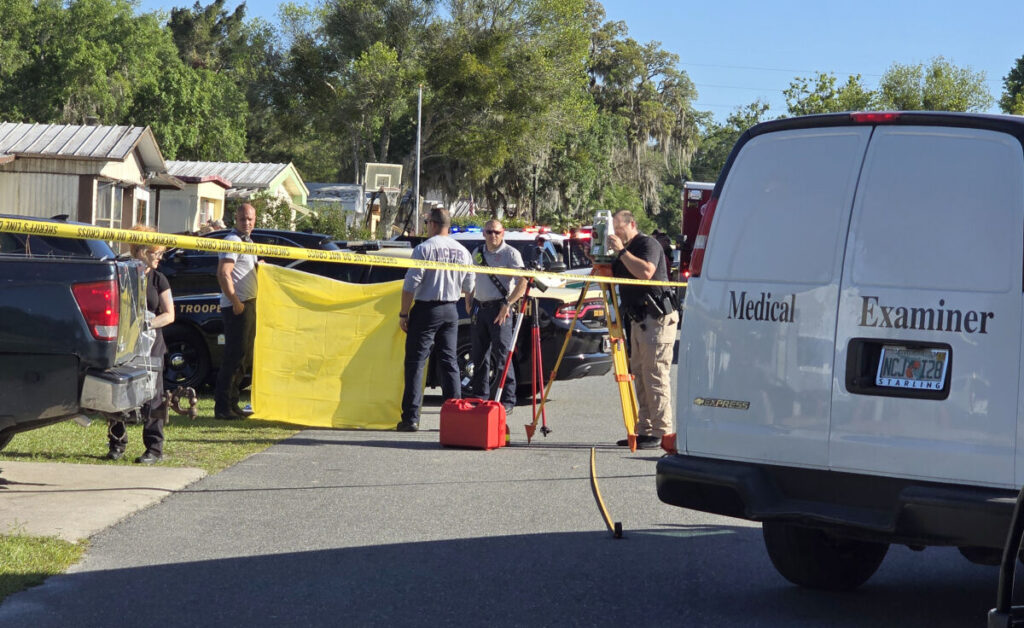
Home Park off Northeast 35th Street in Silver Springs, Fla. on Sunday,
April 12, 2026. [Bruce Ackerman/Ocala Gazette file photo]
The future outlook is even more competitive, with approximately 1,000 people moving to the state daily. Over the next five years, Florida fire departments project needing 3,961 new firefighters for expansion, while simultaneously losing 2,490 personnel to retirement or the DROP program.
The survey indicated that 71% of all needed hires (3,850 positions) must be dual certified as both firefighters and paramedics.
While there appears to be no public-facing data showing how many firefighters become certified each year, it is safe to conclude that the total is less than the open positions reported in the 2023 survey. When combined with projected retirements, this underscores a limited pool of qualified candidates and intense competition among departments. Marion County’s historical reliance on paying low wages to non-certified “trainees” was no longer sustainable.
The road to a 42-hour workweek
To fully implement the newly promised 42-hour workweek (24/72 schedule) by the September 2029 deadline, MCFR will need to hire approximately 245 additional personnel to staff a completely new “D-Shift.”
Both county and union leaders acknowledge this is a monumental task but believe the new compensation package will make it easier.
“The success of this depends on hiring qualified applicants,” Chief Banta told those at the May 7 meeting. “There’s no reason we can’t recruit, because we just set the rates, so the end of the schedule is a premier schedule… Everybody in the room’s a recruiter at this point.”
Graff echoed the sentiment, noting that the combination of top tier pay and a pathway to a 24/72 schedule should make Marion County the ultimate destination for first responders in Central Florida.
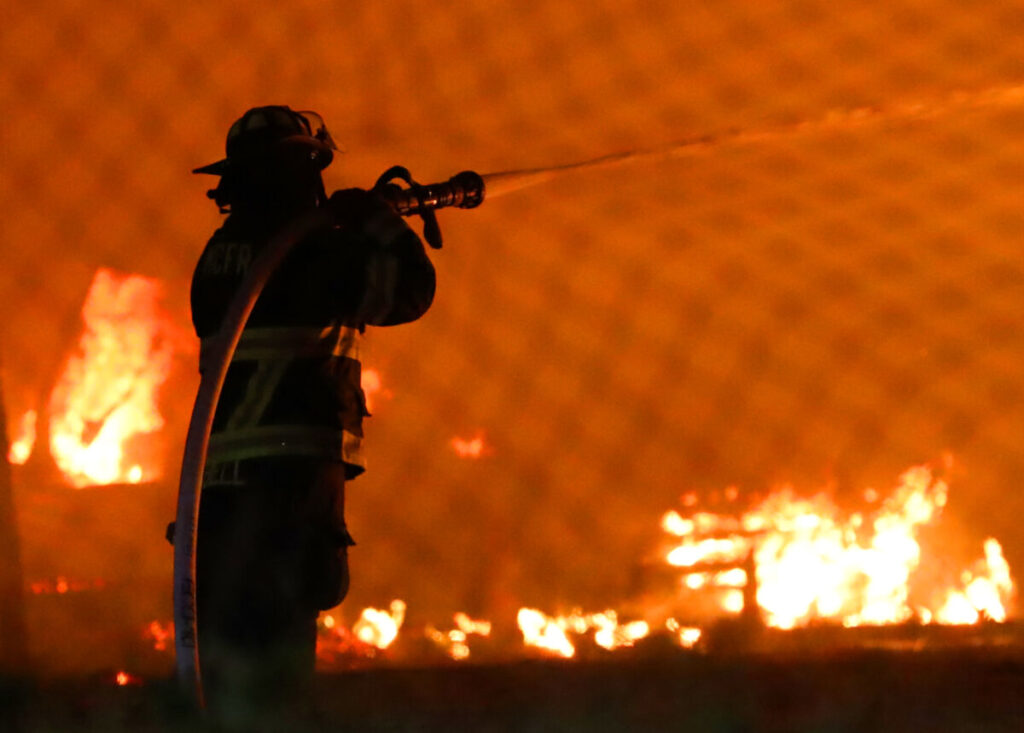
Marion County Fire Rescue try to contain the fire from spreading on
Northwest 44th Avenue Road in Reddick, Fla. on Tuesday, August 12, 2025.
[Bruce Ackerman/Ocala Gazette file photo]
“I challenge everyone to change that mindset,” Graff said. “Bring a friend, fill it. The faster we get it done, the faster we get [to the new schedule].”
There is a sense of urgency to begin hiring before other departments in the state transition and begin building their new D-shift as well.
“I think by 2029 the majority of the state’s going to be on 24/72 and we’re going to be fighting for the same candidates we are now. It’s my hope that hopefully the department moves forward quicker so we can grab the people who are on that waiting list [of other departments who have already transitioned to 42-hour work week],” Joseph Romani said for the union.
James Geering, a Marion County resident and host of the podcast “Behind the Shield,” who has been publicly critical of the department’s leadership over its reluctance to adopt a healthier work schedule, attended the May 7 bargaining session.
Geering, who has used his platform to advocate for schedule reform, was acknowledged during the meeting by Banta and union leadership.
Following the session, Geering told the “Ocala Gazette” that if the 42-hour workweek is finalized, he would shift from critic to advocate.
“I would be the biggest recruitment voice they have,” Geering said. “I mean that wholeheartedly.”
What happens next?
The union members will vote on the contract May 25-27 and then it will be brought to the Marion County Board of County Commissioners at their next regularly scheduled meeting, on June 2.

Support community journalism
The first goal of the Ocala Gazette is to deliver trustworthy local journalism so corruption, misinformation and abuse are not hidden from the public or unchallenged.