
Marion County approves historic fire rescue contract with $20,000 pay raise, 24/72 schedule
County leaders hope the changes will help stop years of firefighter turnover.
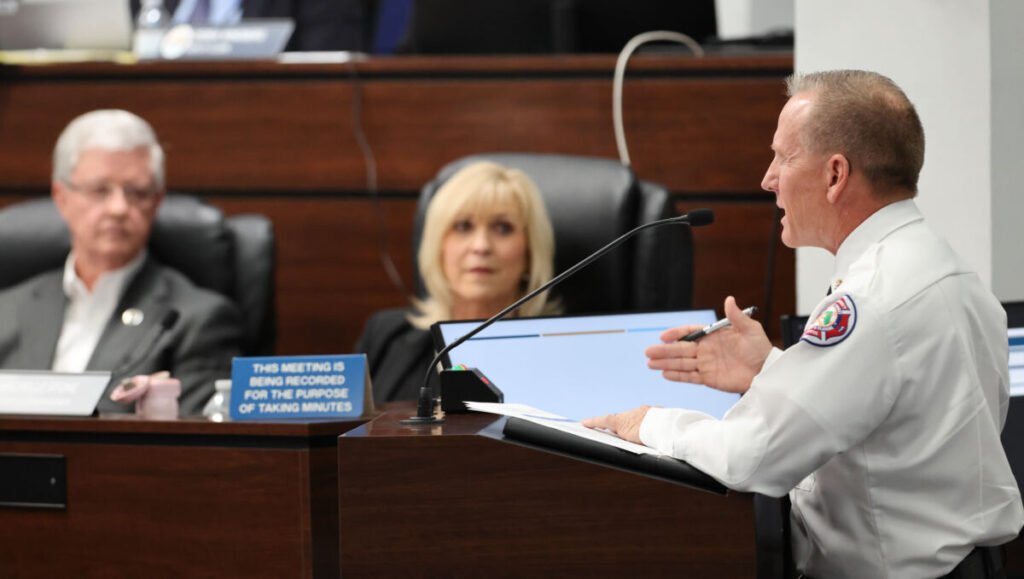
File photo: Marion County Fire Rescue Chief James Banta, right, speaks as Commissioners Craig Curry, left, and Michelle Stone, center, listen during a joint workshop at the Marion County Commission auditorium in Ocala, Fla. on Thursday, March 13, 2025. [Bruce Ackerman/Ocala Gazette] 2025.
Marion County commissioners on Tuesday unanimously approved contracts with the Professional Firefighters of Marion County designed to aggressively combat a severe staffing crisis that has plagued the department for years.
Addressing the Board of County Commissioners, Fire Chief James Banta said, “Today we have an opportunity to send a clear message to those men and women: Because you take care of our community, we’re going to take care of you. This agreement represents a significant investment in their health, wellness, recovery, compensation, and quality of life. It’s also an investment in the future of Marion County and our ability to provide exceptional service for years.”
The agreements combine a historic $20,000 base pay increase with a long-awaited transition to a 24-hours-on/72-hours-off work schedule. Marion firefighters have been working 56-hour weeks with 24 hours on and 48 hours off. Transitioning to 72 days off would bring them down to a 42-hour work week.
Assistant County Administrator Amanda Tart presented the final agreement to the board, noting it was the culmination of efforts between the county and IAFF Local 3169 that began in June 2025.
“These agreements are the results of many months of negotiations… and reflect a collaborative effort between county administration, human resources, our budget team, fire rescue, and our union negotiating team,” Tart said.
The turnover crisis
The driving force behind the county’s significant financial investment is the critical loss of experienced personnel. Tart explained to the commission that the county has become a de facto training ground for neighboring agencies that offer better pay and healthier schedules.
“We continue to experience turnover once employees finish the program and get the experience they need. They are being recruited by neighboring agencies, offering higher compensation, different schedules, and sometimes both,” she said. “This turnover isn’t just with our new recruits; it’s happening at every level of the department.”
The sheer volume of this exodus was highlighted by Union President Rolin Boyd during the negotiation process leading up to Tuesday’s vote. “We’ve lost 528 people in the last five years, 368 in the last three years, in an average of 100 a year, and we’re replacing them with noncertified individuals,” Boyd stressed.
Tart echoed Boyd’s concerns to the commission, emphasizing the hidden costs of losing veterans. “Every time we lose an experienced firefighter paramedic, we lose valuable experience, training, leadership, and institutional knowledge,” she stated. “Replacing that employee requires recruiting, hiring, onboarding, training, and mentoring the new employee, a process that is both time consuming and costly”.
New rates of pay
To immediately stop the bleeding, the county approved a short-term bridge contract that completely resets the department’s wage scale.
“In this contract, each employee covered by the agreement will receive a $20,000 increase to their base salary, and it will increase the starting pay for all positions by $20,000,” Tart said. “This means the proposed base annual pay for a firefighter EMT will be $65,000 [and] $75,000 for a firefighter paramedic, making Marion County one of the most competitive departments in the state.”
The financial commitment required to overhaul the department’s pay and schedule—projected to require an additional $15.7 million from the Fire Fund and $14.4 million from the General Fund in its first year alone—will be sustained through two primary revenue streams collected via residents’ annual real estate bills.
The department’s fire suppression operations are largely supported by the county’s Fire Fund, which is financed through a dedicated fire assessment fee (a non-ad valorem assessment) applied to individual parcels based on property use type. The General Fund is primarily driven by ad valorem property taxes, which are standard real estate taxes calculated based on a property’s assessed value and the county’s established millage rate.
Commissioner Michelle Stone expressed appreciation to the citizens of Marion County, explaining that their vote approving the penny sales tax in the last election freed up money that would have gone to capital expenses like new fire trucks and stations, to be used instead for personnel.
“Thank you to the citizens of Marion County for showing your commitment to public health and safety,” she said.
Work-life balance and mental health
The second contract, effective Oct. 1, officially commits the county to transitioning away from the 56-hour average workweek to a 42-hour workweek (24/72 schedule) by Sept. 30, 2029.
For Commissioner Craig Curry, this schedule reduction was the most critical piece of the puzzle, citing the devastating mental health toll the job has taken on MCFR’s ranks.
“The bottom line to me, when we had those two firefighters [take] their lives, and I can’t say exactly what the motivation of that was, but those two suicides have stuck in my mind to the point where the money is important but the work-life balance is more important to be able to enjoy your family, enjoy your kid,” he said.
Curry praised the joint effort between the county and the union to prioritize responder health.
“If we’ve done anything, we have set the stage for Marion County first responders, firefighters, EMTs, and so forth to enjoy their job, enjoy their family, and I just want to thank y’all from the bottom of my heart for everything that you do for us every day,” he added.
The next major hurdle
Implementing the 24/72 schedule by 2029 will require MCFR to hire nearly 250 additional personnel to staff a brand-new “D-Shift.” To make this rapid expansion possible, the union agreed to a significant operational concession regarding how leadership positions are filled.
Historically, fire departments operate on a strict promote-from-within basis. However, the newly approved contract grants the fire chief the explicit authority to bring in qualified candidates from outside the agency directly into higher-ranked, promotional positions.
Under the new rules, the department’s recruitment and testing processes will be “applied equally to all applicants, internal and external, who meet the established qualifications,” though internal candidates will receive priority consideration when qualifications are equal.
This concession gives MCFR the flexibility it needs to recruit seasoned officers and driver engineers from other departments, ensuring that the massive influx of new hires will have experienced leadership.
Banta told the commission he hopes to get staff up quickly enough to implement the new schedule earlier than expected.

Support community journalism
The first goal of the Ocala Gazette is to deliver trustworthy local journalism so corruption, misinformation and abuse are not hidden from the public or unchallenged.