
Local judicial system feels the strain of population growth and limited state funding
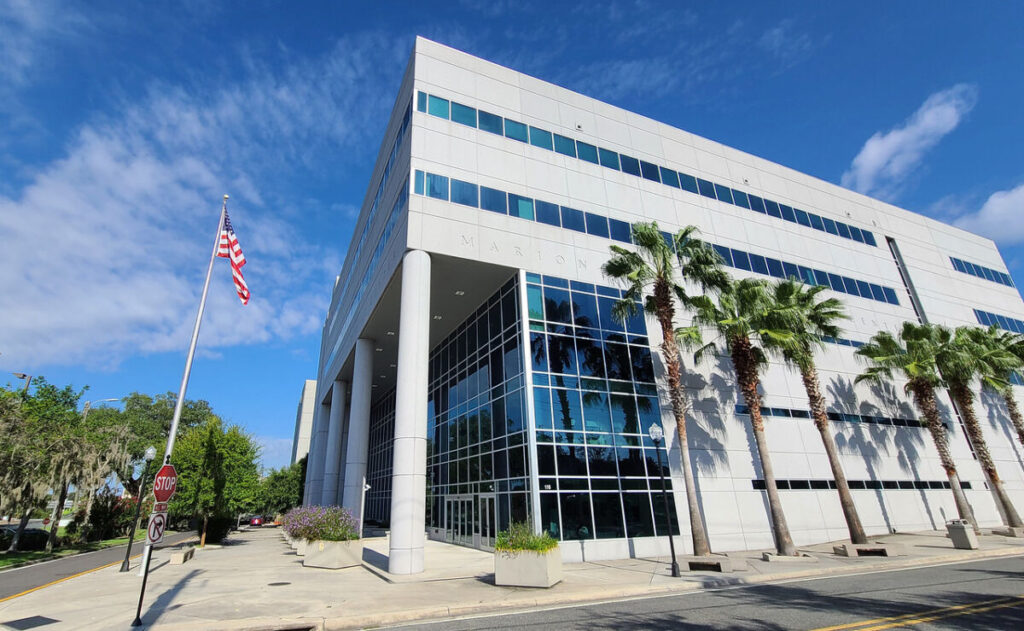
The Marion County Judicial Center is shown in Ocala, Fla. on Wednesday, August 5, 2020. [Bruce Ackerman/Ocala Gazette] 2020.
Marion County’s judicial system will likely see two new judges soon, one each in circuit and county court, but the system still faces mounting pressure as rapid population growth drives up court filings and state funding for critical support positions lags.
At a budget workshop with the Marion County commissioners and court officials on July 17, leaders described a system stretched thin by a surge in cases and a lack of state-provided staff to support newly appointed judges.
“The Legislature, the governor, approved 39 new judges and they’re all going to be appointed,” said Jeffrey Fueller, Court Administrator for the Fifth Judicial Circuit. “But they didn’t give us any case managers or staff to support the judges.”
Even with the time involved for the state to set up judicial nominating committees and for the governor to review their recommendations, Fueller said he hoped the new judges would be in place during the 2025-26 budget year.
Marion County has seen a dramatic increase in circuit court filings, with nearly 5,000 more cases than neighboring Lake County, despite similar rates of population growth, according to Fueller. The county’s demographic trends, including an influx of retirees, may be contributing to the higher caseload, Commissioner Kathy Bryant suggested.
The state’s decision to approve new judges without providing additional case managers or magistrates has left counties to fill the gap.
“We asked for a whole lot of case managers this year from the Legislature,” Fueller said. “They gave us 39 judges, but they didn’t give us any case managers or staff.”
County-funded magistrate positions have become essential, especially in dependency court, where Circuit Judge Ann Melinda Craggs told the commissioners the workload of serving children and families in need has become “problematic.”
“Last year, general magistrate Joshua Soileau handled 1,912 hearings, and he’s on track for 1,711 this year,” Craggs said. “It’s the only way our dependency judge is able to meet her statutory mandates.”
However, Soileau’s position is funded by Marion County, not the state, which frustrated the commissioners considering the demonstrated need.
Commissioner Michelle Stone expressed frustration that the state wasn’t helping fund the magistrate position. “The only way the state’s going to recognize our need is if we took the funding away,” she said, adding, “I’m not advocating for that.”
County leaders pledged to continue advocating for state support for the courts but acknowledged the challenges ahead for court officials.
Administrative Judge for Marion County Steven G. Rogers explained to the commissioners another element that was adding to the workload. “The main emphasis of what we’re receiving from Tallahassee is on case management and about getting cases closed,” he said.
Rogers said the pressure wasn’t only for criminal dockets but also for civil dockets.
“They kind of want the state system run like the federal system. However, we don’t have staffing that they have on the federal system, making it a little difficult for us to keep up with those standards. And we just need more people with more eyes on the files to kind of help us move them along,” he said.
Officials highlighted the county’s investment in problem-solving and treatment courts, which have shown significant cost avoidance and high success rates. Alina Stoothoff, Senior Court Operations Consultant for the Fifth Circuit Problem Solving Courts, reported that treatment courts saved the county more than $700,000 last fiscal year by diverting offenders from jail, with a 71% success rate in criminal programs and 88% in juvenile programs.
State Attorney’s Office
On July 23, Bill Gladson, the State Attorney for the Fifth Circuit, which encompasses Marion, Sumter, Lake, Citrus and Hernando counties, said his budget for Marion County was “4.6% less than our request from last year.”
Gladson said he did away with the early intervention program and absorbed the work from that among all of the attorneys who work in his office.
Gladson acknowledged during the workshop that the county was getting a couple more judges, and the addition was “a reflection of our growth.” He added that he’d asked the state to fund an additional 28 positions but didn’t receive funding from the state for them.
“I don’t know if [the new judges] are going to be assigned a criminal [docket] or not, but if they are, that’s an issue for us. We don’t have the staffing to add to the [new] dockets. If you create a whole new docket, you’ve created a secretary, investigator, victim advocate and three or four lawyers,” he said.
Gladson said he expected to continue asking for more staffing positions.
Public Defender’s Office
On July 24, Michael Graves, public defender for the Fifth Judicial Circuit, expressed similar concerns about state funding when he presented his budget request to the county commissioners.
“The Fifth Judicial Circuit [public defender’s office] is funded at 49% of what the state attorney’s budget is statewide. The average throughout the state is 57% as well as the fact that of every dollar that we get from the state budget, we are required to fund 20% of that out of trust funds, from fines, fees, collections and alike, and we’re trying to close that gap,” Graves told the commissioners.
“[Funding] has very simply has not kept up in the last 20 years with the growth of this circuit, certainly the growth of Marion and Lake counties, such that we should receive the appropriate tax funding or the funding from the from the state, and hopefully that would reduce our reliance on the county funding,” he said.
“Our counties have been so kind to make up the gap for both the state and the public defender’s office in an effort to try to have a criminal justice system that flows for the people in a manner that’s appropriate with due process,” said Graves.
“Under my budget, we are requesting an increase. I know it’s a bad time, but an increase a little bit less than 5% generally. It comes from the need to hire more lawyers in the last year here to serve the citizens of Marion County,” he added.
Graves said he and the state attorney were exploring ways to save costs through continued shared needs like technology.

Support community journalism
The first goal of the Ocala Gazette is to deliver trustworthy local journalism so corruption, misinformation and abuse are not hidden from the public or unchallenged.