
Land Use Regulation Commission approves new regs
The commission proposes changes to landscape requirements, open spaces, buffers and dog parks in the county's Land Development Code.
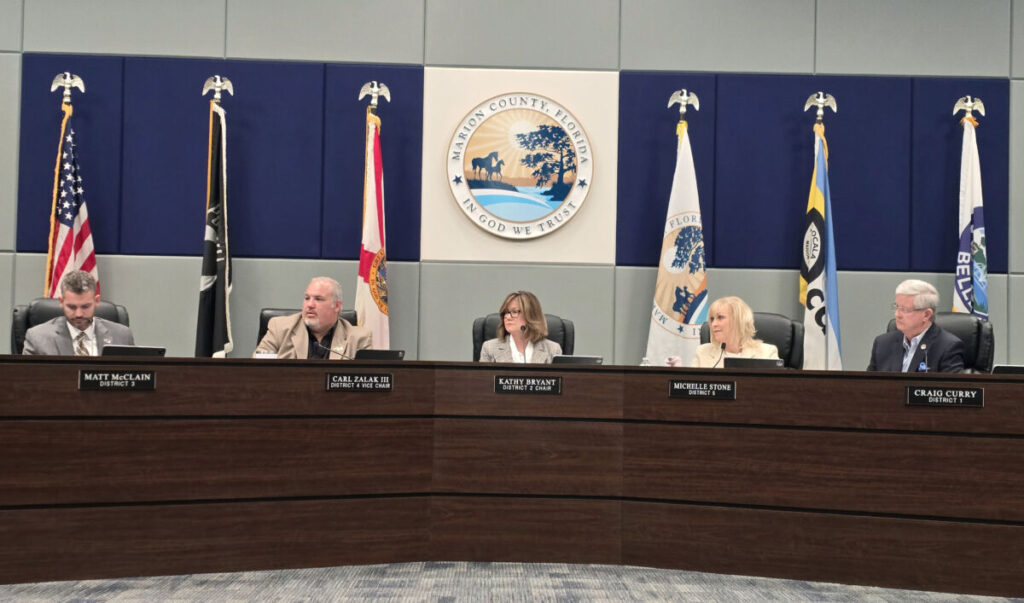
The Marion County Commission meets in the McPherson Governmental Complex in Ocala. [Bruce Ackerman/Ocala Gazette file photo] 2025.
The Marion County Land Use Regulation Commission reviewed and revised several sections of the[BTK1] Marion County Land Development Code (LDC), adding landscaping requirements and protection of open spaces that will change how developers handle trees, vegetation and the appearance of the projects, during a meeting on March 11. The commission’s suggestions will be discussed and voted on by the Board of County Commissioners later this month.
Some of the LDC sections under review were last revised in 2012, said Jim Couillard, county director of Parks and Recreation and a landscape architect. Couillard presented the code changes to the commission, often holding steadfast to tree protection and buffer requirements in the face of the commission’s occasional questioning and pushback.
That BOCC has long expressed dissatisfaction with the post-development look of many projects that were approved. The board and county residents have previously complained about several “big-box” and national chain projects in the county that allowed the buffer trees and shrubs to die off. By changing the LDC, the revised code will have some teeth to require maintenance and enforcement of the regulations.
A buffer integrity certification process was suggested, allowing for inspections of buffers every 24 months, along with requirements for larger, more mature seven-gallon plantings instead of the current requirement of three-gallon plant containers.
Other suggested changes in the code include requirements for diversity of plantings, the use of native Florida species, a restriction on palm trees to no more than 25% of plantings and that palms cannot be substituted for shade trees. Additionally, cypress mulch would be completely prohibited as it destroys wetlands and cypress trees, Couillard said.
The meeting was attended by one member of the public, Nancy DiMaggio, who spoke to the inspection and certification of buffers. Her concern was that any person certifying the health of a buffer should not work for the company responsible for maintaining it.
The commission approved current requirements for agricultural zoning, including provisions for the sale of locally grown produce and/or hay, the allowance of residences for agricultural employees and minimum open pasture area of at least 9,000 square feet for one animal such as a horse, mule, donkey, sheep, cattle, goats, swine or other large farm animals. Other allowed uses are beekeeping operations, pigeon lofts, pot-bellied pigs as pets and up to three yard sales per year.
Another discussion regarding open space focused on dog parks in communities and the commission voted for a minimum size of one-quarter acre, with divided sections for small and large dogs. Additionally, parking lots for improved open space cannot be more than 10% of the open space itself.
Another discussion about tree preservation and further discussion of definitions is slated to take place during the LRDC meeting at 5:30 p.m. on March 25. The details about tree size and how to protect them warranted more time, said LRDC chair David Tillman.
The BOCC is slated to hold the first of two public hearings on these recommendations during its March 31 meeting at 5:30 p.m. at the McPherson Governmental Campus Auditorium. Public comment is welcomed.

Support community journalism
The first goal of the Ocala Gazette is to deliver trustworthy local journalism so corruption, misinformation and abuse are not hidden from the public or unchallenged.