
Keeping rescuers healthy
Firefighters work together to maintain physical and mental well-being as they serve the community.
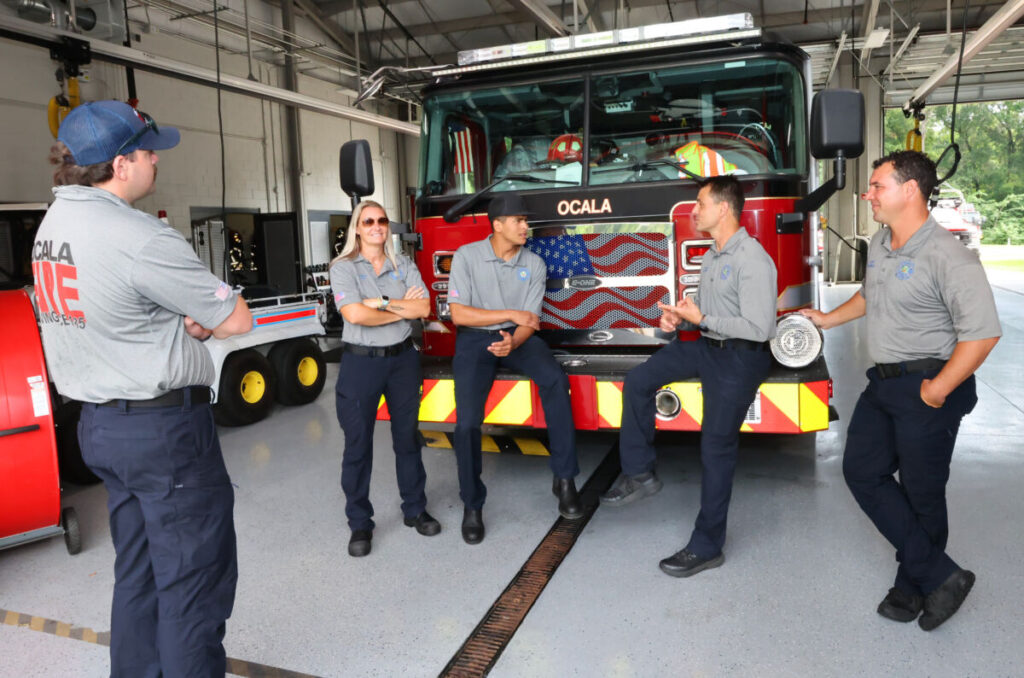
Clayton Blalock, firefighter/EMT; Jacqueline Nettles, FEO/paramedic; Chase Moore, firefighter/EMT; Capt. Jesse Blaire, captain/paramedic; and Tim Herff, FEO/paramedic; left to right, talk between calls at Ocala Fire Rescue Station 7 on Southeast 31st Street in Ocala on May 28, 2026. [Bruce Ackerman/Ocala Gazette] 2026.
I spent two days recently riding along with crews from Ocala Fire Rescue’s Station 7 while reporting a story about the challenges facing Marion County’s growing elderly population. Between calls, another important issue emerged, this one about how these firefighters work to stay physically and mentally healthy while caring for others in distress.
Firefighters face elevated risks of cancer, cardiovascular disease, sleep disruption and psychological trauma, according to numerous studies. At Station 7, conversations around the dinner table, workouts in the station gym and even debates about red dye and ice baths reflected a profession increasingly focused on staying healthy enough to spend a career helping others.
“What adversity did you face, and how did you overcome it?”
That is what 25-year-old firefighter/EMT Chase “PT” Moore said he was asked by an official at a neighboring fire department when he interviewed for a job after he graduated from the Florida State Fire College at age 22.
“I really couldn’t answer the first part of the question, let alone the second part,” he said.
“You really hadn’t had any adversity in your life?” I inquired.
“No, I have a good family and couldn’t think of one thing to say and I didn’t want to just make something up,” he explained.
With almost two years under his belt at OFR, Moore talked about some of his hardest calls. I won’t repeat them in this story, but they all tragically included the deaths of adults and children and a description of the smell of death.
“It’s a horrible smell,” he said.
“How did you get the nickname PT?” I asked after learning PT is short for “prime time.”
“The chief gave me that name,” Moore answered proudly.
“Probie” is a term that fire departments use for probationary firefighters, those in their first year on the job.
Moore said he got the nickname because he was “chief of the probies, always entertaining everyone, and I still do. Every station needs someone like me, the entertainer,” he answered with a quick laugh while his fellow firemen in earshot of our conversation chuckled and started talking about what the “chef” was going to cook for dinner.
Driver/EMT Gorka Aperribay, who has been with the department for five years, said he learned how to cook from his parents and usually takes on the duties of cooking for the crew.
I couldn’t help but admire how well-seasoned the cast iron pots and pans were that sat on a stove top.
“What’s the secret to keeping the cast iron pots from rusting?” I asked Aperribay. The trick, he said, is not cleaning them with soap.
Aperribay commutes from Orlando for his work at OFR. He’s not alone. Turns out, quite a few of the firefighters live outside Marion County. I’ve come to learn this is commonplace, as many firefighters prefer to separate where they work from where they live. Some locations hold memories they’d prefer not to revisit during their downtime.
Aperribay said everyone chips in $20 and they cook healthy meals without resorting to using the money for fast food.
“But I bring my own junk food,” Moore said, pulling out potato chips and a bag of gummy bears.
“You better watch out for that red dye,” said 17-year driver/paramedic Jacqueline Nettles.
Nettles is the only female on her shift at Station 7 and her colleagues grudgingly avoid cooking with onions for her sake.
Moore responded to concerns about red dye by bragging that testing shows his metabolic life at 21 years, well under his age of 25, unlike the rest of the crew’s test results.
The firefighter profession has spread more awareness over the last decade about the impacts of fire service on members’ health, both physically from interrupted sleep and exposure to carcinogens as well as the bodies’ constant exposure to traumatic events.
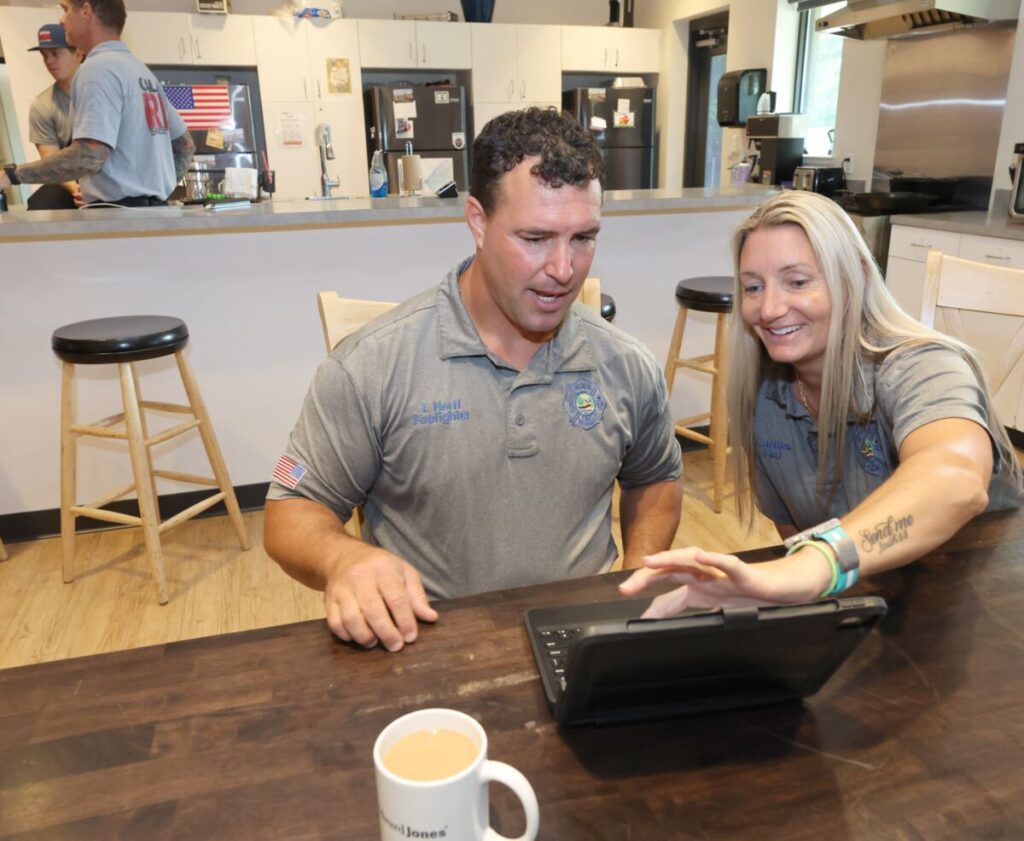
Throughout the two days, the conversations were intertwined with an awareness that they needed to be more proactive in monitoring their health than the average person. Moore was open about avoiding some risks, like drinking alcohol or riding his dirt bike instead of a motorcycle on the street.
Nettles spoke of having a skin reaction following a post-fire inspection of the St. Paul AME Church in mid-May.
“Two days after the fire and it still felt hot inside,” she said, adding that they were advised to wear protective gear.
Firefighter/paramedic Eduardo Ignacio-Simon proposed ice baths after working out, which most participated in.
Nettles, however, told her coworkers it seemed counterproductive to do that right after working out.
“Why would you want to reduce blood flow, post-workout?” she asked.
Fire equipment operator Tim Herff, a father of two who moved to Ocala from Chicago, wears a Halo ring to track his sleep. He noted the sharp difference in the data he got while on duty as opposed to when he was off duty. While driving the rescue vehicle, Herff thanked me for riding along and for telling their story.
“It’s hard for us to do,” he noted.
When I asked soon-to-be Capt. Vince Alexander, a father of one who is nearing his 11th year at OFR, what he thought would help those seeking a career in fire, he said it would be ideal to enter it knowing how to fix things.
“This new generation didn’t spend much time holding the flashlights for their dad while he fixed things,” Alexander said.
“Part of the job with the new ones entering the field is to play that role, teach them about tools and how engines work. And it’s not just at the station; it’s after work, too. If they need to fix their car or build a shed, you show up and help them learn how to do it,” Alexander said.
Firefighter/EMT Kyler MacDonald listened nearby, nodding his head in agreement. With one year and two months in the fire service under his belt, he was busy studying two large volumes. One lay open with a diagram of the heart, the other was the Bible.
MacDonald is studying to become a paramedic, a process that takes a year of schooling and clinicals on top of his work at OFR.
Nettles said the first year on the job entails a lot of continued learning as the firefighters need to learn the individual departments’ procedures and guidelines.
Moore said that after that first-year learning curve, he knew the next step in his career was going to involve attending paramedic school.
OFR veteran Jesse Blaire stopped by the station and sat at the communal table where MacDonald studied to grill him on how to increase pressure on a rescue scene. With all of us listening, we saw MacDonald recall what he was learning at a steady pace.
Blaire pushed him to think through some of the options he might not read about in his paramedic textbook: “What if I lost my arm and you had to raise my pressure; how would you do it?” he asked.
MacDonald grew up as a friend of Blaire’s son and knew the senior Blaire long before he joined OFR.
Blaire stands out amongst his peers in his aptitude for medical concepts and his no-nonsense communication style. He’s like that uncle or aunt that some of us might be lucky enough to have, who gives it to you straight and isn’t going to necessarily tiptoe around your feelings.
Blaire, now in his 24th year in the fire service, has been a pioneer in paramedicine, along with 25-year veteran OFR Capt. Chris Hickman. Blaire described the boundaries he creates in his mind so he can balance work and life when he goes home.
While Blaire’s system of compartmentalizing might sound cold to some, he explained: “I only want to know the information I need to know to complete the task.”
He believes younger firefighters can sometimes become consumed by the outcomes of the people they help.
“I just want to know that on the job I did checked the boxes that I was supposed to check because I don’t want to know if the guy is now permanently disabled and his family is not able to maintain the same lifestyle that they did before the accident because then you think about it constantly,” he said.
“I always ask the [new firefighters],” he said, “are you sure you want to know the outcome? Because if you want to know, I’m going to give it to you, but you might not. So, you should carefully consider how much weight you want in your backpack, because we all carry a backpack. How much do you want to carry in it?”
The metaphorical backpack Blaire described is the accumulation of tragedy, grief and difficult memories that firefighters encounter throughout their careers.
Moore said he believes he handles difficult calls well.
“I leave it at the call,” he explained.
Then, after a pause, he acknowledged another role he plays around the station.
“But sometimes I can tell by the way the guys are walking around after a call that it’s staying with them,” he said. “So, I try to make a joke and bring humor back.”

Support community journalism
The first goal of the Ocala Gazette is to deliver trustworthy local journalism so corruption, misinformation and abuse are not hidden from the public or unchallenged.