
Judge’s law enforcement status prompts paperwork shuffle at Marion County Sheriff’s Office
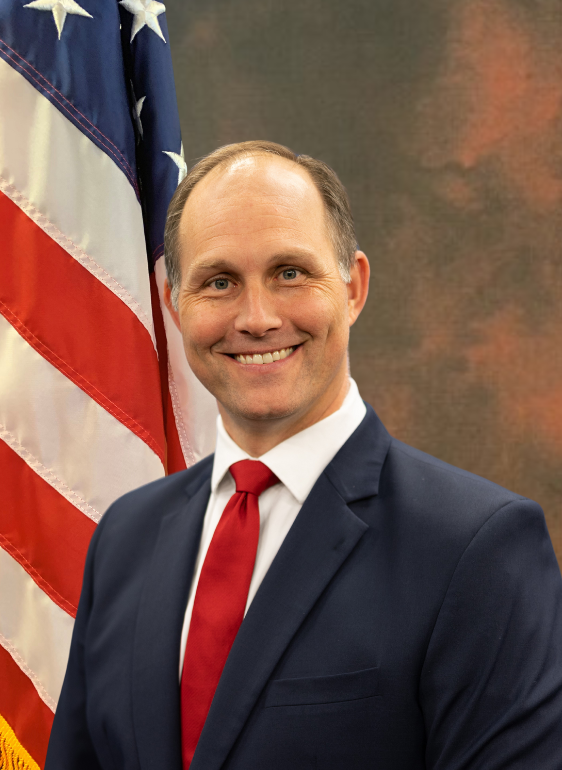
Judge Timothy McCourt
By Jennifer Hunt Murty
Circuit Judge Timothy McCourt recently found himself navigating a tangled administrative web regarding his past employment with the Marion County Sheriff’s Office (MCSO) after state records indicated his law enforcement certification remained active while he served as a judge. The Florida Constitution generally prohibits a person from simultaneously holding dual offices, such as an active sworn law enforcement officer and a judge.
The paper trail began on Jan. 29, 2026, when the “Gazette” contacted McCourt to point out that the Florida Department of Law Enforcement (FDLE) database still listed him as an active MCSO employee. Upon receiving the inquiry, McCourt immediately contacted MCSO Human Resources, reminding them that he had resigned his positions as General Counsel and deputy sheriff effective Jan. 2, 2024, specifically to assume his role as a judge Jan. 3, 2024.
Upon hearing from McCourt, MCSO HR Director Monica Chisholm signed the first of three “Affidavit of Separation” forms (CJSTC 61), listing his separation date as his original exit date: Jan. 2, 2024.
However, just a few days later, the agency changed course. On Feb. 2, Chisholm signed a second affidavit, this time listing McCourt’s official separation date as Jan. 29, 2026. The office informed McCourt the date was changed because his credentials had ostensibly been held on inactive reserve status, meaning the office had to “use the date of the request to separate as the separation date.”
McCourt pushed back forcefully against this second affidavit. In a Feb. 11 email to MCSO, he expressed frustration, insisting that his original resignation letter of Dec. 21, 2023 clearly and unambiguously terminated his employment as a deputy sheriff. He pointed out that he had turned in his agency-issued weapon, badge, and vehicle upon leaving, and noted that judicial ethics prohibited him from holding a reserve certificate in the same county where he presides over criminal cases.
However, McCourt was likely placed on reserve status with the MCSO due to a Patrol Reserve form he signed and dated Dec. 28, 2023, a week after his resignation letter, which offered three choices: active status, inactive status, or separation. McCourt signed and dated his choice as “inactive status.”
In an email dated Feb. 11, McCourt wrote to MCSO Human Resources Executive Assistant Emily Zeigafuse, “I contacted Sheriff (Billy) Woods and informed him of all of this. He advised that this situation will be rectified and that a corrected and amended separation affidavit will be submitted to reflect that my separation date was Jan. 2, 2024.”
The agency issued a third affidavit on Feb. 11, the date of McCourt’s email, amending the separation date back to the original Jan. 2, 2024. FDLE has recently updated their records and seemingly accepted the retroactive separation date.
An internal MCSO memorandum attributed the two-year delay to an “administrative error” and “clerical oversight,” explicitly noting that McCourt’s initial inactive reserve request form was never actually signed or approved by Woods even though McCourt was bonded as a deputy during this period.
McCourt told the “Gazette” he remembered receiving correspondence from MCSO about training during the summer of 2025 with instructions about what he needed in order to keep his certificate active, but noted, “I effectively ignored it and took no action following my receipt of it to maintain my law enforcement certification.”
Adding another layer of complexity to the timeline, during this period, McCourt was dating and eventually became engaged to Marissa Duquette, who served as legal counsel for the MCSO.
In a records request to MCSO, the “Gazette” received an email from October 2025, which was sent by Duquette to McCourt’s personal email address. It was almost entirely redacted by the MCSO, citing active litigation.
When McCourt was questioned about potential conflicts of interest—such as whether he signed sealed search warrants for the same agency his fiancée represented—McCourt said they created boundaries. He stated that while they were dating, Duquette would refer warrants elsewhere for review if he happened to be the on-call judge. McCourt further noted that once the couple decided to advance their relationship toward marriage, they agreed it was appropriate for Duquette to resign from her position with the MCSO to avoid any ethical conflicts.
According to judicial canons, a judge must manage who appears in their courtroom. McCourt noted that Duquette never appeared before him as an attorney representing a party to a case. He also said judicial ethics opinions dictate that if a judge is married to a law enforcement agency’s attorney, the judge is not disqualified from presiding over criminal cases involving that agency but they “need only disclose that relationship in cases where the agency is involved.”
Court records indicate that McCourt signed numerous warrants for the sheriff’s office during the two years he was dating, but not engaged to, Duquette while she served as the sheriff’s general counsel.
McCourt told the “Gazette” that over 22 months hr supervised the felony court docket, he had entered orders of recusal in approximately 70 cases in an effort to navigate boundaries.
Judges must avoid the ethical conflicts associated with maintaining ties to former employers. According to a June 2025 Judicial Ethics Advisory Committee (JEAC) Opinion (2025-12), judges should not associate with their former law enforcement agency to maintain their active certification if they serve as a judge in the same county where that agency is located.
McCourt notably started working in Lake County when he was appointed to the bench but shortly thereafter was reassigned to Marion County and presided over the felony docket.
McCourt indicates he received no financial benefit from the MCSO since he resigned and said he did not participate in any training.
Under the Florida Retirement System, there is an extra “3% per year of creditable service” for law enforcement because they are considered a “special risk class.” By fixing the separation date, McCourt will have qualified for that multiplier only during the few years he held deputy status while simultaneously serving as general counsel for Woods.

Support community journalism
The first goal of the Ocala Gazette is to deliver trustworthy local journalism so corruption, misinformation and abuse are not hidden from the public or unchallenged.