
Joint office for homelessness hosts annual meeting
The Marion County Continuum of Care brings together a number of organizations with common goals.
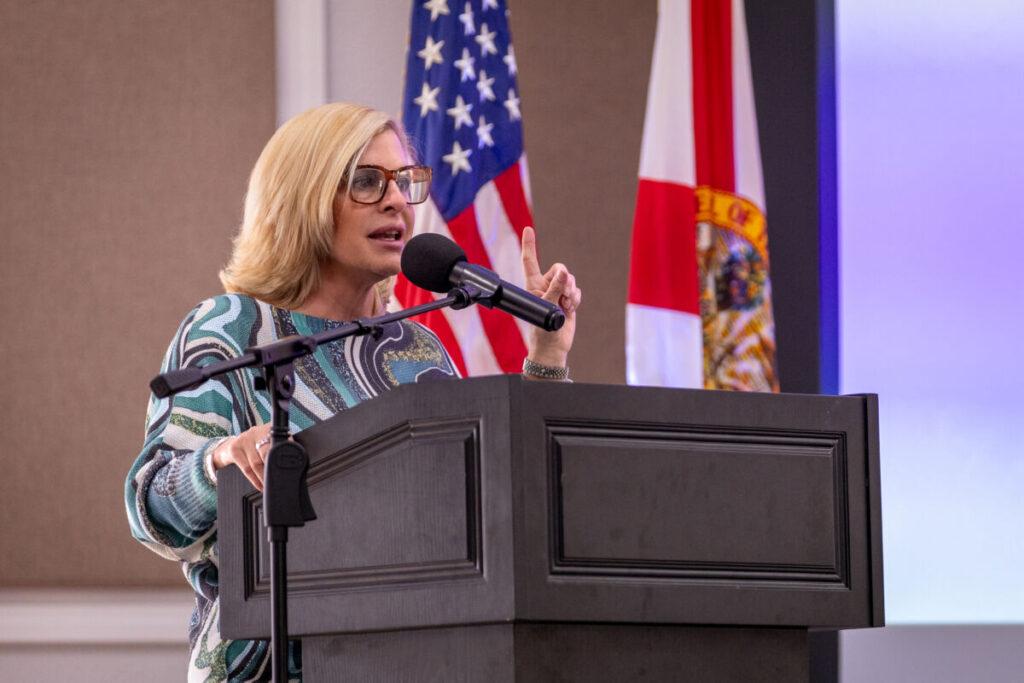
Angie Peters, Chairperson for the Continuum of Care addresses the crowd during the annual meeting held on Tuesday, Feb. 12, 2025 at the Southeastern Livestock. [ Mark Anderson, Marion County Public Relations]
Like most communities across the country, Marion County has tried to come to terms with how to tackle homelessness. Following a 2019 local study by the Public Policy Institute, the county and city of Ocala created a joint office to address the issue. On Feb. 11, hundreds gathered at the Southeastern Livestock Pavillion for the first annual meeting of the Marion County Continuum of Care to acknowledge the history of their efforts and the challenges they faced to get to this point.
Hundreds of the stakeholders in attendance responded with an empathetic chuckle as Cheryl Martin, the director of Marion County’s Community Services Department, acknowledged that the effort came with a few learning curves.
“When the county and city first came together to discuss the creation of a joint office, I envisioned grand, one-size-fits-all solutions that would end homelessness with an elegant checklist, bringing harmony to the community—and perhaps solving world peace while we were at it. But, as you might guess, I learned some lessons and the reality quickly showed me that things weren’t so simple. Homelessness is a complex, multifaceted issue, that is not a one-size-fits-all,” Martin said.
The partnership is designated as the lead agency addressing homelessness by the U.S. Department of Housing & Urban Development and receives federal funds earmarked for addressing homelessness as well as state funds through the Department of Children & Families.
The county department Martin oversees handles the red tape associated with funding the joint office and oversees “community development, human services, and affordable housing.”
“The responsibility of the joint office entails applying for and overseeing homeless services grants, ensuring that funding is effectively allocated to the numerous nonprofit organizations represented in this room today,” said Martin.
Martin indicated they have historically received a total of $900,000 from DCF and HUD grants, but recently learned they would be receiving an additional $750,000 from DCF.
Many of the agencies that have joined as partners of the COC set up tables in advance of the meeting to share information about their services.
Chicara James, with the Estella Byrd Whitman Community Health Center, told the “Gazette” they were hoping to network with the other agencies to gain more referrals for those who need healthcare in their neighborhood, which is made up primarily of zip code 34475.
Carrfour Supportive Housing, a nonprofit development company new to operating in Marion County, sent a representative to the meeting hoping to connect with more partners.
Carrfour’s first project in central Florida is with Mercy Village, which is currently building the first phase of a supportive permanent housing project.
Other agencies like the Salvation Army and Refuge of Hope Independent Living were both seeking volunteers as well as offering information for awareness about the social services they offer.
Community Legal Services attended to share information about their services to help address eviction or family hardships that might lead to homelessness.
Incoming chairperson for the COC, Angie Peters, told the crowd, “We are committed to building a stronger, more coordinated system by strengthening our outreach efforts, expanding collaboration across all sectors, and actively engaging industry-specific stakeholders who can contribute specialized knowledge and resources to the cause.”
Peters encouraged the crowd not to pass up any opportunities to personally contribute to meeting the homelessness challenge.
“This is not just a city or county issue—it’s something that requires all of us, the more than 400,000 people in Marion County, to make a difference,” she said.
Peters shared an example of her personal outreach to help Ms. Aubrey, “an 80-year-old widow of a veteran, who was living in her car.”
“I had passed by Ms. Aubrey countless times without giving it much thought, but after hearing a message at a Continuum of Care meeting about the importance of staying alert to those in need, one day I decided to stop and engage with her. That day, I learned Ms. Aubrey had been living in her car for nearly three months, with no family to support her. That moment set off a chain of events and outreach to my partners in the COC to help find Ms. Aubrey the support she so desperately needed,” recalled Peters.
“If I had not stopped that day, there’s a good chance she would still be living in her car today. But today, one year later, I’m happy to say, Ms. Aubrey is no longer in that car. Thanks to the collaboration of the Marion County Community Services team, Mayor Marciano, Chris Hickman, and others across multiple agencies and organizations in Marion County, Ms. Aubrey will soon be the proud owner of a new manufactured home,” Peters said.
“All of this is made possible through collective efforts and from acting when seeing those in need. It’s important to remember that a single act of awareness and compassion has the power to lead to life-changing results for our neighbors,” Peters encouraged the crowd.
Members of the public who are interested in contributing to the efforts of the COC are encouraged to attend one of the meetings to learn how to get involved.
“The Continuum of Care meetings are always open to the public, so feel free to join us at one of the upcoming meetings. All meetings are on the fourth Tuesday of each month, starting at 11:30 a.m., with the membership meeting immediately located in the Marion County Growth Services room,” Peters told the crowd.
The next meeting is on March 25. Peters indicated they would hold a strategic planning meeting during April’s meeting.
To learn more, go to marionflcoc.org/about-us/coc-overview
______________
Digital extra:
The Ocala Gazette asked for COC distributions made by Marion County for the past two years and received the following distribution outline:
24-25 Total: $1,594,229
- DCF Challenge: $86,000
- Arnette House: $20,000
- Project Hope: $9,156
- OHA: $56,844
- DCF Challenge (Extra): $455,080
- Project Hope: $45,844
- OHA: $224,269
- Salvation Army (Encumbered): $184,967
- DCF ESG: $172,000
- Saving Mercy: $172,000
- DCF ESG (Extra): $17,500
- Saving Mercy (Encumbered): $17,500
- DCF TANF: $38,000
- OHA: $38,000
- DCF Staffing:
- Marion County: $185,894
- HUD NOFO: $639,755
- City of Ocala HMIS and Coordinated Entry: $280,196
- CASA DV Bonus: $239,942
- Planning: $119,617
23-24 Total: $1,247,805
- DCF Challenge: $86,000
- Arnette House: $20,000
- Brother’s Keeper: $14,000
- City of Ocala: $52,000
- DCF Challenge (Extra): $175,646
- Brother’s Keeper: $87,823
- Arnette House: $87,823
- DCF ESG: $172,000
- Saving Mercy: $130,610
- St. Theresa’s: $41,390
- DCF ESG-CVIII:
- Interfaith Emergency Services: $122,000
- Saving Mercy: $55,754
- DCF TANF:
- Brothers Keeper: $38,000
- DCF Staffing:
- Marion County: $185,894
- HUD NOFO: $412,511
- Ocala Housing Authority: $37,144
- Greater New Hope Inc: $29,242
- Shepherd’s Lighthouse, Inc: $281,311
- Planning: $64,814

Support community journalism
The first goal of the Ocala Gazette is to deliver trustworthy local journalism so corruption, misinformation and abuse are not hidden from the public or unchallenged.