
Horse Farms Forever Conservation Summit At OBS
Keynote speaker Temple Grandin talked about getting into horses' heads; the Acorn Award was presented to the Drake family.
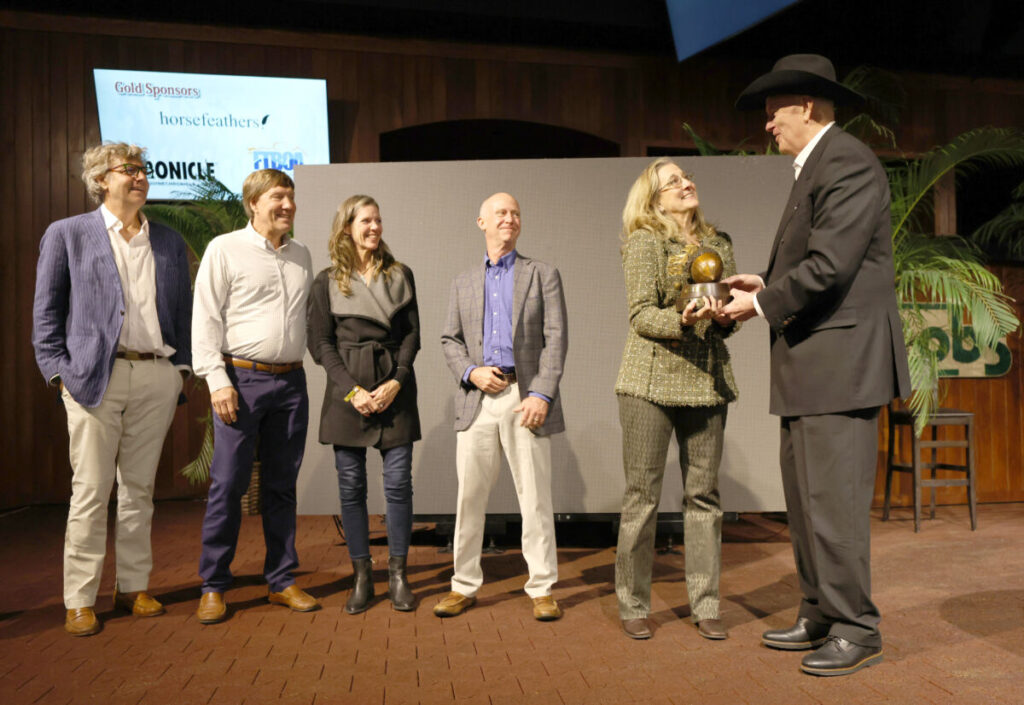
Ann Louise Drake of Drake Ranch, second from right, receives the Acorn Conservation Award from Bernie Little, right, the Horse Farms Forever Board President, as other members of the Drake family look on during the 6th annual “Conversations About Conservation” Horse Farms Forever Conservation Summit at the Ocala Breeders’ Sales Company in Ocala, Fla. on Thursday, Nov. 13, 2025. [Bruce Ackerman/Ocala Gazette] 2025.
On a crisp fall day, hundreds of conservationists, horse owners, local residents and elected officials attended Horse Farms Forever’s annual Conservation Summit and left with a better understanding of a horse’s mind from keynote speaker Dr. Temple Grandin.
Grandin is a world-renowned scientist whose work in animal welfare has changed the meat industry. Her methods for cattle handling, particularly, have created a calmer and safer atmosphere for all involved.
As an autistic person herself, she has also raised awareness about autism and how to capitalize on the unique abilities and perceptions of people with autism.
Grandlin headlined the Nov. 13 event at the Ocala Breeders Sales Company complex; over 300 people attended. She said her own autism helps her see in pictures, not words, and she believes that animals perceive their environments in a similar way.
Grandin focused on animals’ sensory inputs and emotions
Animals have “five core emotions,” she said. “Fear, anger, panic, seeking and additional emotions such as maternalism and lust/reproduction.” Her studies have found that levels of the stress hormone cortisol are much higher in animals that have been frightened or remember being frightened such as by a veterinarian or trainer. After a scary situation, she said, it takes about 20 minutes for an animal to feel calm again.
One tactic she suggested was to ensure that any new items or stimuli in an animal’s environment are presented gradually and without movement. Let a horse explore a new kid’s playset to satisfy its own curiosity level; don’t just ride up and demand the horse sniff it. Or let the horse trailer be in the pasture for a few days before trying to load a horse for the first time, she suggested.
Grandin’s talk was wide-ranging and eclectic, moving from her own challenges with autism as a child and adult and transitioning to research into animal behavior and emotions. The “squeeze chute” often used in cattle handling was something she modified for her own use and the concept has been expanded into the use of comforting “thundershirts” for dogs and cats and weighted blankets for humans.
Grandin reminded the audience members of some basic handling tips to let animals feel secure. Non-slip matting at a vet’s office or on an animal ramp is essential. She also said not to pull away a dog sniffing at a post or tree. That’s like “not getting the gossip at the coffee shop,” she said. Dogs especially use their noses as primary sensory input and letting them explore and “check their pee-mail” is important for their feelings of safety and security.
Her focus in previous years has shifted somewhat from animal handling to the self-inflicted problems associated with extreme animal breeding. She cited English bulldogs as an example of one of the most egregious breeding problems in dogs and showed a photo of an Arabian foal with a severe “dish face”, the skeletal structure literally concave, as what not to do.
“Breeding should be less extreme,” she said. Don’t breed an animal that can’t breathe properly or have a normal gait or enjoy life.
Grandin was self-deprecating while discussing her considerable achievements. She’s published several books, including the scientifically focused “Thinking in Pictures,” “Livestock Handling and Transport” and “The Autistic Brain” and for a more general audience, “Animals in Translation” and “Visual Thinking.” At age 78, she is still giving talks and offering input and advice for animal welfare. Her book royalties and speaking fees, she said, have helped send 25 students through master’s and doctoral programs.
“I’ve done pretty good for someone who can’t do algebra,” she said to laughs and applause from the audience.
Marion County is home to hundreds of horse farms and represents dozens of breeds, from racing Thoroughbreds to Paso Finos to Gypsy Vanners and quarter horses. The county houses an estimated 100,000 horses. Understanding a horse’s mind and propensities is key to successful breeding, racing and riding, Grandin said.
Acorn Conservation Award given to Drake family
Horse Farms Forever President Bernie Little presented its 2025 Acorn Conservation Award to the Drake family, who have conserved 5,800 acres of the Drake Ranch. This is one of the largest privately owned conservation tracts in the county.
Family representative Ann Louise Drake, in a video presentation, said, “Drake Ranch is now in its fourth generation of family stewardship. We remain committed to preserving the land and protecting its legacy.”
Family members estimate that some of the cypress and oaks on the ranch are over 1,000 years old. Wildlife on the ranch include deer, turkey, bald eagles, egrets, sandhill cranes and more.
The Drakes were early Florida settlers and initially came to the state in the 1870s. The conservation land was placed into the easement back in 2002 and will never be developed. The parcels are bordered by the Withlacoochee River and include wetlands and ranch land that are part of the Florida Wildlife Corridor. It connects with other nearby conservation areas that protect wildlife and ecosystems including the Goethe State Forest and the Ross Prairie Wildlife Management Area in southwest Marion County and northeast Citrus County.
Each year, the Acorn Award is given to an “individual or family who has made a significant contribution to the preservation of land and horse farms in Marion County.”



Support community journalism
The first goal of the Ocala Gazette is to deliver trustworthy local journalism so corruption, misinformation and abuse are not hidden from the public or unchallenged.