
Hands-on and historic
The Silver River Knap-In and Prehistoric Arts Festival will showcase skilled artisans.
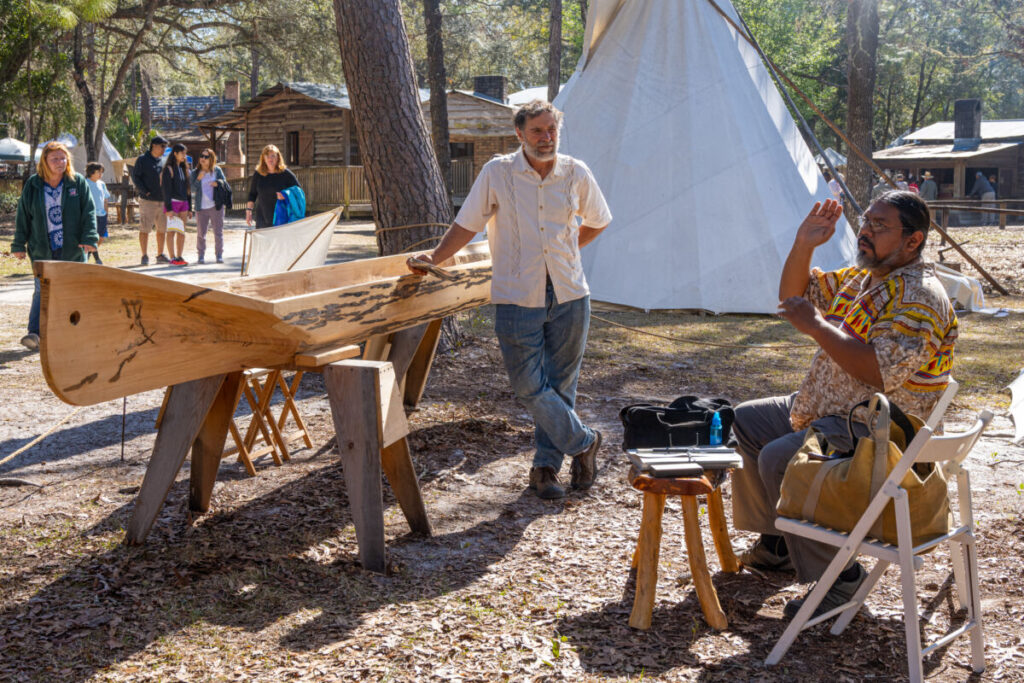
Pedro Zepeda, right, is a Seminole canoe carver and will once again bring his handcrafted creations to Ocala, this year on Feb. 21 and 22. [Photo by Michael Warren]
The past as present. That is what will happen in coming days, when the Silver River Knap-In and Prehistoric Arts Festival will bring Native American artisans to Ocala to demonstrate time-honored skills and traditions.
Among the many participants will be Pedro Zepeda, a Seminole canoe carver who last year received the 2025 Florida Folk Heritage Award, which is given to outstanding folk artists and advocates who have made longstanding contributions to Florida’s folklife and cultural resources.
Making a special appearance will be Harold Littlebird, a Kewa and Laguna Pueblo artist who is renowned for his intimately crafted pottery, which often features images that connect with the natural world.
The history of Marion County is deeply intertwined with Native American history, including with the Timucuan and Seminole tribes. The area is rich with artifacts, many of which may be found inside the Silver River Museum and Environmental Education Center, located inside Silver Springs State Park. The festival takes place at the center, which includes a pioneer village and wood-fired kiln.
Visitors to the festival, which will take place Feb. 21 and 22, will be able to view the treasures on display in the museum and also talk with and see at work a number of expert flint knappers, archaeologists, shell carvers, potters, hide tanners, bow makers and other specialists.
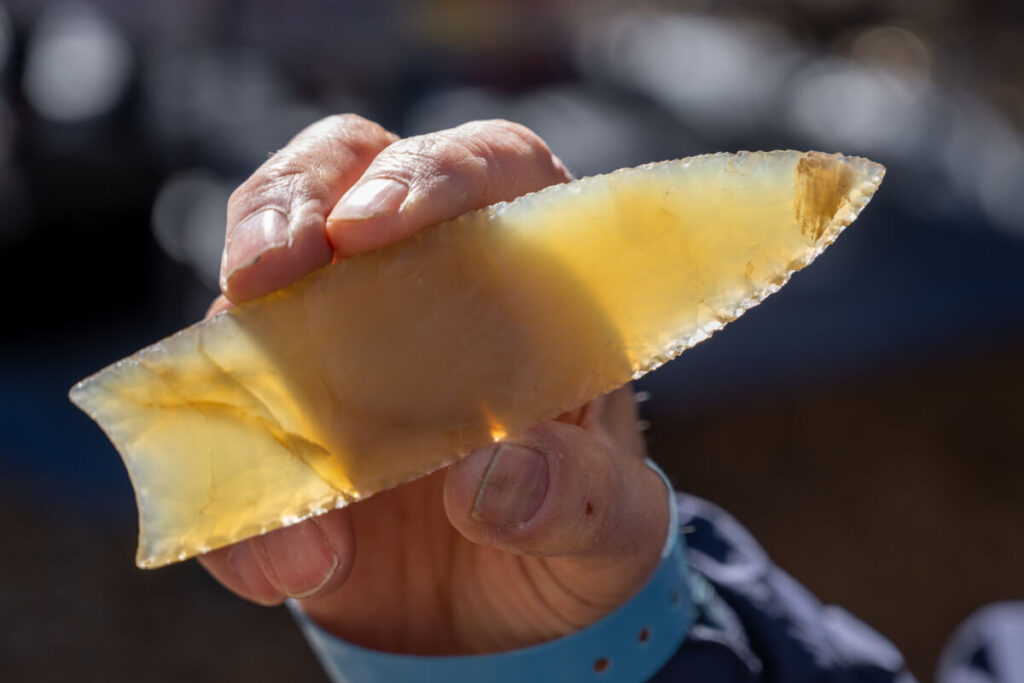
Knap-In and Prehistoric Arts Festival. [Photo by Michael Warren]
This event will include displays of ancient Native American stone tools as well as hands-on activities like archery and pottery making. Experts will give talks on the archaeology of Florida. Vendors will offer unique crafts and food for sale.
Pedro Zepeda
According to the Florida Department of State, Zepeda is a master folk artist and teacher who specializes in traditional Seminole arts. Growing up in a Seminole community, he learned many of the artforms from experienced tribal members.
Zepeda said these included his grandmother, Tahama Osceola; his brother, Brian Zepeda; and Seminole Indian leader Ingram Billie Jr.
The press release announcing Zepeda’s being named the recipient of the 2025 Florida Folk Heritage Award noted that using only an adze and sourcing cypress trees that have fallen naturally, he creates dugout canoes in the traditional Seminole style that have been used for transportation for centuries.
Zepeda makes presentations at conferences and events across the country. He has demonstrated at the Florida Folk Festival, Ocmuglee Mounds National Historical Park, the Smithsonian National Museum of the American Indian and was 2019 Artist-In-Residence at HistoryMiami. His work has been featured in several museums.
From 2007-2013, he worked at the Ah-Tah-Thi-Ki Museum on the Big Cypress Seminole Reservation, first as the oral history coordinator, then as the traditional arts coordinator and lastly as the outreach coordinator.
Prior visitors to the knap-in or the annual Ocali Country Days event, which is also held at the state park, may recall seeing and talking with Zepeda.
“I’ve enjoyed teaching about canoes and Seminole culture and history. I want the public to come away from my demonstrations and talks a little more informed about the Seminole people. Not only about our past but also who we are today and we’re still here practicing our culture. It’s important to maintain our traditional arts because they are not simply objects, but carriers of cultural knowledge that we don’t get without practicing those arts,” he wrote.
He said he will be bringing a 16-foot dugout canoe that he made from cypress to Ocala.
“Often, I’ll also bring other carvings that are done, or that are in progress,” he added.
Scott Mitchell is the longtime director of the museum and educational center, which are part of the Marion County Public Schools system.
“Pedro is well known and respected among Seminole and Miccosukee, and non-native people, for his cultural knowledge and canoe carving ability. He is exceptional in his ability to relate to all people and as a soft-spoken educator. He is a direct descendent of the famous Seminole war leader Osceola (~1804-1838) and Cory Osceola (1893-1978), who was a well-known canoe carver,” Mitchell said.
Harold Littlebird
According to the Adobe Gallery of the Southwest Indian, Littlebird’s stoneware is “an uncommon medium in Pueblo pottery and his masterful use of it truly sets his creations apart. The significance of his work is underscored by the inclusion of his stoneware in the permanent collection of the Museum of Indian Arts and Culture in Santa Fe, New Mexico.”
Born of Kewa (formerly Santo Domingo) and Laguna Pueblo heritage, Littlebird graduated from the Institute of American Indian Arts in 1969.
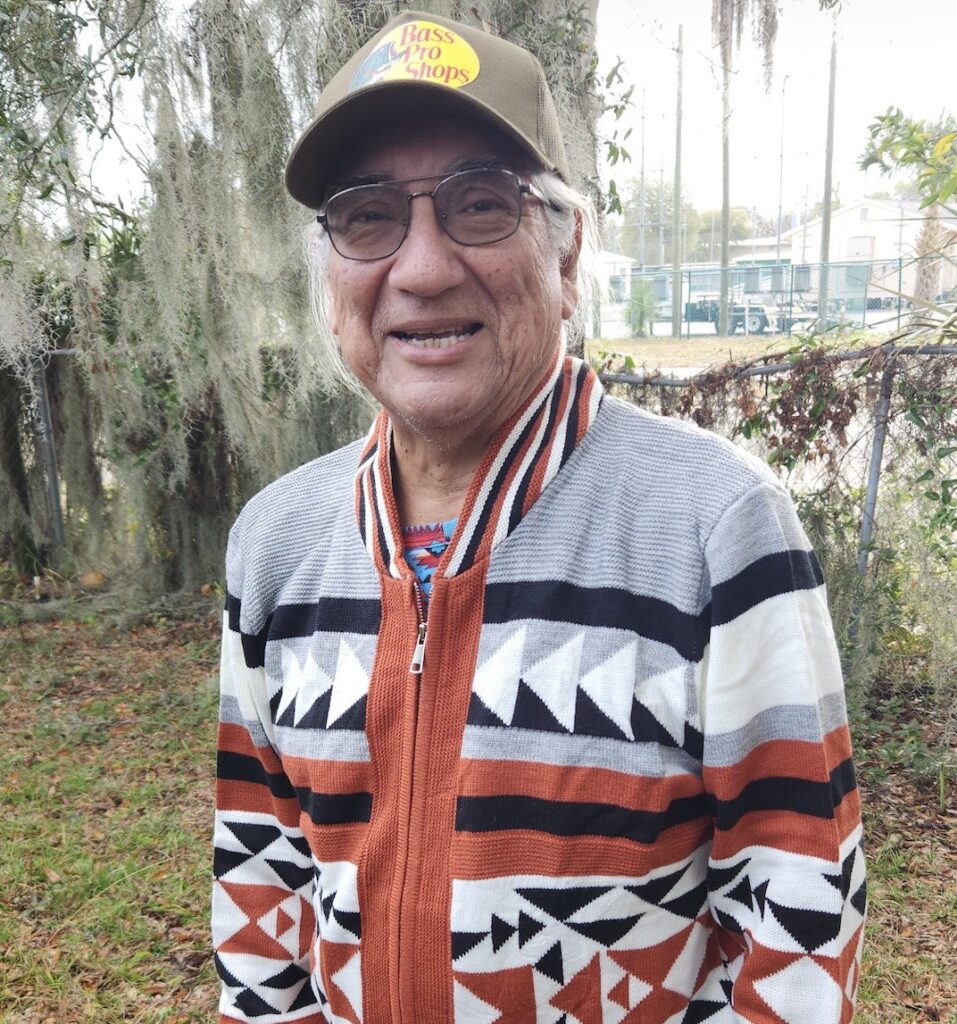
Littlebird lives in Oxford, in north Sumter County, just south of Marion County. He said by phone that during the pandemic he showed his work at an arts and crafts show in northeast Ocala but this is his first time coming to the Prehistoric Arts Festival.
“I’m very excited about participating,” he said.
Littlebird lived in California, then Utah for a time. He said he wanted to know more about his Pueblo ancestry by actively participating in ceremonial life and went to live with his brother in northern New Mexico.
“It was there I was introduced to the hippie generation, while becoming involved with beat poets like Alan Ginsberg, which made me a poetry student as well as a pottery major at the Institute of American Indian Arts in Santa Fe. I became a singer, songwriter and performer all through high school and into my artistic career, which started in the early ‘60s to now,” he shared.
He said he often gets back to New Mexico for shows and celebrations.
Littlebird describes his work as contemporary but with traditional pursuits behind it.
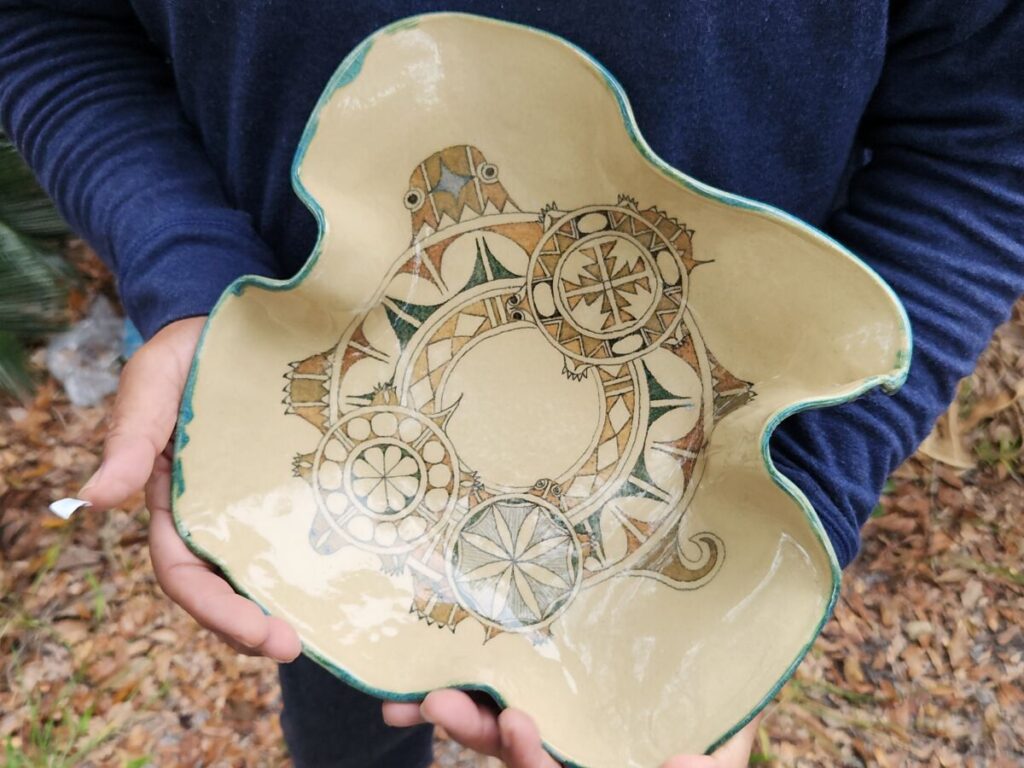
underglaze pencils. [Submitted photo]
“One of the things I try to tell people is that it’s not only a craft but has valuable concepts of indigenous history and spiritual elements that have been passed on from generation to generation by elders, through stories, song, prayer, dance and participation in tribal ceremonies. I call my own creations stories in clay, by what creator God has gifted me to pursue,” he noted. “Though I do not speak my own tribal languages very well, I strive to understand the value of those traditions.”
He said his work is more contemporary because it is stoneware pottery, which is usable.
“My work you can actually use, and it is also a collector’s item because I’m represented in the Smithsonian in Washington, DC, at the National Museum of the American Indian, as one of only a handful of potters,” he said.
Littlebird said he learned early on that his art would be non-traditional.
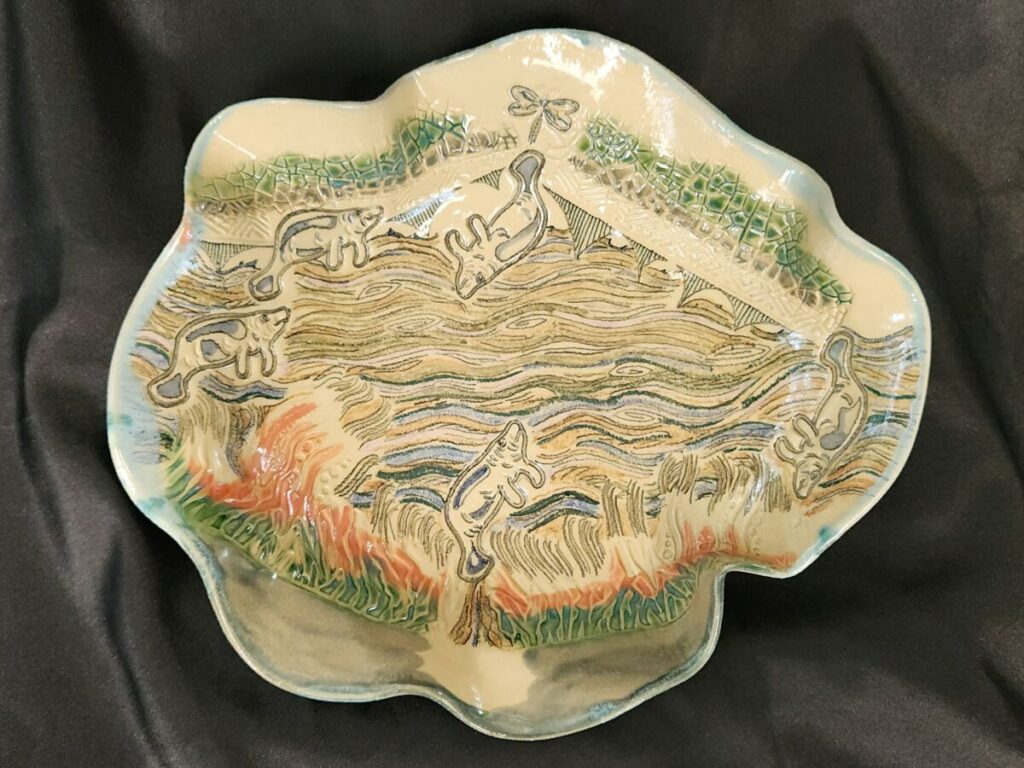
clay stamps and underglaze pencils. [Submitted photo]
“I do all hand work. I haven’t worked on a potter’s wheel since I was a student at the institute. I learned how to throw forms, all kinds of things, but it just wasn’t inspiring me. I told my professor and he said, ‘I see you are a hand builder.’ He gave me some special underglaze pencils and I went, ‘Whoa, you mean I can draw with these?’ And he said he knew I loved to draw,” he explains.
And when you see Littlebird’s works today, you will see his drawn as well as stamped images underneath the glazes.
“I outline first, in my black underglaze pencil and then fill in the colors,” he said. “And I use stamps as well. I’ve made clay stamps from when I was in high school, and a lady who was making her own, she gave them all to me. And I found a great manatee stamp at Goodwill.”
Hours for the Silver River Knap-In and Prehistoric Arts Festival are 9 a.m. to 4 p.m. Feb. 21 and 22. The festival entrance is at 1445 NE 58th Ave., Ocala. Admission is $10 per person; free for ages 5 and younger. Proceeds support educational programs at the Silver River Museum. For more information, call (352) 236-5401 or visit silverrivermuseum.com

Support community journalism
The first goal of the Ocala Gazette is to deliver trustworthy local journalism so corruption, misinformation and abuse are not hidden from the public or unchallenged.