
Grooming for success
Robert Fick got a second chance through a juvenile justice program that pairs young men with retired thoroughbred racehorses.
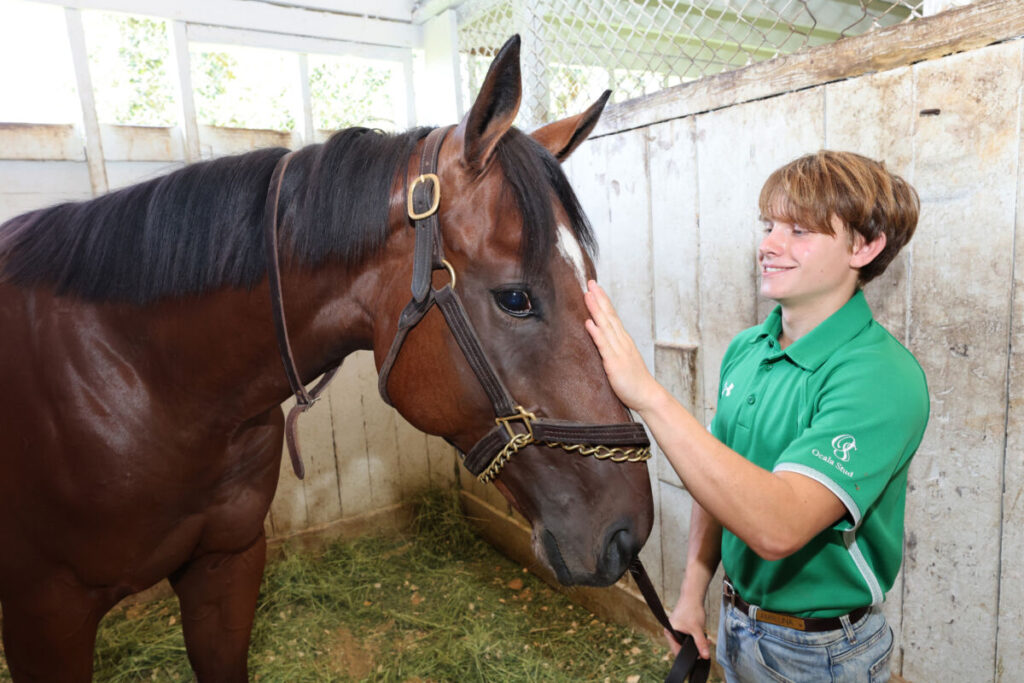
Robert Fick, a groom, spends some time in the barn area with a 2-year-old Uncle Mo colt as he grooms the thoroughbred at Ocala Stud Farm in Ocala, Fla. on Wednesday, Sept. 3, 2025. Fick was hired as a groom at Ocala Stud a year ago after participating in the Second Chances juvenile program. [Bruce Ackerman/Ocala Gazette] 2025.
After Robert Fick’s father died, Robert’s world grew darker. Fick, then 15, started hanging out with kids his dad might not have approved of.
It didn’t take that long before Fick found himself at the Ocala Center for Success and Independence, a residential program for young men ages 12 to 18 who have been sent there after running up against the State of Florida’s Juvenile Justice system.
But it was at the center that Fick learned about an equine program, run through the Thoroughbred Retirement Foundation’s Second Chances Juvenile Program for the Department of Juvenile Justice. In the program, youth must have been at the Center for Success and Independence for 30 to 45 days, have not gotten into trouble and have passed a risk-assessment evaluation.
When Velvet Saulsberry visited Fick’s class and talked about an offsite equine program, Fick knew he wanted admission into the program—and out of the center.
He ran up to Saulsberry after she spoke and tried to persuade her to take him on as one of her equine students.
Saulsberry, who works for Youth Opportunity Investments, runs the equine program at the center and has about seven students at any one time.
She talked to Fick’s teachers, his mother and his case manager. She made sure he arranged to stay in touch with a therapist. Eventually, Fick was approved.
He not only did well in the equine program, he shone.
In April, Fick, now 19 and a graduate of Ocala’s Vanguard High School, was named one of five Youth Ambassadors by the state’s Department of Juvenile Justice.
A Juvenile Justice website says about Fick, “Robert optimized his time in taking part in this program by actively learning and performing essential equine care tasks. He approached tasks with a collaborative spirit, consistently supporting his peers and contributing to the team environment.”
A year ago, Fick also landed a job as a racehorse groom with Ocala Stud, a thoroughbred farm that has bred three Kentucky Derby winners. Fick’s first-year anniversary at the farm was Sept. 3.
“He’s one of our model employees,” said Joe O’Farrell, who oversees day-to-day operations at the farm with his brother, David, and father, Michael.
“We take pride in hiring locals,” Joe said. “We’ve had other Second Chance people. We’re trying to take care of people.”
Fick, who also has a second job at Big Midget, said for now, he just wants to do a good job at Ocala Stud and learn as much as he can. But he’s not ruling out returning to school and then assessing “what roads are available.”
No matter what, he’s pretty sure his future will involve horses, he said.
For Saulsberry, who helped Fick and others get through the Second Chance program, “I like seeing the growth and development,” she said.
She refers to herself as “the dictator of the barn.”
She said she practices a “no-nonsense policy” in dealing with students’ problems and attitudes. But she’s also willing “to try anything” and is happy to work with “anyone who wants to learn,” she said.
She takes her students on field trips to such places as the University of Florida and community colleges. Vets visit and talk to the students. The students talk to blacksmiths, who demonstrate how to train horses to lift their hooves to be ready for horseshoeing.
Saulsberry tries her hardest to find jobs for center graduates.
Two days after Fick returned home from the center, he was working at Ocala Stud.
In addition to teaching students about horses, Saulsberry also has them do such things as plant roses and care for plants, try their hand at leatherwork, or make twisted wire art bracelets. She’s proud that in six years, her program has had no accidents.
She credits the horses for helping the students learn how to control anxiety and anger and to communicate better.
At Ocala Stud, many of the horses are young and have to be trained. The thoroughbred farm specializes in breeding horses and then training them for two years. Like children and youths, the young horses may be anxious. They may not understand how to interact with other horses or people. Saulsberry tries to get her students to observe the horses and to figure out what might trigger them. In doing this, the students might come to understand what triggers themselves, Saulsberry explained.
The students learn how to approach the horses and how to talk to them.
Saulsberry said all of her students have communication issues that need improvement. Pairing students and young horses helps both the students and horses learn to communicate.
O’Farrell explained that when his grandfather, Joe, started Ocala Stud in the 1950s, he focused on the sale of 2-year-old thoroughbred horses to distinguish them from those raised in Kentucky.
Kentucky sells yearlings, and yearlings raised in Florida would not have the same cachet as horses raised in the Kentucky Derby state, even though all the horses “are bred on the same bloodlines,” according to the younger Joe.
Grandpa Joe proposed, “Why don’t we train them and do the hard work? We can offer a time trial,” grandson Joe related.
“And it caught on,” the younger Joe said. “When you’re buying a yearling, you don’t know what you’re getting. But when you buy a 2-year-old, you get to see performance. You can see them at full speed for a short distance. That kind of sets us apart.”
He said Ocala Stud has a racetrack on its property and a starting gate where the young horses can train.
Ninety percent of 2-year-old thoroughbred sales happen in the Ocala area, he said.
And Ocala has definite advantages in raising horses, according to Joe.
“We have a short freeze and all that sunshine. Our aquifer is very high. You can put a well in within 10 feet. The grass grows fast. We have limestone that’s similar to what Kentucky Bluegrass grows on. Florida became a training center and it caught on in the 1950s and ’60s,” Joe said.
For those who know horses, this information is useful. But many of the students in Saulsberry’s program know nothing about horses when they start.
Saulsberry said Fick began her program with no equine skills.
“He’s definitely matured,” she said. “He’s very professional.”
Other of her students have enrolled in trade school, community college and a four-year college, and some have been supported by Saddle Up Scholars, a program of U.S. Equestrian. Some are working with their parents in a family business. Others have jobs.
Joe O’Farrell also is an unofficial educator and community outreach specialist, not only by working for his family’s farm but also by being involved with equine policy through the Farm Bureau, the Florida Horse Park and the Florida Thoroughbred Breeders’ and Owners’ Association.
He seems to delight in discussing the art and business of running a thoroughbred stud farm.
For example, did you know high season for thoroughbred horse sales is in the spring? April is the peak month, but March also is pretty busy and sales can go through June. Breeding often coincides with Valentine’s Day and into late February.
The last Kentucky Derby winner from Ocala Stud was Street Sense in 2007 and there have been two previous winners. Many Ocala Stud horses have placed in other races.
Ocala Stud has around 80 brood mares and eight stallions. The gestation time for a foal is 11 months. During the winter season, Ocala Stud may have over 200 horses in training and up to 400 horses.
Joe said it’s not always easy to predict which horse will go the distance to the Kentucky Derby and beyond. Street Sense, for example, was a little on the big side but wasn’t necessarily the fastest or the smartest during training at Ocala Stud.
“You never know,” Joe said.
Many buyers arrive at the Ocala International Airport. They can fly horses home in planes that may be retrofitted to fit 10 to 12 horses.
Horse racing as a sport has been popular with the English, Turkish and Saudis for many years. Today, buyers from Australia, Europe, Japan and Korea, among other countries and continents, fly to Ocala to check on their horses in training and perhaps buy some more.
Joe said it doesn’t matter from where the visitors come.
“The passion is the same,” he said. “It’s a worldwide sport. The racing never ends.”
To run a stud farm, you have to know something about agriculture, horses, medicine, business and racing.
“I’m kind of a jack of all trades,” Joe said.
And he said he loves the work.
“Being a part of the community, and a positive part, is very rewarding,” he said.
For more information about Ocala Stud, go to ocalastud.com
To learn more about all of the TRF offerings, including a program for women at the Lowell Correctional Institution in Marion County, go to trfinc.org/trf-second-chances-program



Support community journalism
The first goal of the Ocala Gazette is to deliver trustworthy local journalism so corruption, misinformation and abuse are not hidden from the public or unchallenged.