
Florida legislature bills would likely remove FPA protections in Marion County
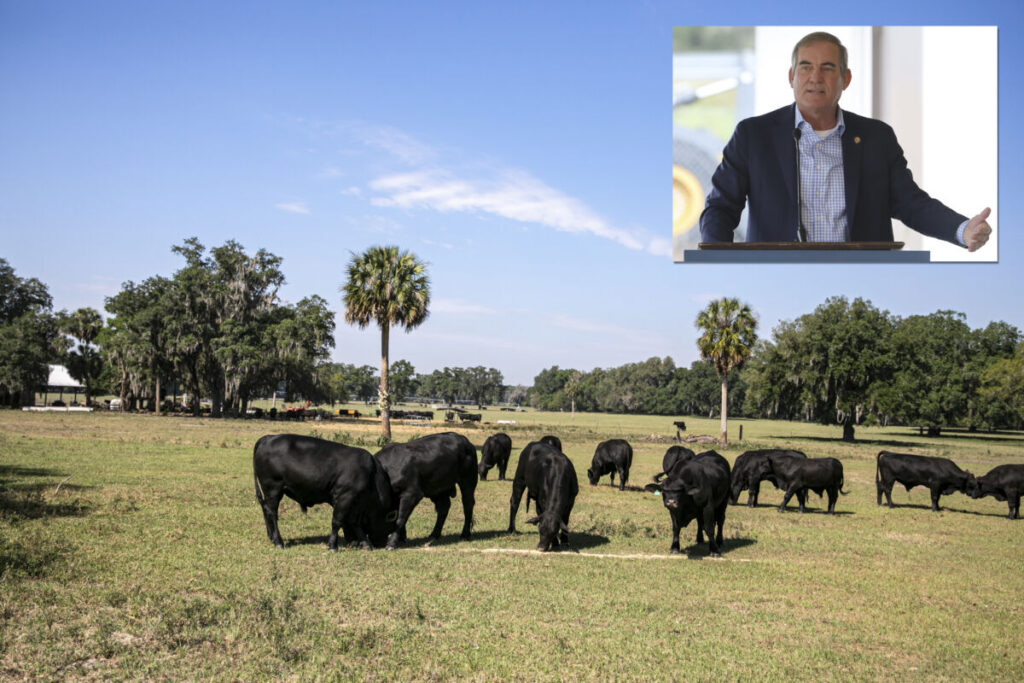
This is a composite image of State Sen. Stan McLain and property inside the Farmland Preservation Area in Marion County. McClain, R-Marion, and Rep. Kevin Steele, R-Pasco, have each filed bills that would wrest local control of development from cities and counties across the state and open up hundreds of thousands of agricultural acres to developers without review from local governments. If passed, the new laws would supersede any local overlay zones of protection, including Marion County’s Farmland Preservation Area.
State Sen. Stan McClain, R-Marion, and Rep. Kevin Steele, R-Pasco, have each filed identical bills that would wrest local control of development from cities and counties across the state and open up hundreds of thousands of agricultural acres to developers without review from local governments. If passed, the new laws would supersede any local overlay zones of protection, including Marion County’s revered Farmland Preservation Area.
Senate Bill 1118 and House Bill 1209 summary sections state, in part, the measures authorize property owners “…to instead apply for administrative approval of a development regardless of future land use designations or comprehensive plan conflicts under certain circumstances;” require “that an authorized development be treated as a conforming use…;” and prohibit “local government from enacting or enforcing certain regulations or laws.”
The bills would also require “administrative approval of such development if it complies with certain requirements.”
The bills propose no restrictions on minimum lot size and assumes that maximum densities per any current land development code would be automatically put into effect. The city of Ocala and the Marion County Board of County Commissioners would lose their authority to restrict the number of units per acre in a housing project.
SORA and HFF concerned about FPA protections
Tim Gant, president of Save Our Rural Areas, a grassroots group that focuses on preserving farmland, said the bill “is a for-real existential threat to the FPA and a direct threat to self-rule at the local level. On top of that, it’s a special right granted to the right kind of people, those with large land holdings. This bill keeps coming up every session under a different name, oftentimes changing as the session progresses. It is time for our local officials to loudly denounce this as what it is, a power grab which would reduce their positions to that of rubber stamp sycophants.”
Also concerned was Bernie Little, president of Horse Farms Forever, who responded to what he called an “unprecedented change in state laws.” The bill would supersede any FPA protection zone, he said.
“If this bill passes as written,” Little said, “what does mean in the real world? One example would be any property inside the Farmland Preservation Area that qualifies as an ‘agricultural enclave’ as defined by the bill is exempt from the protections of the FPA, the Comprehensive Plan and the Land Development Code and approved for development without any public hearing.”
Little pointed out that the bill “significantly preempts the rights of local government” and would “allow developers to completely circumvent the long-established authority of local government to follow their mandated comprehensive plan, land development code and public hearing requirements before any development is allowed.”
The bill language only provides for protection of state-mandated protection areas and lists two: “The Wekiva Study Area, as described in s. 369.316; or 2. The Everglades Protection Area, as defined in s.169 373.4592(2).”
Further bill details
The bill also proposes changes in legal definitions of key terms that would affect new developments.
“Compatibility,” the bill states, “means a condition in which land uses or conditions can coexist in relative proximity to each other in a stable fashion over time such that no use or condition is unduly negatively impacted directly or indirectly by another use or condition. All residential land use categories, residential zoning categories, and housing types are compatible with each other.” [emphasis added]
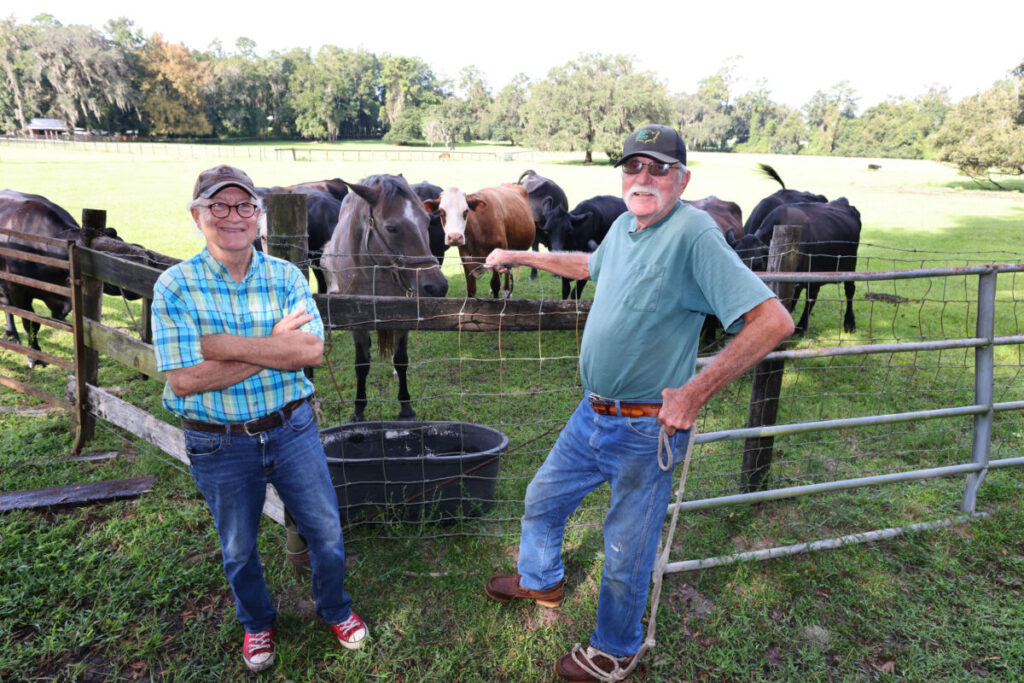
Tim Gant, the president of Save Our Rural Areas (SORA), left and Jerome Feaster, vice-president, are shown at Feaster’s “Backforty” farm in Shiloh, which is inside the Farmland Protection Area, on Sept. 5, 2023. [File photo by Bruce Ackerman]
Requests for comment from McClain, Marion County Attorney Matthew Minter and BOCC Chair Kathy Bryant were not immediately available. We’ll be adding their input in future stories when received.
The details of the bills are on these web pages:
flsenate.gov/Session/Bill/2025/1118
flsenate.gov/Session/Bill/2025/1209
The senate bill was introduced on March 4.
As of March 5, the house bill was referred to several committees: Housing/Agriculture & Tourism; Intergovernmental Affairs; and Commerce.
Contact information for state legislators is:
Senator Stan McClain, [email protected], (352) 732-1249
Representative Ryan Chamberlin, [email protected], (352) 635-0450
Representative Richard Gentry, [email protected], (386) 251-1100
Representative Yvonne Hinson, [email protected], (352) 264-4001
Representative JJ Grow,, [email protected], (850) 717-5023
Representative Judson Sapp, [email protected], (352) 496-3430

Support community journalism
The first goal of the Ocala Gazette is to deliver trustworthy local journalism so corruption, misinformation and abuse are not hidden from the public or unchallenged.