
Fighting for higher education
Community, school board rally against state cuts to funding for advanced courses.
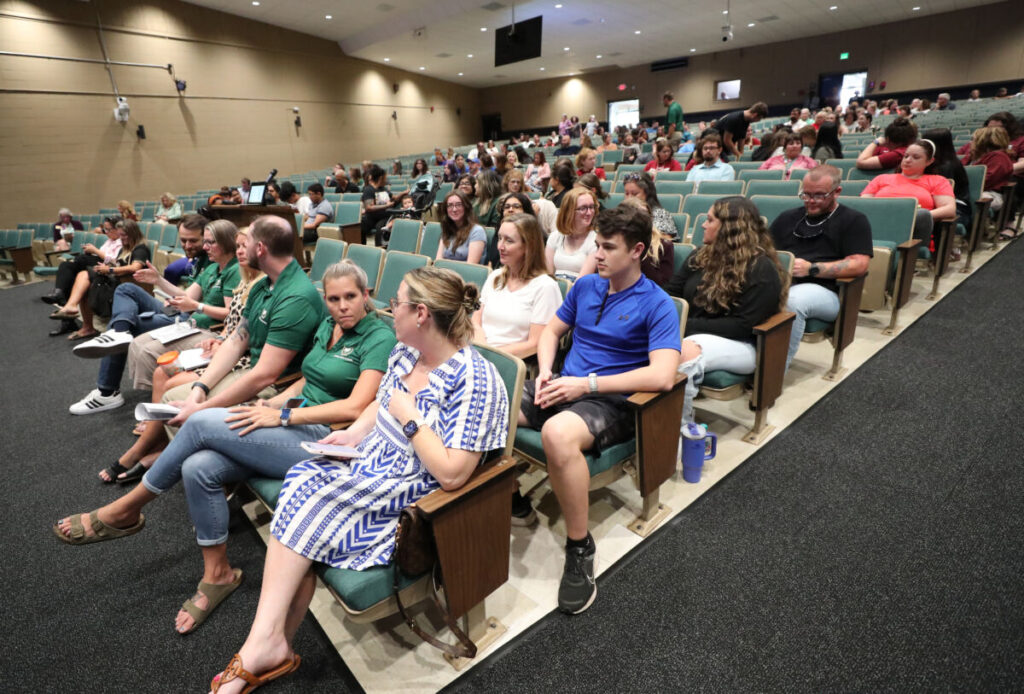
People listen during a town hall on proposed legislative education cuts in the auditorium at Marion Technical Institute in Ocala, Fla. on Tuesday, April 15, 2025. [Bruce Ackerman/Ocala Gazette] 2025.


The future of advanced courses for Florida students is in danger as two proposed bills in the Florida Legislature threaten cuts to Advanced Placement, International Baccalaureate and college-level testing for public schools.
The Marion County School Board created a resolution opposing Florida House Bill 5101 and Senate Bill 2510, which, if signed into law, would reduce career and professional education funding by 50%.
Although the two bills differ in language, both passed chambers and are now known as CS/SB 7030. The differences between the two bills are expected to be worked out.
Locally, the legislation would cut Marion County Public Schools’ budget by over $2.5 million, which officials say would pose a significant detriment to advanced programs.
The resolution was sent to the Florida Legislature on April 9.
Currently, schools can receive additional funding for each full-time equivalent student who participates in dual enrollment, IB, AP, AICE, CAPE and early high school graduation programs. This funding is added to the base student allocation.
“The additional FTE generated from these programs is added to the district’s weighted FTE when calculating the district’s flexible base funding,” according to the bill.
Both bills propose that districts and schools with students in advanced programs such as these will no longer be eligible for additional FTE membership. It would also cut the bonuses given to teachers for each student who meets those course requirements.
The existing statute would be changed “to adjust the weighted values used to calculate the additional FTE students in half for the following programs: Advanced Placement (AP), International Baccalaureate (IB), Advanced International Certificate of Education (AICE), Dual Enrollment and Early Graduation,” according to SB 2510.
Community members, educators and students in Marion County have expressed strong opposition to the proposed legislation. Among them was John Crawford, the magnet coordinator for Forest High School’s College and Career Advanced Placement Academy. The legislation would cut over $450,000 in funding for Forest High School alone.
“When this add-on funding is effectively used, as it is here in Marion County, it closes that achievement gap between the ‘haves’ and the ‘have nots,’” Crawford said. “What we really need is to invest in this program, and we need the state to continue to hear that message.”
Crawford organized a town hall on April 15 where he presented data on funding for Career and Professional Education (CAPE) programs as well as other advanced programs and potential detriments that will be seen if the legislation passes.
Across Marion County, over 5,000 students participate in AP, IB and Advanced International Certificate of Education (AICE) testing.
In effect, both the House and Senate bills include language that will reduce the amount of the add-on weights applied certain types of students and school districts funded in the Florida Education Finance Program.
The Senate Bill specifically “modifies CAPE Digital Tool Certificates and CAPE industry certification funding, including changes to the additional full-time equivalent membership, and modifies the requirements of the CAPE Industry Certification Funding List,” according to SB 2510.
Chloe Kostowicz was among those who attended the town hall. A senior at Forest High School who also served as a Student Representative to the School Board this year she has taken AP courses and is part of a career and technical education program to train her as an EKG technician.
“I can have a job working as an EKG tech right out of high school, which will help me pay for college and help me pay for other expenses as well and get me ready to go into the workforce,” Kostowicz said. “It is essential to have these types of programs available for students, and it’s really sad that they’re trying to take that away.”
The legislation would not only affect the high school level, however, as many of Marion County’s middle schools receive funding through the same revenues.
“This would have a devastating effect on some of the schools, which count on that money to provide these advanced programs to these students, not only at the high school level, but for schools like Howard Middle School, which has a very successful MYP program because of the dollars that are generated from this add-on funding,” Crawford said.
Howard Middle School’s Middle Years Programme (MYP) provides the opportunity for middle school students to participate in IB courses even before entering high school.
School Board Member Allison Campbell said given that Marion County has an average pass rate of 62% in comparison to the statewide average of 30%, the Legislature should introduce a caveat into the bill language that rewards districts that are successful.
The House Bill intends to cut the funding by 50%, while the Senate Bill is intended to cut funding by 50% but rolling a portion back into the base student allocation funding, Campbell said.
Campbell said she wishes to see the legislation allocate more funding to districts with higher pass rates so that even if a district has a lower average, they have something to work toward in getting students closer to that goal.
“If you’re wanting to level the playing field, then let’s make sure that you’re actually treating apples to apples and rewarding the success of those that are doing it well,” she said.

Support community journalism
The first goal of the Ocala Gazette is to deliver trustworthy local journalism so corruption, misinformation and abuse are not hidden from the public or unchallenged.