
DeSantis signs budget, vetoes $567M
Among the cuts was $6.25 million that would have gone toward restoring the Ocklawaha River.
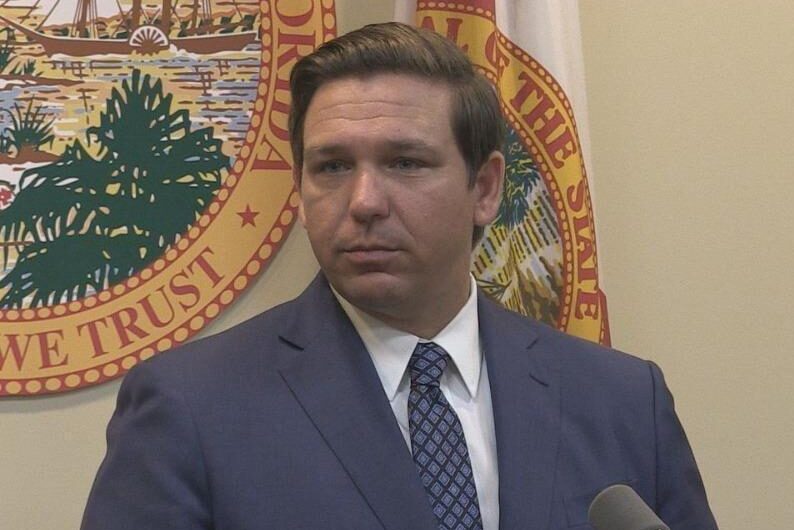
Gov. Ron DeSantis
Gov. Ron DeSantis on June 30 signed what he said was a $117.4 billion budget for the fiscal year that will start July 1 and issued $567 million in line-item vetoes, while saying the plan better prepares the state for potential economic downturns.
“I think what you see in the budget is an example of a very fiscally responsible state,” DeSantis said during a bill-signing event at the Rohan Regional Recreation Center in The Villages.
The budget includes $580 million to pay off state debt and lawmakers approved a separate bill (HB 5017) that requires an annual $250 million repayment of state bonds.
“I can tell you that right now, I don’t know what’s going to happen over the next couple years. If I did, I would start a hedge fund,” DeSantis said.
“But I think we have to be prepared that we could have a slowdown, that there could be hiccups,” he added.
Lawmakers passed the budget for the 2025-2026 fiscal year on June 16 after disagreements about spending and tax cuts led to extending the annual legislative session, which was scheduled to end May 2. The budget included a bottom line of $115.1 billion.
But DeSantis said that number does not include what is known in the Capitol as money in the “back of the bill.” That includes money carried over from previous years. When such money is included — and vetoes are factored in — DeSantis said the budget totals $117.4 billion.
DeSantis and House Speaker Daniel Perez, R-Miami, have clashed for months. Perez made a priority of trying to shrink the budget and DeSantis made a point Monday of saying the overall spending plan is “roughly” $10 million higher than his recommendations from early February.
The governor and speaker also battled about tax cut plans, with DeSantis wanting to provide property tax rebates to homeowners and Perez seeking to reduce the sales tax rate. In the end, neither idea passed.
DeSantis used the appearance in The Villages to reaffirm his support for asking voters next year to pass a constitutional amendment to reduce or eliminate taxes on homesteaded properties. But he cut $1 million from the budget that had been earmarked for the Legislature’s Office of Economic & Demographic Research to study a potential property tax elimination.
“It’s kind of like a state version of, like, the Congressional Budget Office,” DeSantis said. “I’ve been very nonplussed by their analysis. So, I vetoed that because we don’t need to give a bureaucracy money to study this.”
The Legislature linked the budget to a proposed constitutional amendment (HJR 5019) that will ask voters in 2026 to increase the limit of a rainy-day reserve, known as the Budget Stabilization Fund, from 10 percent of general revenue collections to 25 percent. The Legislature also approved setting aside $750 million in each of the next two fiscal years in anticipation of the ballot measure passing. DeSantis vetoed $750 million of the funding.
That was in addition to the $567 million in line-item vetoes, which nixed money for dozens of projects and programs across the state.
As examples, DeSantis vetoed $4.44 million for public television stations, $2 million for repairs to the Brickell Key Bridge, $1.73 million for the South Florida AgriCenter and Emergency Shelter at the South Florida Fairgrounds and $750,000 for the development of the Florida Museum of Black History.
One lawmaker hit hard by vetoes was Rep. Alex Andrade, a Pensacola Republican who chairs the House Health Care Budget Subcommittee, which spent weeks scrutinizing a foundation linked to First Lady Casey DeSantis’ signature economic assistance program, Hope Florida.
DeSantis axed 15 projects in the Panhandle sponsored by Andrade, totaling $7.45 million.
The budget includes 2 percent pay raises for most state employees, with state law enforcement officers and firefighters in line for additional 8 percent to 13 percent boosts. Meanwhile, the plan eliminates more than 1,000 vacant state government positions.
Per student spending in the pre-kindergarten through 12th grade system will increase from $8,987.67 to $9,130.41. The plan also includes $691.5 million for Everglades restoration, the same as in the current year; $675.2 million for water improvement projects; and $170 million for flood and sea-level grants.
The spending plan also directs $13.7 billion for the state transportation work program. That is down from $14.5 billion in the 2024-2025 fiscal year
Money for Visit Florida, the state’s tourism arm, will remain at $80 million.
REGIONAL CONNECTION
Sen. Tom Leek, R-Ormond Beach, thanked DeSantis for cutting $6.25 million that would have gone toward restoring the Ocklawaha River.
Environmentalists have tried for decades to restore the river, which was dammed as part of an effort to create the long-abandoned Cross-Florida Barge Canal. But officials and businesspeople in areas such as Putnam County have contended that the reservoir, known for its fishing, is an economic engine.
Leek, whose district includes Putnam County, said the funding, which was a priority of Sen. Jason Brodeur, R-Sanford, would have “destroyed the Rodman Reservoir and quality of life in our surrounding communities.”
Proponents of the restoration of the Ocklawaha River issued a press release early Tuesday in response to DeSantis’ decision.
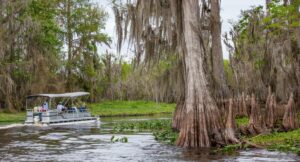
A natural section of the Ocklawaha River. [Photo courtesy Great Florida Riverway Trust, Inc.]
“Despite today’s governor action, I remain committed to Ocklawaha River restoration. This is a water resources project of state and national significance that would strengthen the Florida Wildlife Corridor, be the largest springs restoration project currently in the state and reconnect three rivers and Silver Springs, all while generating hundreds of jobs and millions in economic benefits for Putnam and Marion counties,” Brodeur said in the release.
Anglers and fishing-related businesses throughout the region voiced support for restoration, highlighting how restoring natural freshwater flow from the Ocklawaha to the lower St. Johns River will promote native fish populations and vital habitat from the river’s headwaters to the Atlantic coast, according to the document.
A January 2025 report by subject matter experts projects that restoration and related infrastructure improvements will yield approximately $200 million in net benefits over 20 years, generating more than $2 for every $1 invested, the release stated.
Marion County’s Margaret Hankinson Spontak, president of the Great Florida Riverway Trust, a regional group advocating for restoration of the Great Florida Riverway and its river communities, praised legislative leaders for advocating on behalf of local communities and conservation and said in the release, “Governor Ron DeSantis’ veto signals that there’s more work needed to bring leaders and river communities together to create a vision and plan for restoration and supporting recreation.”
Ocala Gazette editor Susan Smiley-Height contributed to this report.

Support community journalism
The first goal of the Ocala Gazette is to deliver trustworthy local journalism so corruption, misinformation and abuse are not hidden from the public or unchallenged.