
County’s five-year plan will allocate over $16 million to alleviate homelessness, increase affordable housing
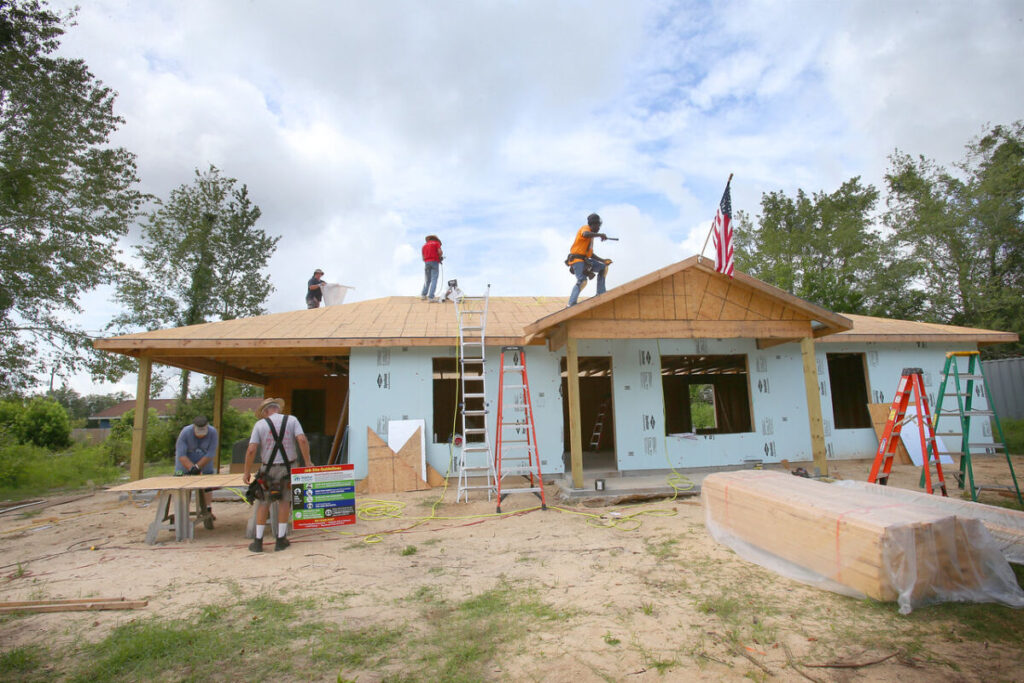
File photo: A construction crew works on a Habitat For Humanity home that is under construction on Northwest 2nd Place in Ocala, Fla. on Tuesday, July 28, 2020. [Bruce Ackerman/Ocala Gazette] 2020.
Marion County’s Five-Year Consolidated Plan is about to take effect in October; Here is a closer look at how the county plans to appropriate over $16 million toward housing development to serve the low-income community.
Through this federal funding, the county plans to develop and preserve affordable housing, prevent and end homelessness, stabilize communities, maintain and enhance public facilities and infrastructure, provide accessible public services, and enhance community development, according to the consolidated plan.
Since Marion County is considered a federal entitlement community by the U.S. Department of Housing and Urban Development, every five years county staff must implement a plan to implement any federal programs that fund housing, community development and economic development. Community Services Director Cheryl Martin presented this rendition of the plan in March, with a final approval from the County Commission on Aug. 6.
“It outlines the needs analysis for Marion County, our housing market, and then outlines our strategic plan for the next five years and how we’re going to budget our Community Development Block Grant, our Home Investment Partnership funds and our Emergency Solutions grant,” Martin said.
The plan will be enacted on Oct. 1, 2024, and last until Sept. 30, 2029.
Marion County receives HUD funds each year, including from the Community Development Block Grant, HOME Investment Partnership Program and from the Emergency Solution Grant(ESG).
“All of these funds must serve a low- to moderate-income population, and we are expected to receive approximately $16,222,814 over the next five years through the combination of those three grant sources,” Martin said.
The city of Ocala collaborates with Marion County in a Consortium to secure HOME funds, with Marion County taking the lead. Meanwhile, the city independently receives CDBG funds as an Entitlement City, according to the county.
The funds include about $10.9 million for CDBG projects, to help develop viable urban communities by providing decent housing, a suitable environment to live in, and additional opportunities for low– and moderate–income people. HOME funding of about $5.3 million can be used by the county to develop and rehabilitate rental housing and homeownership that is affordable and accessible for low– and moderate-income people. ESG funds of about $913,380 will support outreach for homeless people and families.
With these funds, the county aims to increase the availability of affordable housing, reduce discriminatory housing barriers, increase the amount of housing for people with special needs and transition homeless people and families into housing, according to the plan.
The median contract rent in Marion County is currently $885 higher than the national fair market rent of $617 for one-bedroom apartments and larger.
“This compares to an area median rent of $1,043 for a one-bedroom apartment. This means that a household receiving a tenant-based rental subsidy cannot afford most homes within Marion County,” according to the plan.
To ease this strain, HOME funds will allow the Consortium to “to acquire, construct, and renovate affordable rental housing for county residents,” by 2029.
“In addition, Marion County has a new domestic violence provider as of January 2024 called CASA Marion. The county is working to acquire an identified permanent location within the next year,” according to the plan.
In the previous five-year plan, many community programs were supported by these revenues, such as Kut Different Inc., Marion County Veterans Helping Veterans Inc. and Habitat for Humanity. The county also acquired five manufactured homes to make them available for low-income buyers.
For the 2019-2023 plan, the county received funding through the same three grants, for a total of about $14,484,510.
The existing homeless shelters in Marion County include the Center of Hope of the Salvation Army, Interfaith Emergency Services and Arnette House. Three transitional housing programs exist for single mothers: Shepherd’s Lighthouse, Hands of Mercy Everywhere and Project Hope.
With 192 people moving to Marion County each week, this level of growth has been sustained for over a year and is expected to continue. Between now and 2029, the county hopes to apply its consolidated plan to alleviate the shortage of affordable housing that has resulted from this influx of new residents seen each week.

Support community journalism
The first goal of the Ocala Gazette is to deliver trustworthy local journalism so corruption, misinformation and abuse are not hidden from the public or unchallenged.