
County budget squeeze
Shortfalls for 2026-27 budget year emerge amid rising health care, public safety costs.
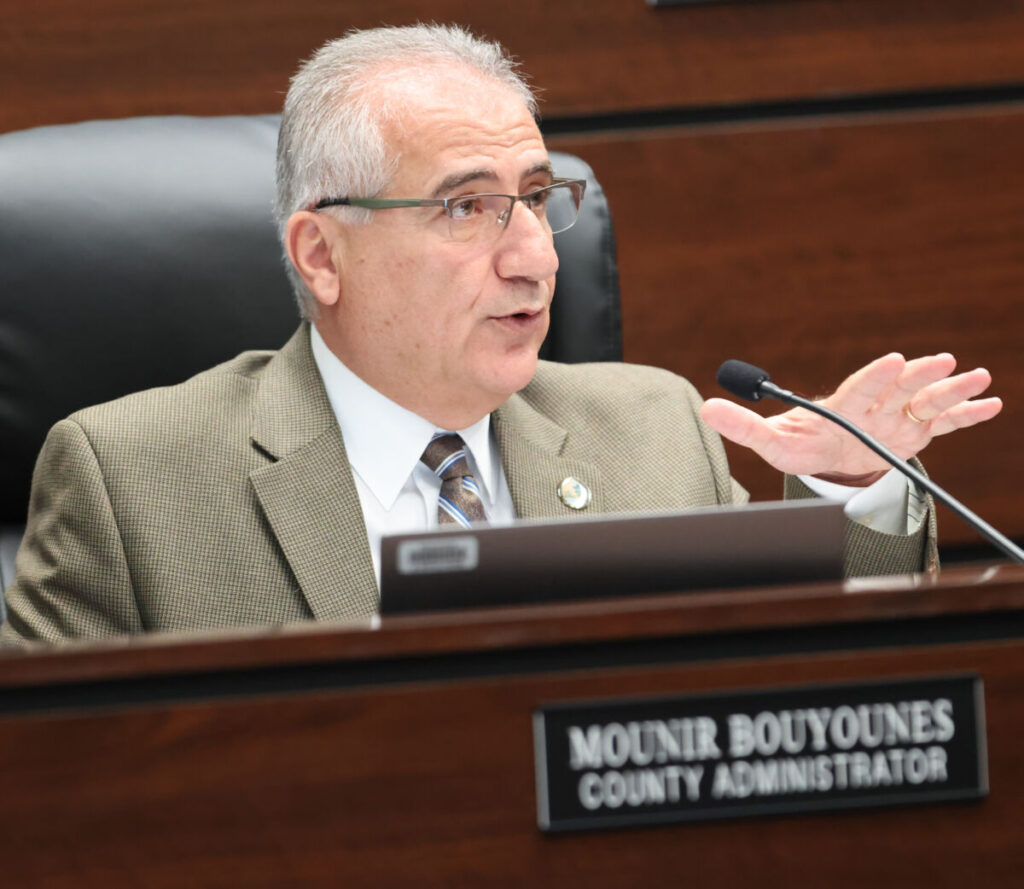
County Administrator Mounir Bouyounes speaks during a meeting of the Marion County Commission in the McPherson Governmental Complex in Ocala on Feb. 18, 2025. [Bruce Ackerman/Ocala Gazette file photo]
Marion County commissioners and department heads gathered for an initial budget workshop on April 7 to face a sobering financial reality: maintaining the current property tax millage rate of 3.09 will not be enough to cover the county’s mounting operational costs for the 2026-27 fiscal year.
County Administrator Mounir Bouyounes set the tone early in the meeting, warning commissioners that routine belt-tightening will not solve this year’s deficit. Describing the various department budgets submitted by staff as “practical,” Bouyounes noted, “I don’t think we’re going to be able to make it by just being practical unless there is some policy decision made at the board level and we have better direction where we need to go.”
The board directed staff to continue refining the numbers and return to workshops later this summer with models analyzing the impact of keeping the millage rate at 3.09 or raising it to 3.35 or 3.48.
Bouyounes explained that massive increases in employee benefits and labor negotiations are the primary culprits.
“Major cost drivers in the proposed budgets are going to be health insurance and, as you all know, we are engaged in negotiation with the union,” he said, referencing the ongoing negotiations with the union representing Marion County Fire Rescue employees. “Every way we looked at it, just to do the minimum that is required of us to do, we will not be able to balance the budget.”
Health care costs
The county says it is currently facing an estimated 20% increase in health insurance costs, which, Bouyounes noted, will help prevent the depletion of health reserves while covering spikes in high-cost prescription claims and expensive emergency room visits.
To combat these rising costs, the county recently opened a dedicated Employee Health Clinic. The clinic costs approximately $3.1 million annually to operate out of the Health Insurance Fund. The goal of the clinic is to provide free preventative care to county employees, retirees, and dependents, handle workers’ compensation in-house and ultimately reduce the frequency of high-dollar medical claims.
Because the clinic was opened earlier this year, officials noted it will likely take until its second year of operation before the county begins to see tangible financial relief on its broader health insurance claims. In the meantime, the Tax Collector and other officials have pledged to launch aggressive internal campaigns to educate employees on how to make wiser, more cost-effective healthcare choices
Fire/EMS
During the workshop, the county estimated there will be an annual $4 million budget increase under the new collective bargaining agreement with MCFR fire/EMS personnel.
However, at the eighth negotiation meeting held last month, the county expressed concerns about being able to deliver what they had already discussed.
During that negotiation, Assistant County Administrator Amanda Tart explained that funding both a schedule change (a Kelly day or a 42-hour work schedule down from 56 hours) and significant pay increases is not financially feasible for the upcoming year as each initiative would cost approximately $4 million. The county’s general fund is already facing an $8 million deficit[GH1] .
Regarding the community and taxes, Tart expressed doubt that MCFR could afford to be a statewide leader in both pay and schedule within a “very conservative community that doesn’t want a high tax base[GH2] .”
Growing tax base doesn’t make up growing costs
Further straining the general fund, several constitutional officers announced they are seeking 3% Cost of Living Adjustment (COLA) raises for their staff. Sheriff Billy Woods, Clerk of Court Greg Harrell and Tax Collector George Albright all confirmed they are planning for 3% salary increases to keep pace with inflation and prevent employees from leaving for the private sector.
Budget Director Audrey Fowler presented several financial models to illustrate the dilemma. While Property Appraiser James “Jimmy” H. Cowan Jr. expects a 6.8% increase in taxable property values, it won’t be enough to offset the new expenses.
Fowler revealed that funding all the requested budget increases — including health insurance, the MCFR fire/EMS union contract, and new personnel — would require raising the millage rate from 3.09 to 3.78. Keeping the millage at 3.09 with those requests would leave the county roughly $27 million in the red.
Commissioners spent the latter half of the workshop grappling with how to bridge the gap without excessively burdening taxpayers. Commissioner Craig Curry suggested delaying some capital improvement projects to prioritize essential emergency services, asking, “What would it do to everybody if we put those off?”
Bouyounes agreed that $6.6 million in new capital projects — such as the Judicial Center’s third-floor buildout — could be temporarily deferred or funded using one-time carry-forward money.
The board also discussed potentially lowering the county’s strict 20% cash reserve policy — a safety net used to float the county until tax revenues arrive in December — down to 15% or 18% to free up millions in cash.

Support community journalism
The first goal of the Ocala Gazette is to deliver trustworthy local journalism so corruption, misinformation and abuse are not hidden from the public or unchallenged.