
Contract negotiations underway for MCFR
Discussions to try to help retain skilled personnel include reduced work week hours.
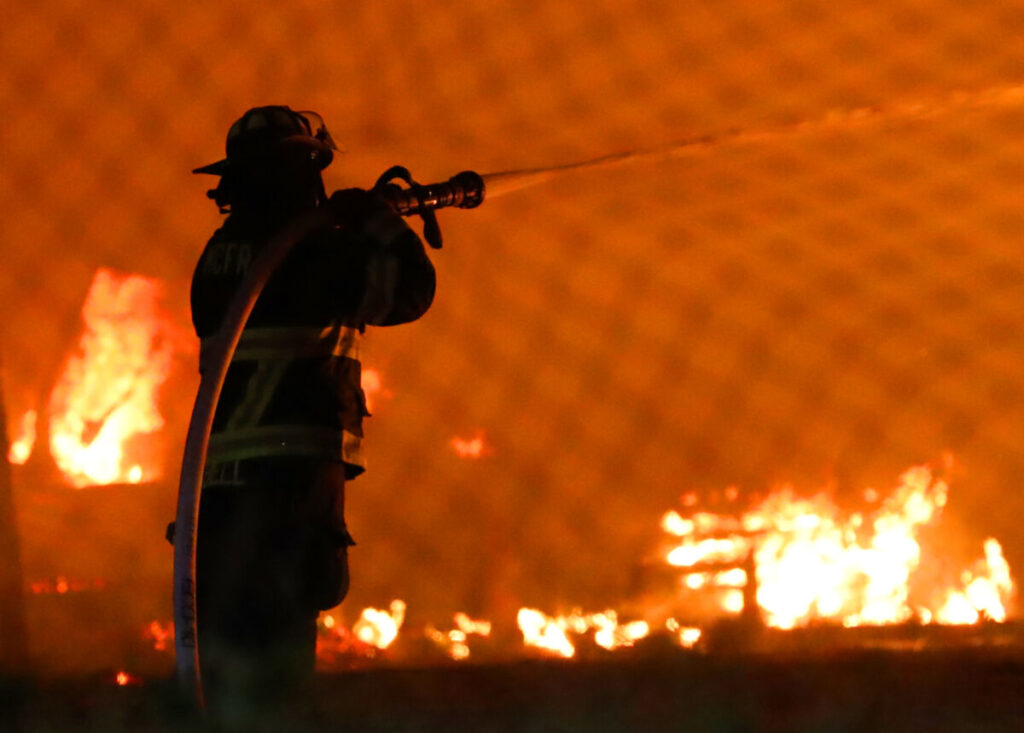
A Marion County Fire Rescue firefighter works as a raging fire consumes the Tizwhiz Feed and Hay facility in Reddick on Aug. 12, 2025. [Bruce Ackerman/Ocala Gazette file photo]
Adopting a shift schedule with built-in time off, known as a Kelly Day, and benefits to attract and keep skilled first responders, were front and center issues as fiscal year 2026-27contract negations for Marion County Fire Rescue firefighters and emergency medical services personnel kicked off on Aug 12.
MCFR Chief James Banta, Professional Fire Fighters of Marion County President Rolin Boyd and 2nd Vice President Joe Romani and other MCFR members met with Assistant County Administrator Amanda Tart and others representing the Marion County Board of County Commissioners at a county facility in northeast Ocala to have preliminary discussions and set a future meeting.
A new contract will be required by June of 2026, but Tart hopes with the “back and forth” negotiations the “lofty goal” of an agreement can be reached by Jan. 1, 2026.
An undercurrent as the meeting began was the signing of House Bill 929 by Florida Gov. Ron DeSantis.
According to flgov.com, DeSantis said firefighters “put their lives on the line to save others” and signed the bill, which calls for (firefighting) gear free of harmful chemicals; notification of (firefighting) gear with toxic chemicals; monitoring of mental health and suicide risks and limit a standard shift to 42 hours to “reduce burnout.”
Romani discussed the union’s position on HB 929 in a press release, stating: “(HB 929) focuses on firefighter health and safety, the language encourages employers not to exceed an average of a 42-hour work week for firefighters. This is in contrast to the current schedule for most fire departments of an average of 56 hours a week. At the current average, it’s equivalent to first responders working an 8-hour workday, 7 days a week.”

Marion County Fire Rescue’s Lt. Kyle Bagwell, firefighter/EMT Jacob Banta and firefighter/paramedic Justin Forester work to free a driver from a rollover crash. File photo courtesy Marion County Fire Rescue]
The release also noted that, “The union proposed a simple request to move towards a ‘3-week Kelly Day,’ which would move the average hours worked by firefighters from a 56-hour week to a 48-hour average per week. This schedule was developed in Chicago in 1936 and was named after Mayor Edward J. Kelly for his work to secure a fair work week for firefighters.”
Representatives for the fire and EMS personnel noted a “loss of qualified people” in the department, indicated scheduling was likely a factor and pointed to a statewide trend in adopting different types of revised shift schedules.
Banta commented in a statement to the “Gazette” that a Kelly Day schedule may be considered for firefighters and a final agreement should help get and keep skilled personnel.
“The union has requested consideration of a schedule change to a 3-week Kelly Day for the fire side and we will give that request thoughtful consideration,” Banta stated in part.
“My priority is to see a final agreement that positions Marion County Fire Rescue with a competitive contract—one that not only attracts highly qualified firefighters but also strengthens employee retention so we can continue providing exceptional service to our community, while being responsible about cost to the citizens,” he stated.
According to graphics presented at a budget workshop earlier this year, for the current fiscal year, which runs from Oct.1-Sept.30, as of July, MCFR logged 72,792 calls, with 77% of those EMS calls, 14 % fires and 9% motor vehicle collisions.
Projected budget revenue coming to EMS is $34,533,000, which includes an estimated $28 million income from ambulance transport. Projected budget revenue to fire rescue of $102,641,843 includes estimated amounts from taxes and assessments.
Fire operations in July showed 379 budgeted positions; 344 filled and 35 vacant with the bulk being 29 vacant firefighter positions. Positions were vacant for three driver engineers, two lieutenants and one captain. EMS indicated 293 budgeted positions in July and 277 filled, with eight firefighter, five paramedic and two EMT positions vacant
The combined total personnel expenditure for EMS and fire for FY 24/25 is on track for $92,488, 892 compared to a budget figure of $89,441,418 and $ 81.7 million last year.
A Rank-and-File Staffing Summary presented at the budget workshop indicated 26 firefighters were needed currently and one EMS personnel.
MCFR Public Information Officer James Lucas stated in an email that “all firefighters, paramedics and EMTs are covered by the union contract. The pay rates are set in the contract; there is no pay difference between members vs non-members.”
The current pay rate for a single certified EMT is $15 minimum and $26.25 maximum while the minimum pay rate for a single certified paramedic is $18.74 and maximum is $32.80, according to rates supplied by Lucas. The minimum pay rate for a firefighter /EMT is $15.25 and maximum is $26.69 and the firefighter/paramedic pay rates are $18.25 minimum and $ 31.94 maximum. Driver Engineer (I) pay rates are $ 19.93 minimum and $34.88 maximum. The pay rates for a lieutenant are $22.52 minimum and $ 34.91 maximum and for a captain the minimum and maximum pay rates are $25.68 and $44.96.
Boyd was quoted in the press release as welcoming the early start of negotiations.
“We are happy to start this discussion so soon. We hope to secure a great contract that keeps the experienced and well-trained men and women of MCFR here in their home,” he stated.

Support community journalism
The first goal of the Ocala Gazette is to deliver trustworthy local journalism so corruption, misinformation and abuse are not hidden from the public or unchallenged.