
Commissioners make another step forward on impact fees
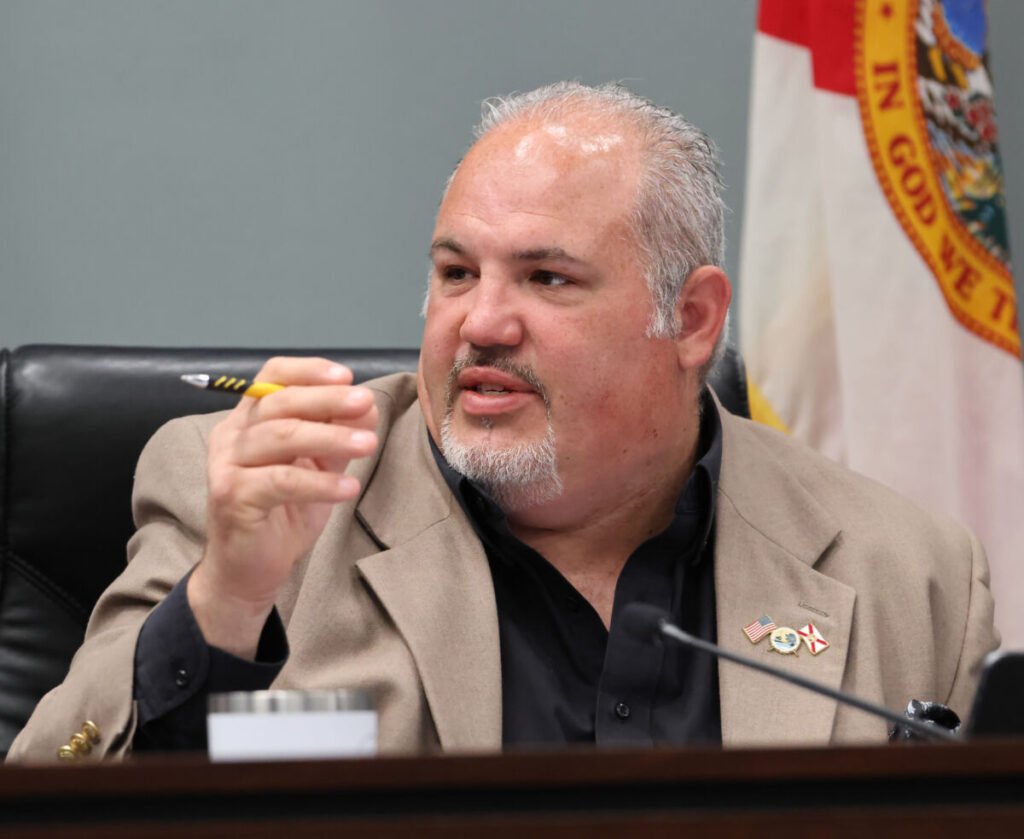
Carl Zalak, the Vice Chair of the Marion County Commission, speaks during a meeting of the Marion County Commission in the McPherson Governmental Complex in Ocala, Fla. on Tuesday, February 18, 2025. [Bruce Ackerman/Ocala Gazette] 2025.
Marion County residents will get two opportunities in the coming to weigh in on whether the county should raise certain impact fees on developers and reinstate others to offset the rising costs of transportation improvements and fire services brought on by new residents and businesses.
The Board of County Commissioners on Feb. 18 considered whether to abide by legislative restrictions limiting the increase of impact fees to no more than 50% unless a supermajority of the board approved doing so and that the county demonstrated an urgent need by showing “extraordinary circumstances.”
Ultimately, the commission decided to claim “extraordinary circumstances” so that they could use greater discretion over establishing how much in impact fees would be assessed without legislative restrictions.
At a Jan. 29 workshop, commissioners reviewed a study that indicated they do have extraordinary circumstances. The question remains whether they will adopt recommendations from a consultant and take steps to implement 100% of the recommended impact fees or set them at a reduced rate.
Since that workshop, county staff offered additional information to consider. Assistant County Administrator Tracy Straub explained that if the county restricted impact fees according to legislative direction to less than 50% they’d also be restricted to rolling out the increase incrementally over a four-year period.
Commission Chair Kathy Bryant said the board had already waited too long to reinstitute fire service impact fees, which were suspended in 2015, and to increase the county’s transportation impact fees. She said the four-year rollout of the fees would delay the collection of revenue the county needs now to meet more than $1 billion in backlogged road .
Commissioner Carl Zalak, who was first elected to the board in 2010, called the current rate of transportation impact fees “a joke” and acknowledged that the commission should have raised them a lot .
Commissioner Matt McClain said he supported increasing impact fees but felt the legislative four-year step-up period allowed the local economy more time to absorb the higher costs. Commissioner Michelle Stone agreed with McClain and said she was not inclined to implement impact fee increases at the levels suggested by the consultant.
Impact fees are one-time assessments on new construction designed to offset the financial effects that new residential and commercial construction have on local infrastructure and public services.
In November, Marion County voters agreed to renew the county’s 1-cent sales tax add-on for 20 years. The revenue generated from the tax served to reduce the impact fees now recommended because it factored in both community needs and other funding .
Impact fees are not collected until building permits are pulled, which means local governments are behind in receiving funds to meet the impacts of the new growth.
Impact fees can be used for capital improvements to meet the needs associated with new development; however, the money cannot be used for prior debt or projects unless “there is a nexus showing use for need due to new growth,” explained the county’s consultant during the Jan. 29 workshop.
Impact fee and sales tax revenue cannot be used for operations costs, which means that growing personnel costs to meet growth needs must be funded elsewhere.
Transportation
The transportation impact fees were calculated on a consumption basis. The consultant recommended the following impact fees for transportation:
| Land Use | Unit | Current Impact Fee | Recommended Calculated Impact Fee |
| Residential single family | 2,000 sq ft | $1,397 | $5,318 |
| Light industrial | 1,000 sq ft | $428 | $2,145 |
| Office | 1,000 sq ft | $676 | $4,766 |
| Retail/Shopping Center | 1,000 sq ft | $676 | $4766 |
Fire/EMS
The impact fees proposed by the consultants were broken into Fire/EMS:
| Land Use | Unit | Current Impact Fees for Fire Rescue or EMS | Recommended calculated Fire Rescue impact fee (countywide except for Ocala) | Recommended calculated EMS impact fee
(countywide) |
| Residential single family 2,000 sq feet | Each dwelling unit | $0 | $744 | $238 |
| Light industrial | 1,000 sq ft | $0 | $190 | $56 |
| Office | 1,000 sq ft | $0 | $401 | $119 |
| Retail/Shopping Center | 1,000 sq ft | $0 | $1,156 | $343
|
Fire service impact fees would be assessed on all new construction outside the Ocala city limits. However, since Ocala relies on the county for ambulance services, those impact fees could be assessed countywide.
The large warehouses and multistory buildings that have been built in Marion over the past 10 years have created the need to have increased training and fire suppression apparatus. Zalak said that since those facilities have implemented additional fire suppression measures, such as sprinkler systems, the board should consider reducing their fire impact fees.
However, an analysis from the Marion County Fire Rescue and the consultant did not support that conclusion because the department is still obligated to respond to a call for service even if the facility has installed a fire-suppression system.
In addition to impact fees paid by newcomers to Ocala, MCFR Chief James Banta is expected to return to the commission with a request to increase fire fee assessments that are part of every property owner’s bill outside the Ocala city limits. These fees can be used for operational costs, which will continue to increase as more personnel are hired to meet the growing population’s needs.
The county’s fire assessment has remained at an average of $199 per household. In the last couple of years, Ocala has increased its fire assessment fee to $364.15 for a single-family home with a square footage between 1,601 and 2,500.
County staff indicated they would address EMS impact fees with Ocala leaders during a joint workshop on March 13.

Support community journalism
The first goal of the Ocala Gazette is to deliver trustworthy local journalism so corruption, misinformation and abuse are not hidden from the public or unchallenged.