
Charting a course
This WWII naval aviator served on missions aboard PB4Y-2 aircraft.
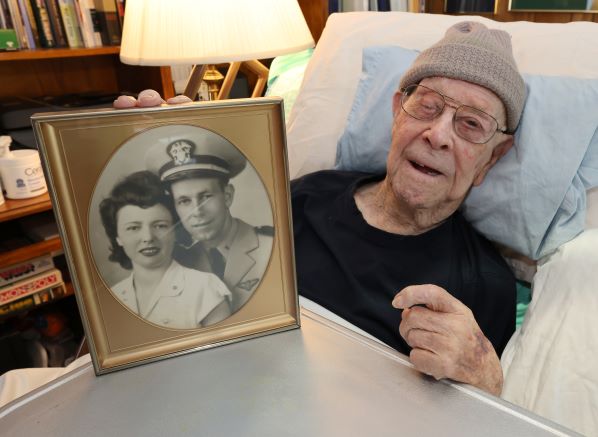
World War II veteran Raymond Charnley, 103, poses with a photo of himself and his late wife, Bernie, taken on their wedding day in 1943, at his home in southeast Ocala, Fla. on Wednesday, May 7, 2025. He served in the U.S. Navy Aviators during World War II, mostly in the Pacific theater, as a co-pilot and navigator. [Bruce Ackerman/Ocala Gazette] 2025.
Ray Charnley, 103, of Ocala, charted his own course during World War II as a naval aviator.
His service included being a copilot and navigator on missions that lasted six hours on PB4Y-2 four-engine patrol aircraft along the coast of Japan, on at least one occasion under enemy fire. He was trained to use a sextant for celestial navigation and the course readings were taken through a bubble on the top of the aircraft.
“Today, a GPS will tell you where you are,” said Charnley, who celebrated his 103rd birthday on Feb. 20, 2025.
Charnley described the PB4Y-2 aircraft as similar to a B-24 four-engine bomber but with a single tail.
According to the Pima Air and Space Museum website, pimaair.org, the PB4Y-2 was used in World War II and as hurricane hunter plane.
“In 1943 the Navy asked Consolidated for a new patrol bomber based on the B-24. The PB4Y-2 design incorporated many changes including a single vertical tail, more armament, low level engines, and a stretched fuselage. The Privateer also had state of the art search radars and navigation equipment giving the aircraft an all-weather capability. By 1945 several squadrons of Privateers were conducting operations from the Philippines to the Aleutian Islands,” the website states.
According to the Naval History and Heritage Command website, history.navy.mil, the airplane was employed by the Navy’s Hurricane Hunters for a time.
Charnley a native of Johnston, Rhode Island, was working as a draftsman at Brown and Sharpe Manufacturing in Providence, Rhode Island, when he enlisted in the U.S. Navy on Jan. 12, 1943, according to military records he supplied.
The 2000 book “Graniteville Went to War (WWII GIs Remember)” is a compilation of a number of veterans’ from around his hometown, including Charnley.
Charnley entered the Naval Cadet Training Program in January 1943 in Connecticut and “education and civilian cleansing” is referenced in the book. He had pre-flight training in Athens, Georgia, primary training in Memphis, Tennessee, and advanced flight training at Pensacola. He was trained in two-engine and four-engine aircraft including the B-24 bomber, the book indicates.
Charnley left in 1945 for overseas duty as a copilot and navigator in PB4Y-2 aircraft and flew from San Diego to Hawaii and then on to a main base on Tinian, Marianas Island.
“Stationed at advance base on Iwo Jima flying weather (flew into eye of hurricane) air-sea rescue (for downed B-29 planes) and reconnaissance missions when war ended,” Charnley stated for “Graniteville Went to War.”
One of Charnley’s two brothers joined the military and was stationed at Hawaii.
“He couldn’t stand Hawaiian music later,” Charnley said.
Charnley married his first wife, Bernie, in 1945. After the war ended, he worked at Quonset Point Naval Air Station in Rhode Island for a year and then they moved to Miami in 1947, where he worked with the United States Geological Survey.
The USGS, “the science arm of the Department of the Interior,” provides “an array of earth, water, biological and mapping data and expertise to bear in support of decision-making on environmental, resource and public safety issues,” according to usgs.gov
According to “Graniteville Went to War,” Charnley and his family moved to Ocala in 1956 and he retired in 1977. Bernie, with whom he had a daughter, Debbie Nuetzi, passed away in 1991.
“My first wife died in 1991, and I remarried in 1995 to (Ella, who passed away April 2, 2025) a 7th generation Florida ‘Cracker.’ I play golf two to five times a week and am enjoying life,” his closing entry in the book states.
Charnley lives with his daughter and her husband, Mark Nuetzi, in southeast Ocala. Debbie, who graduated from Ocala High School in 1969, was born in the Miami area. She said her father saved two youths in danger of drowning in a canal near Miami International Airport in the late 1940s.
Charnley received a token of recognition from the USGS for the lifesaving act, but Debbie described her father as largely shrugging off the heroic act as all in a day’s work. She said he chided the youth to go tell their moms what they’d done.



Support community journalism
The first goal of the Ocala Gazette is to deliver trustworthy local journalism so corruption, misinformation and abuse are not hidden from the public or unchallenged.