
Bomb training scheduled for Ocala National Forest
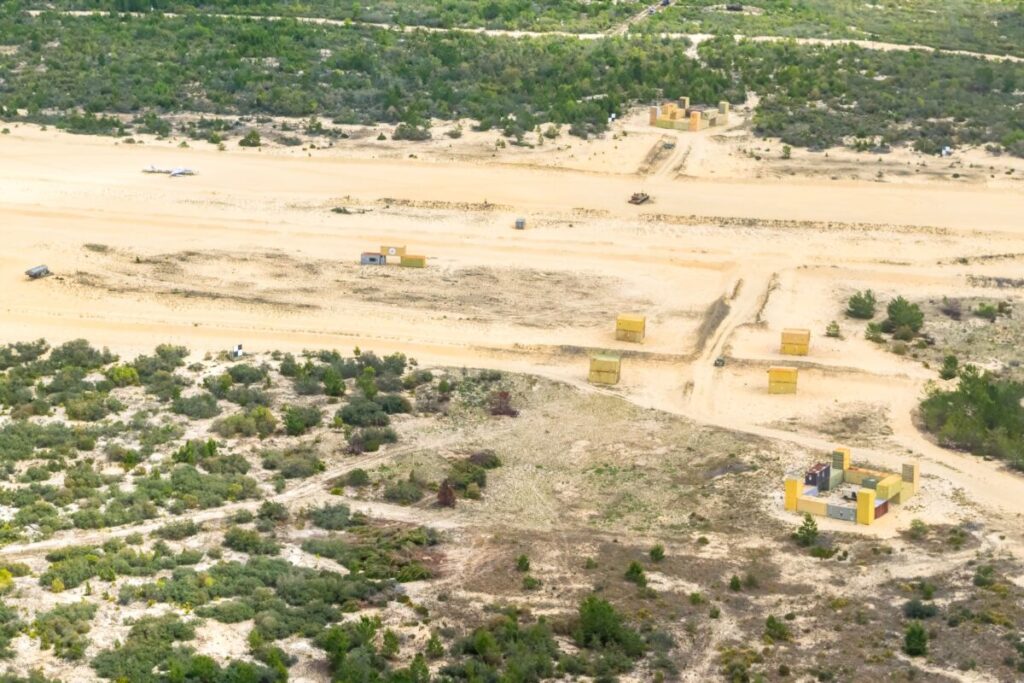
The Pinecastle Impact Range spans 5,698 acres of the Ocala National Forest and is the only location on the East Coast where the Navy trains with live bombs [Michael Warren].
Bomb training has been scheduled for the week of March 24-30 at the Pinecastle Range Complex in the Ocala National Forest.
Live and inert bombs will be dropped during training exercises on March 24 from 1 to 5 p.m., on March 25 from 1:30 to 10 p.m., and on March 26 through 30 from 1 to 10 p.m.
Ocala is the only place on the east coast of the United States where the Navy is authorized to train with live explosives.
Bomb training was briefly halted last month after an exercise went awry—an F-18 dropped a live bomb 6 miles north of its intended target, starting a wildfire in the Ocala National Forest.
During the authorized bombing schedule on Feb. 12, a Navy F/A-18F Super Hornet’s dropped explosive started a forest fire that spread about 20 acres before being contained by the U.S. Forest Service Firefighters.
The fighter jet was assigned to Strike Fighter Squadron ONE THREE ONE (VFA-131) out of the Naval Air Station in Oceana, Virginia, according to Naval Air Station Jacksonville.
Ocala has played a pivotal role in naval operations since the early 1940s, when the War Department acquired more than 40,500 acres of the forest for what was then called the Lake Bryant Bombing and Gunnery Range, according to NAS Jacksonville.
Through World War II, the U.S. Army Air Force Command used this range, as part of the Pinecastle Army Field and Orlando Army Air Base, for rocket missions, bombing practice, ground gunnery and firefighting.
In 1951, the Navy acquired a portion of the range, which has continuously been in operation ever since to help train military personnel.
Today, this unique portion of the Ocala National Forest is used as a training location so military pilots can get real-life training in a realistic environment.
“The Pinecastle Range is the only U.S. East Coast training facility authorized for the release of explosive air-to-surface ordnance, including close air support, an essential factor in air warfare training,” according to NAS Jacksonville.
Synthetic training, such as the use of simulators, is commonly used within the Navy for training. The Ocala National Forest offers a kind of training that cannot be simulated, however, and is instrumental for pilots who specialize in air strikes, according to NAS Jacksonville.

Support community journalism
The first goal of the Ocala Gazette is to deliver trustworthy local journalism so corruption, misinformation and abuse are not hidden from the public or unchallenged.