
Black history in Marion County
Ocala native recalls father and son pioneers in the local Civil Rights Movement.
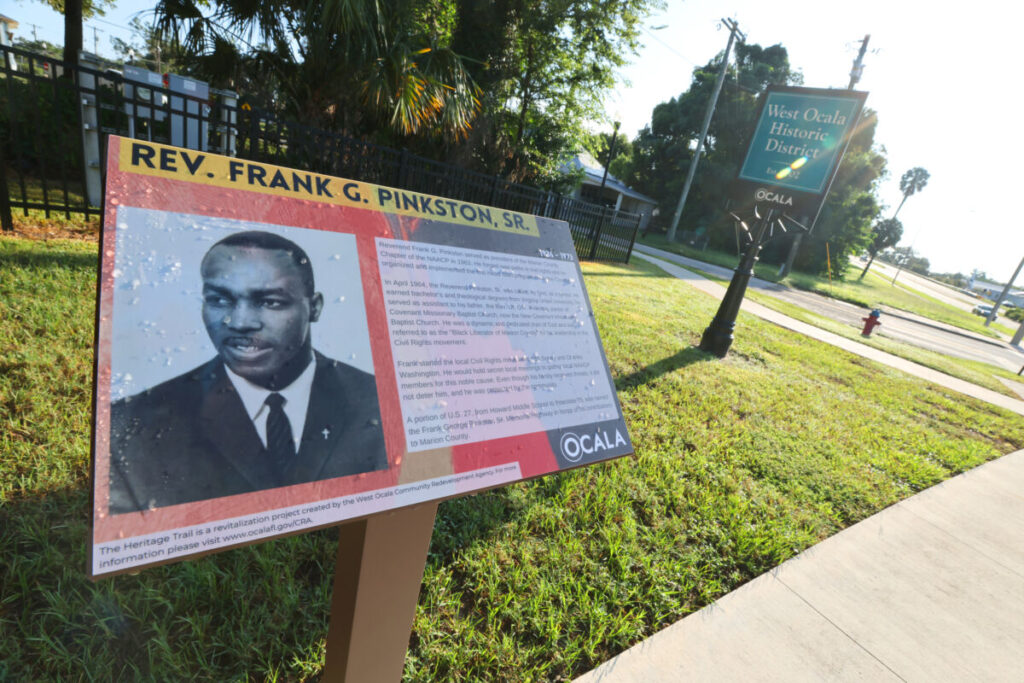
An honorary plaque for the Rev. Frank Pinkston is shown at the Heritage Trail Park on West Silver Springs Boulevard in Ocala. [Bruce Ackerman/Ocala Gazette file photo]
A former Ocala resident and 1960s Civil Rights activist recalled during a recent phone conversation that a pastor, the Rev. Dr. Oliver Van Pinkston, was an unsung hero in Ocala’s fledgling equal rights movement and that his son, the Rev. Frank Pinkston, became a noted local leader.
Dorsey Miller, 83, an Ocala native now living in Fort Lauderdale, said O. Van, at the time the pastor of New Covenant Missionary Baptist Church at 606 SW Broadway St., welcomed him and other area youth who were interested in planning demonstrations in the summer of 1963. The church’s website states that Pinkston served as pastor from 1949 until 1999.
Miller said he helped organize a lunch counter sit-in demonstration at a Pine Avenue drug store for Black patrons in July of 1963 and that Frank became a leader of the local anti-segregation initiative seeking equal treatment for all people in public places.
Frank led mass meetings that attracted scores of youth and extra loudspeakers were used for overflow crowds, according to Miller.
Miller said that while he considers Frank to be “Ocala’s own Martin Luther King Jr.” he feels that O. Van is often not properly credited for his role.
“Rev. O. V. Pinkston is the real unsung hero of the Civil Rights Movement in Marion County,” Miller said in a Feb. 22 phone interview.
“During the 1960’s, Covenant was a ‘beacon of light’ and headquarters in the fight against racism and injustice shown against our people. These efforts produced many leaders who blazed the way and the people responded in mass numbers,” according to the church’s website. “Covenant became active in all related organizations: District, state and national congresses and conventions and we still continue as active participants.”
Miller graduated from then segregated Howard High School in 1961 and left the area to attend Morehouse College in Atlanta. He returned to Ocala on a school break during the summer of 1963. He said the Ocala sit-ins came about after he met with Charles Washington, a youth leader from Haines City, who was going to Hampton Junior College in Ocala. He said they sought a base of support for local youth and students.
Miller said the Student Non-Violent Coordinating Committee (SNCC) was active in Dunnellon and it was unclear why the Civil Rights Movement was not active in Ocala.
“We went to the (Marion County) NAACP,” Miller said. He said the president explained that the group “only had seven members” and there appeared to be no prospect of starting a youth group.
Miller said when he and Washington left the NAACP president’s office they were on Broadway Street across from New Covenant MBC and thought they’d ask the pastor, Rev. O. Van Pinkston, if they could use church rooms for their meetings.
“He didn’t hesitate,” Miller said.
An initial mass meeting drew about 200 youth, Miller indicated.
“We needed an adult leader to get the NAACP fired up and lead the fight, someone respected and with the power to lead,” Miller said.
He called Frank Pinkston, who was 27 years old in 1963, “dynamic” and “charismatic.”
Miller estimated that it was around June of 1963 when Frank became president of the Marion County NAACP. He said a youth council was formed and Washington was elected president. Miller was vice president and David Rackard was named secretary.
Miller, Washington and Rackard arranged three lunch counter sit ins to be held on a Saturday in late June of 1963 at Liggett’s Drugs in the Pine Avenue Shopping Center, McCrory’s at Magnolia Avenue and Broadway Street and the Marion Hotel.
McCrory’s and the Marion Hotel closed to avoid a confrontation, but at Liggett’s Drugs, where Miller led about 25 students to be served at the lunch counter, he said the manager asked him aside to speak privately with the president of Liggett’s Drugs via phone.
“The president of Liggett’s said if we left peacefully he would see to it that the counters were desegregated by Monday. We left and they were desegregated,” Miller said.
A Sept. 4, 2024, “Gazette” article described the opening of the Heritage Trail Park in West Ocala, which features plaques honoring figures from the African American community, including Frank Pinkston.
The plaque hails him as the “Black Liberator of Marion County,” who, along with Sonny and Charles Washington, “started the local Civil Rights Movement” with “secret meetings” to gather NAACP members.” The plaque states that he was “not deterred” by threats “to himself or his family.” Frank was born in 1936 and passed away in 1973, according to the article.
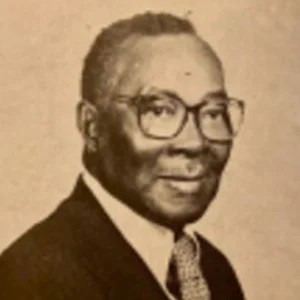
Fred Pinkston, 91, of Atlanta, is Frank’s brother. He served in the U.S. Army from 1957 to 1959 and later moved to south Florida. Fred said the family of seven siblings lived near the current Silver Springs State Park.
Fred said his brother Frank graduated from segregated Howard Academy in 1953 and then attended Virginia Union University and attained a bachelor’s degree in engineering and a master’s degree in theology from the school’s seminary. He also said his brother was a student leader in the Richmond 34 protest while in Virginia.
According to the Virginia Commonwealth University website, “on Monday, Feb. 22, 1960, 34 Virginia Union University students were arrested at Thalhimers department store on Broad Street for refusing to leave its Richmond Room restaurant. The sit-in was just one of many that hundreds of students were taking part in that day in a stream of protests aimed at challenging the discriminatory practices that barred African Americans from certain Richmond businesses. The arrests and the impact of the student sit-ins helped to change those discriminatory practices. (The protest)…was a very peaceful protest and before some of these others. However, it became overshadowed because of some of the more violent arrests and protests that happened deeper in the South,” the article states.
Fred said the mass meetings held by his brother gave a “boost” and were motivational for those attending. He said famed Civil Rights figure Ralph Abernathy spoke at one of the meetings here. He also said his brother was “threatened by the (Ku Klux) Klan.”
Published articles give details of a group of Black men with weapons, known as the Ocala Hunting and Fishing Club, who served as security guards for Frank and his family. In an April 39, 2014, University of Florida Samuel Proctor Oral History interview, Lucious Connell Stevenson said the group of five or six would “watch over” the youth council after marches from outside the church, escort the Pinkston family at night and remain at the family’s property in Silver Springs until the next morning.
“Narrators who were part of the youth movement in the 1960s spoke about how they felt protected. They also discussed the training they received on how to protest and learn how to not retaliate if provoked,” the opening of the oral history project states.
Meanwhile, Miller said a “lot of change” came out of the movement here.
“There was some pushback, but people began to work well together. There was not a whole lot of violence (in racial protests here in the 1960s) and that’s a tribute to the Black and white communities,” Miller said.
Miller said he has concerns about the political climate on national and state levels, but he hopes people will continue to work together and build on what was accomplished 60 years ago.
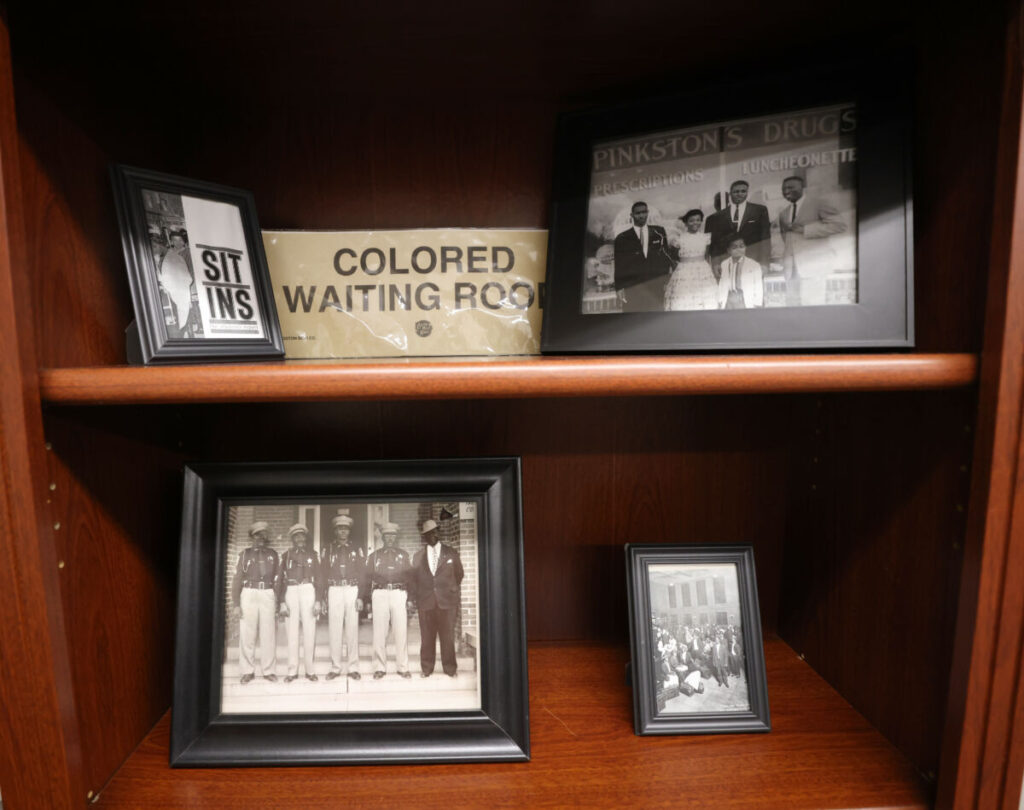
family, during the grand reopening of the Black History Museum
of Marion County at the Howard Academy Community Center in
Ocala on Nov. 16, 2021. [Bruce Ackerman/Ocala Gazette file photo]
Area resources
Black pioneers who helped shape Marion County are honored in the Heritage Trail Park in West Ocala. The park, which stretches along the north side of State Road 40 from Northwest 9th Avenue to Northwest 11th Avenue, has a sidewalk lined by eight, 48-inch by 96-inch weather resistant art panels with portraits of honorees by local artist Charles Eady. There also are 16, 12-inch by 18-inch plaques that describe the accomplishments and contributions of additional local honorees. To learn more, go to ocalafl.gov
The Black History Museum of Marion County is located inside the Howard Academy Community Center at 306 NW 7th Ave., Ocala. It contains a wide array of information about local and national people and events. To learn more about the museum, call (352) 671-4175.

Support community journalism
The first goal of the Ocala Gazette is to deliver trustworthy local journalism so corruption, misinformation and abuse are not hidden from the public or unchallenged.