
All fired up
Visitors to Ocali Country Days on Nov. 9 and 10 will have an opportunity to see potter Deb Sands loading and stoking a wood-fired kiln.
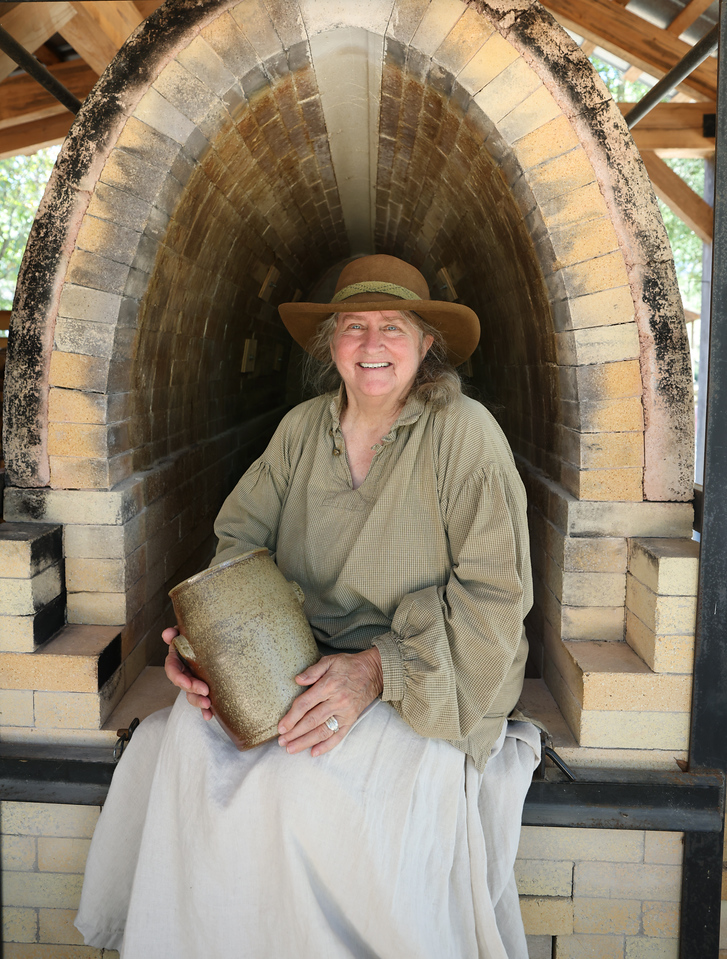
Deb Sands of Deb Sands Pottery poses in the wood-fired kiln in the Cracker Village at the Silver River Museum at Silver Springs State Park in Silver Springs, Fla. on Thursday, Oct. 24, 2024. Sands will be firing the wood-fired kiln during Ocali Country Days on Sunday, Nov. 10, 2024. [Bruce Ackerman/Ocala Gazette] 2024.
|
Getting your Trinity Audio player ready...
|
Deb Sands’ sky-blue eyes, soft voice and gentle demeanor belie the fact that she is a tough-skinned tamer of one of the world’s oldest mechanisms for producing functional wares and decorative pieces—a wood-fired kiln.
It was Sands, who, in 2016, mentioned to Scott Mitchell, a coordinator with Marion County Schools who works at the Silver River Museum & Environmental Education Center inside Silver River State Park, that the Pioneer Village on the property needed such a kiln.
“Deb started with the museum as a historical pottery making demonstrator in 2014 or 2015. She is a very talented artist and knows a great deal about historic stoneware ceramics. Her historically accurate display and pottery wheel are fascinating, and she’s great at sharing her knowledge with guests,” Mitchell noted.
“In 2016 Deb suggested we build a wood-fired kiln here to teach school students and visitors about pioneer skills and local history. The kiln was completed in 2017 and has been an important part of the museum program since. We don’t know exactly how many wood-fired kilns there are in Florida, but there are not many. Ours is unique in that it primarily serves as a teaching center and is not commercial in nature,” he added.
Sands and her kiln, named Lasair, which she said is the Gaelic female name for flame, will be a key part of the Ocali Country Days festival that will be held at the museum campus on Nov. 9 and 10.
“In 1995, the Ocala National Forest Historical Interpretation Association donated and moved several replica pioneer buildings, such as the Godwin House and the pioneer schoolhouse/church, from Camp Kiwanis to the Silver River Museum. That same year the first museum Pioneer Days was held as an educational fundraiser. The festival, now called Ocali Country Days, has happened every fall since then and this is the 30th year,” Mitchell said of the history of the event.
“Ocali is a historic name for the native Timucuan people, or possibly the name of their main village, who lived in what is now western Marion County. The name was recorded by early Spanish explorers in the 16th century. The word was later adapted to become ‘Ocala.’ We call our festival Ocali Country Days because it recognizes our first inhabitants but also celebrates how pioneers made a new life in the countryside of what is Marion County,” Mitchell explained.
Among the many displays at the Pioneer Village and inside the museum are numerous examples of vintage pottery items that would have been used in everyday life in those early days. In the gift shop, visitors can purchase cups, bowls and small jugs made by Sands and fired inside the kiln on the property.
Getting from the point of creating pottery to go into the kiln until it is fired and unloaded several days later is a very laborious labor of love for Sands, who does it all on a volunteer basis.
“I call her Lassie,” Sands said of her pet name for the kiln, “and sometimes she’s very good and sometimes she’s very particular.”
The journey
Sands, who was born on an air base in Tampa, said she began to learn the art of weaving from her great-grandmother when she was 5 years old. It was 30 years ago that she took a six-week pottery class.
“I’m still a weaver, but now I play with mud more than I do fiber,” she said.
She often participates in “pre-1840 living history events, so everything I make has to represent before 1840. Back then it was more function than art. Ring bottles, also called flasks or harvest jugs, representing 1700s colonial America, are among the styles I make.”
Sands was teaching pottery to Boy Scouts at Camp Daniel Boone in North Carolina around 2010 when she met Mitchell, whose son was attending the camp. When he learned that she lived in Florida, he invited her to come and demonstrate the skill during Ocali Country Days.
Sands, who had been living on Sanibel Island on Florida’s west coast, eventually moved to Fort McCoy.
“I moved from the island to the woods,” she said.
In the interim, Sands met her significant other, Hank Steinmetz, a blacksmith from Ohio. Now, she calls herself a “reverse snowbird” and spends summers in Ohio and winters at her cottage in Marion County.
While in Ohio this summer, Sands threw more than 100 items of pottery that will be fired in the kiln in Ocala during the upcoming festival.
Taming the beast
One thing is sure, when you are in control of an apparatus that “comes to temperature” at 2,350 degrees, you had best know what the heck you are doing.
The firing journey begins with amassing at least two cords of dried wood, and Sands prefers oak that has been locally sourced. When it’s time, her works, along with those of three other local potters, can be loaded into the kiln. She has to climb inside the kiln and patiently—and very gently—secure the pieces onto a series of shelves, moving from the back to the front as she goes, which takes about six hours.
The next step, which often begins around 4 a.m. on firing day, involves building a coal bed at the front of the kiln.
“The fire box comes out and you put the wood down there and start the fire. That takes about four hours. Once we get the coal bed going, we start stoking it. There are three grates that are 2-inch solid steel by 48 inches long. We’ll start with eight to 10 logs and stoke eight to 10 minutes. As temps increase, we stoke a bit faster, eight to 10 logs maybe six to eight minutes and when we’re getting really close to temperature, it’s eight to 10 logs every two minutes. We’re watching the chimney; you start with clear heat coming out, then white smoke, then grey smoke and then it gets flames,” she explained of the process that takes about 12 hours to complete.
The temperament of Lassie depends a lot on the quality of the wood, the weather and other factors, most of which Sands said she has learned by doing.
Sands, who has an electric kiln in Ohio, explained that the unique coloring of items cured in the wood-fired kiln come from the “flames dancing around the pots and licking them and the ash landing on them, which creates a glaze. You can look through the dampers and see it and it’s all magic. It gives me goose bumps. When it’s firing, it sounds like a blast furnace. There is so much pressure in there!”
Once the kiln has “reached temperature,” it gets some final stoking and then is left to “cook” for four or five days and then “we open it and see what happened,” she said with excitement.
Check it out
Visitors to Ocali Country Days will be able to see Sands loading the wood-fired kiln on Nov. 9. She will be there early Nov. 10 to begin the firing process, which, she said, if the conditions are good, should result in the kiln coming to temperature around 2 p.m. that afternoon.
“Deb has taken it and run with it. I think each kiln has its own personality and, over the course of multiple firings, she really knows the ins and outs of it,” Mitchell said.
When asked why she does such demanding work on a volunteer basis, Sands stands a bit taller and replies, with her voice steadily rising: Why? Because it’s a wood-fired kiln! When you see it, you’ll know why!”
Ocali Country Days offers numerous demonstrations of time-honored skills, entertainment, food trucks, visits to the museum and tram tours of the state park.
Mitchell noted that in addition to seeing the kiln in action, some of his other favorite activities are “the demonstrations of sugar cane syrup making and cooking over an open hearth with cast iron. Both of these activities would have been ordinary in the past but are fairly rare now. They require skill and hard work and yield good things to eat!”
He noted that, “with support from the Marion Cultural Alliance and National Endowment for the Arts, the Silver River Museum has been able to bring in additional musical talent to perform and we are bringing the large stage back to the museum lawn and looking forward to great live music both Saturday and Sunday.”
The Silver River Museum & Environmental Education Center is located at 1445 NE 58th Ave., inside Silver River State Park. Once parking areas at that entrance are filled, guests may be directed to park at the main park entrance, where they can take a tram to the other side.
The cost to attend Ocali Country Days is $10 per person, with ages 5 and younger admitted at no charge. All proceeds help support educational programs at the museum.
For complete details, go to silverrivermuseum.com/event/2024-ocali-country-days



Support community journalism
The first goal of the Ocala Gazette is to deliver trustworthy local journalism so corruption, misinformation and abuse are not hidden from the public or unchallenged.