A good sign
Deaf and hard of hearing students in Marion County Public Schools have access to ASL interpreters as well as specialized tools to facilitate learning.
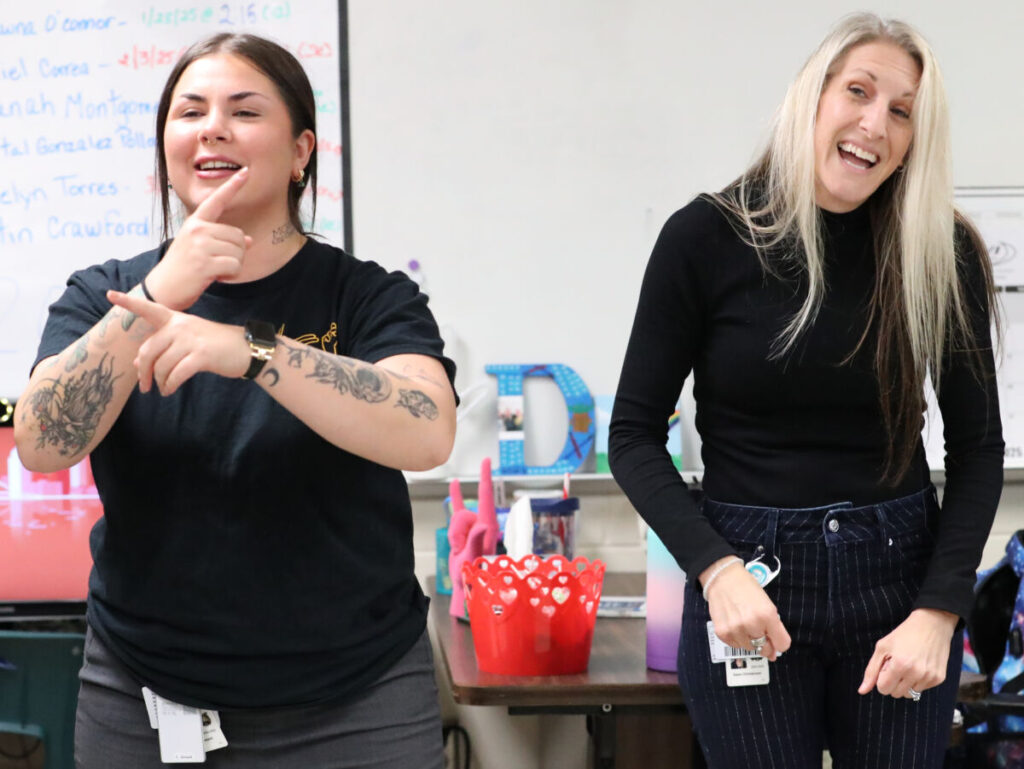
Luisa Seward, left, and Dawn Christerson, right, who are both American Sign Language interpreters, sign for students as they play a game called “Heads-Up,” which is similar to Charades, in the Cat Period for Deaf and Hard of Hearing students at Forest High School in Ocala, Fla. on Thursday, February 20, 2025. [Bruce Ackerman/Ocala Gazette] 2025.
Marion County students who are deaf or hard of hearing don’t have to live at a boarding school for the blind and deaf like the one in St. Augustine. They can get their education right here, close to home, with the assistance of certified American Sign Language interpreters on staff with the Marion County Public School System.
Currently, 80 deaf or hard of hearing students attend Marion County Public Schools, said MCPS Director of Public Relations Kevin Christian. The district has 21 full-time ASL interpreters and 10 substitutes supported by the district’s budget, plus extra funds for the purchase of specialized sound systems and other assistive technology, Christian said.
In addition to ASL interpreters, the local district uses a variety of specialized tools to assist the hard of hearing. For students who already have frequency modulation (FM) auditory systems, cochlear implants or hearing aids, the teacher speaks into a small microphone that hangs on a lanyard around the neck or is clipped to the collar. Closed captioning also helps when using videos, Christian noted.
“I’m glad we can do it for our students,” he said. “The goal is for those students who have hearing deficiencies to integrate into the classroom with those who don’t have a deficiency, so all of them can learn together. If those students can function in the classroom, that is the best place for them to learn.”
“Columbia University News” reports that in the United States, 85 percent of deaf and hard of hearing students attend mainstream schools along with their hearing peers. Since the 1970s, federal laws have encouraged the inclusion of the deaf or hard of hearing in general education environments where hearing technology has become more advanced, the CU web site stated.
Mainstreaming hearing disabled students also has a positive social impact, noted Deborah Flagg, district lead educational ASL interpreter. Flagg said the program was already in operation when she hired on 26 years ago. In Marion County, students are grouped with other deaf and hard of hearing peers in three hub schools—South Ocala Elementary, Osceola Middle and Forest High School. For those who attend outlying schools, the district also places interpreters at those sites as needed, Flagg said.
“We really encourage students to go to the hub schools so they’ll have socialization and so they don’t feel isolated,” Flagg explained, adding that the program was already in operation when she hired on here 26 years ago.
“It was already up and running when I got here,” she said. “We’ve fine-tuned it and made a lot of improvements over the years. Our interpreters are more qualified. Our program takes everybody who is hard of hearing, including the intellectually delayed. We have a vast variety of students and abilities.”
Flagg is hoping for even more improvements in years to come.
“I’d like to see the Department of Education make more specialized curriculums,” she said. “It would be nice to have ASL from kindergarten up.”
According to a Boston University School of Education study, about 90 to 95 percent of deaf children are born to parents who don’t know sign language and won’t be able to use it effectively before the child enters school. Gallaudet University for the hearing disabled estimates that only 40 percent of families with deaf children use sign language at home.
“We become their models,” said Flagg. “That is why it’s critical that we have interpreters who are qualified.”
To become certified, ASL interpreters are required to first have a bachelor’s degree or qualify through an alternative pathway, Flagg said. Interpreters get screened when they’re interviewed and must meet at least a 3.0 on their educational interpreter performance assessment. During their tenure they are encouraged to work toward improving their skills to a 4.0, Flagg said.
As for further education, hearing disabled graduates have two main options, said Flagg. One is Gallaudet University, a four-year degree program in Washington, D.C., and the other is the National Technical Institute for the Deaf, a two-year program on the campus of the Rochester Institute of Technology in Rochester, New York. In order to attend these schools, students must be fluent in ASL, Flagg said.
For the educators, the rewards abound, Flagg added.
“The best thing for me, because I’ve been doing this for so many years, I’ve seen some of my ex-students’ children come through the program,” she said. “Some disabilities are genetic. It’s always a thrill to see the children of the students I had or see some of my students out in the community as adults.”
Luisa Seward, an ASL interpreter at Forest High School, agreed that the job offers numerous rewards.
“Being able to work directly with kids who are so bright and so wise for their age, I couldn’t be more grateful than to be a part of their academic journey,” Seward said. “Some of my favorite moments have been seeing the younger students apply a new sign in their vocabulary and seeing how exciting it is for them. For our older students, it’s about seeing them fully grasp the concept of something and complete the assignment or activity to perfection. It is such a rewarding experience to see them light up knowing they put in all their efforts. These kids have been an absolute blessing to my work as an interpreter. They’re an absolute joy to work with.”
To learn more, go to marionschools.net and type “Deaf and Hard of Hearing Program” in the search bar.



Support community journalism
The first goal of the Ocala Gazette is to deliver trustworthy local journalism so corruption, misinformation and abuse are not hidden from the public or unchallenged.