
Helping at-risk children succeed
Marion County Public Schools assists students who are considered homeless and the public can help through a supply drive currently underway.
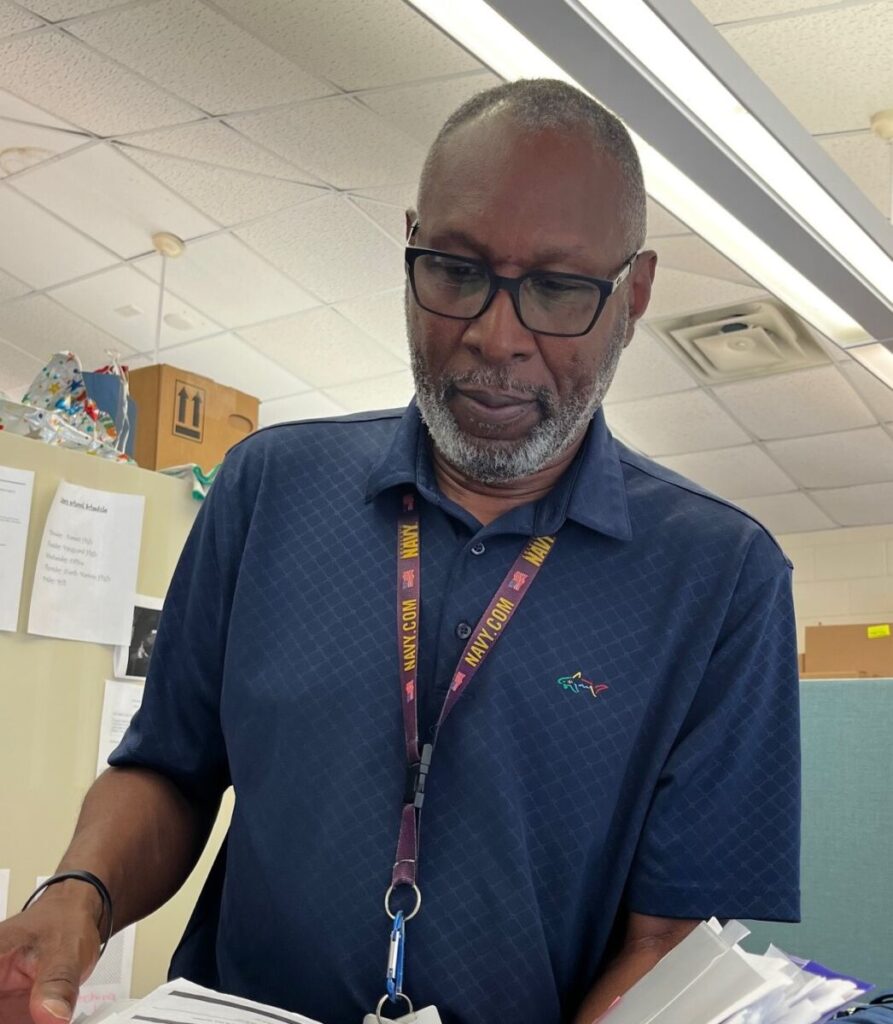
Tom Butler, Marion County Public Schools mental health and wellness/district homeless liaison, looks over files in his office at the Fordham Early Learning Academy. [Photo by Andy Fillmore]
How widespread is the lack of stable housing in Marion County? It depends on who you ask.
The U.S. Department of Housing and Urban Development’s annual “point-in-time,” or PIT, count taken in January indicates that an estimated 391 people were homeless and living shelters or unsheltered outdoors in Marion County.
Yet Marion County Public Schools considered that 1,556 students—nearly four times the HUD one day count—were homeless last school year.
Tom Butler, the MCPS mental health and wellness/district homeless liaison, stated in an email that students may be “living in cars, tents, hotel/motel, living with relatives and friends in the community.”
The Florida Department of Education website details a federal act that dates to 1987 and defines student homelessness and sets guidelines to ensure they have access to classes and school programs.
“The Federal McKinney-Vento Homeless Assistance Act (Pre-K-12) states that children and youth who lack a fixed, regular and adequate nighttime residence are considered homeless. The McKinney-Vento Education for Homeless Children and Youth Program is designed to address the problems that homeless children and youth face in enrolling, attending and succeeding in school,” according to the website.
Under the McKinney-Vento Act, homeless students have the right to continue at their original school before they lost their housing, enroll and attend immediately, receive transportation and participate in school programs for which they qualify.
HUD has four categories of homelessness, the first defines an individual or family who lacks a fixed, regular and adequate nighttime residence. Three additional categories focus on imminent risk of homelessness, homelessness by statute such as certification by a nonprofit as homeless and fleeing from domestic violence.
“Once a student is identified as homeless, the liaison may provide the child with support in the form of school supplies, clothing, personal hygiene items, emergency food and other individual needs as identified. The liaison also coordinates with community agencies and civic groups to meet the needs of homeless children and their families,” the MCPS website indicates.
Butler provided data that breaks down the living conditions of the 1,556 verified homeless students for the 2024/25 school year: 102 students were living in emergency or transitional shelters, 1,007 were sharing housing due to hardship, 133 were in temporary living conditions such as cars or parks and 314 were living in hotels and motels.
Butler and staff interview families to verify the student’s housing status and then provide the proper assistance. He and staff members, whose numbers were reduced due to budget from seven people two years ago to two going into school year 2025/26, register the homeless students and provide their families a range of assistance from breakfast and lunch at school to student transportation, possibly even to a neighboring county, to tuition for the first two years of college.
Federal funds are provided to schools by the McKinney-Vento Act and donations from churches and private donors.
“The budget for 23/24 was $259,461 and for 24/25 was $118,800. For the upcoming year the budget has been projected to be the same, $118,800. No other program funding is projected for the upcoming year of 25/26. Additional funding will come from community-based organizations,” Butler wrote in an email.
He also noted the success of the efforts.
“We had 64 out of 68 homeless students to graduate during the 24/25 school year and 34 of these students were accepted at colleges,” Butler stated.
Butler said he sees his job as more than an administrative position: “It’s a ministry.”
He is a veteran of 11 years’ service in the U.S. Navy, ordained non-denominational pastor and pastor of the New Beginnings Worship Center in Coleman, and social worker with a master’s degree. He has been with MCPS since 2007 and has held his current position since 2018. He also is a member of the board of the Marion County Continuum of Care, which is a coalition of dozens of local agencies and nonprofits that provide resources for the homeless.
Karla Greenway, CEO of the nonprofit Interfaith Emergency Services, one of the largest help agencies in the county, has worked to uplift the local homeless community for decades
“I believe that the way the school district counts homelessness is actually way more accurate than the way we counted for HUD for the pit count,” Greenway stated.
“MCPS counts people living in hotels and other temporary resources like that. They count people who are living on someone else’s couch. So, their numbers are truly more accurate as far as families that do not have permanent stable housing. And when you compare the numbers, there’s a huge difference. I’ve just always thought that number was much more telling of the real picture in our community of families in this situation,” Greenway wrote.
Keisha is a single mom with two school-age children. She is living in an Ocala emergency shelter after becoming homeless due to medical and employment issues. She said her children have been verified as homeless for the MCPS homeless liaison office by a letter from the emergency shelter and were entered into the system. One child attends elementary school and the other is in high school. The children have remained at their original schools and “missed no school,” she said.
The school (MCPS transportation department) makes sure the children are transported to and from the shelter. They receive breakfast and lunch at school and were provided some school supplies. Backpacks were provided by the Food 4 Kids program.
“It’s worked well,” Keisha said, adding that she would like to see the public support the homeless student outreaches.
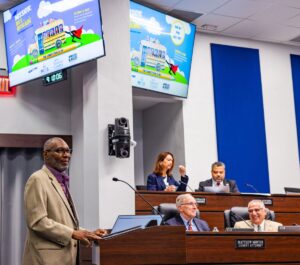
Tom Butler made a recent presentation to the county commission to help kick off the Bus Brigade School Supply Drive to collect needed school items for homeless students. [Photo courtesy Marion County Public Relations]
HOW YOU CAN HELP
The county teamed up with Butler and MCPS to roll out the Bus Brigade School Supply Drive to collect needed school items, including clothing, for homeless students. The drive kicked off at the July 1 MCBCC meeting and will run through the end of this month. Donations will be presented to MCPS at the Aug. 5 MCBCC meeting. County departments will conduct a “friendly competition” to gather the most supplies.
The public can help by taking supplies to any one of dozens of facilities throughout Marion County.
“This is a huge endeavor, and we encourage our community to drop off supplies at our county locations to help support it,” County Commission Chairman Kathy Bryant said in a news release. “There are many supply drives this time of year but this is the only one that directly benefits students in our public schools who are homeless. We’re looking forward to our first meeting in August and have a goal of collecting more than 30,000 items.”
Requested items include:
Filler paper (wide and college ruled)
Spiral notebooks (1-, 3- and 5-subject)
Colored pencils, markers (wide and thin)
Erasers, rulers, glue sticks
Graph paper, zipper binders
Pens (blue and black), scissors (blunt and pointed)
Index cards, pencils (#2 wood)
Hygiene products, deodorant (men and women)
Calculators (regular and scientific)
Duo-tang folders with prongs and pockets
Alarm clocks (electric)
Backpacks (any grade level)
Composition books (wide and college ruled)
Pencil boxes (small and large), zippered pencil pouches
Crayons (24 packs), flash drives
New clothing items (socks, underwear, etc.)
Laundry detergent
Drop-off locations:
Administration and commission office, 601 SE 25th Ave., Ocala
Animal Services, 5701 SE 66th St., Ocala
Building Safety, 2710 E. Silver Springs Blvd., Ocala
Community Services, 2710 E. Silver Springs Blvd., Ocala
Extension Service, 2232 NE Jacksonville Road, Ocala
Human Resources, 521 SE 26th Court, Ocala
Office of the County Engineer, 412 SE 25th Ave., Ocala
Parks & Recreation, 111 SE 25th Ave., Ocala
Utilities, 11800 SE U.S. Highway 441, Belleview
Veterans Services, 2730 E. Silver Springs Blvd., Unit 100, Ocala
All Marion County fire stations
“On behalf of MCPS and our Families in Transition program, we thank the community for supporting the hundreds of homeless and economically challenged students we serve. Giving them a new backpack and school essentials is about more than just supplies—it’s about restoring dignity and giving hope. With every donation, we’re not only changing a child’s life—we’re helping shape the future of Marion County,” Butler stated in the release.
To learn more about the drive, go to marionfl.org/our-county/mission-bus-brigade

Support community journalism
The first goal of the Ocala Gazette is to deliver trustworthy local journalism so corruption, misinformation and abuse are not hidden from the public or unchallenged.