
‘Mr. Ma’ leads the way for Marion manufacturers
For nearly three decades, the Mid-Florida Regional Manufacturers Association has worked to build the area’s manufacturing base.
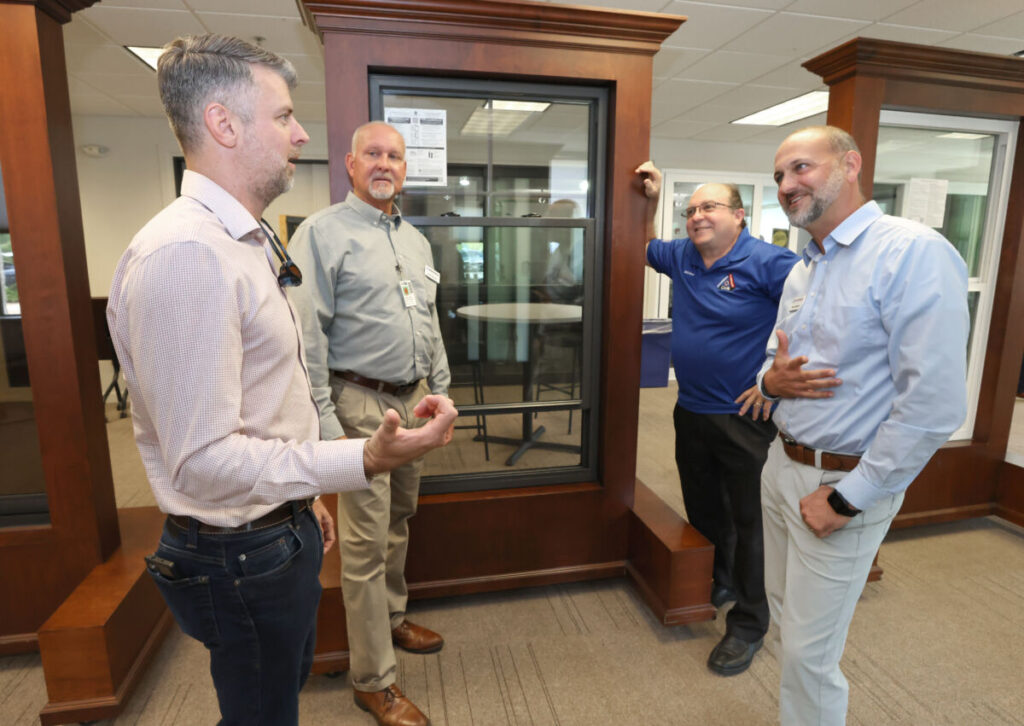
Members of the Mid-Florida Regional Manufacturers Association, from left, Vice President Phillip Schuster, President Mitch Twardosky, board member and associate professor at CF Sam Ajlani and Program Chair Brian Ballard, talk during a tour of Custom Window Systems in Ocala on June 12, 2025. [Bruce Ackerman/Ocala Gazette] 2025.
In March 2020, Brian Ballard stepped out of a Mid-Florida Regional Manufacturers Association tour of a local manufacturing plant to find the world had been turned upside down.
“When we walked out of that tour, everything had changed during that hour,” he recalled. “You went from wondering what was happening to all of a sudden realizing everything just got shut down. It was scary, it was disruptive. There was so much unknown, there was so much misinformation.”
As COVID-19 shut down the nation, MRMA became Marion County’s lifeline for manufacturers.
“I felt like MRMA came in and was an incredible steadying voice of collecting information, boiling that down to what is really going on and what do people in our industry really need to know, how can they react, where can they go to get masks, other PPE supplies. They just did a great job helping our members navigate through that,” Ballard said.
“Manufacturing was listed as an essential job. So, all of these places were still trying to work and navigate and communicate to their employees and get the materials that they needed. And it was scary, disruptive,” he said.
From that moment of crisis to its three-decade legacy, MRMA has been the backbone of Ocala’s industrial might, forging opportunities and resilience for a community on the rise. For 23 years, MRMA has united manufacturers, logistics providers and educators to drive economic growth.
Ballard is part owner of Express Employment professionals and has been a part of MRMA since 2010. He joined the board in 2012, as program chair, and has served in that role ever since.
According to its website, MRMA was formed in 1992 as a means for local manufacturing executives to meet and network with each other monthly. Membership was initially limited to presidents, general managers and chief operations managers of manufacturing firms.
Despite its small size, the group established the organization legally, drafted bylaws and generated enthusiasm for a regional manufacturing association. Since the mid-‘90s, membership has opened to all employees of member companies. This allows workers at any level, from production floor staff to management, to engage in MRMA’s events, such as best practice tours or seminars.
“When MRMA was originally formed, it was just to try to find an avenue for local executives who were in that industry space, to have a place to start coming together with people that understood and spoke the language, understood the problems, the challenges and then find ways to kind of work through some of those things together,” Ballard said.
“It was a much smaller group at that time and had a much more singular focus of just giving those executives a space to be able to just share and collaborate over time as they continued to expand, especially when it came to identifying and recognizing the needs for training and development of the workforce,” he said.
MRMA has since grown into a vital resource spanning Marion, Levy, Citrus and Sumter counties.
Sam Ajlani is an associate professor of Business, Technology and Agricultural Sciences at the College of Central Florida and has been a member of MRMA for more than 10 years.
“I’m one of the senior people because I’m over 10 years on the board, but I’m the education liaison, so I’m a non-voting member,” Ajlani said.
Ajlani affectionately dubs the Mid-Florida Regional Manufacturers Association “Mr. Ma,” giving the acronym, MRMA, a folksy charm that makes it sound like a trusted old friend in Marion County’s industrial scene.
A GROWING DRY PORT HUB
Ajlani highlights MRMA’s role in connecting companies to share knowledge and resources, particularly in the context of Marion County’s growth as a dry port hub. According to him, Ocala serves as a vital inland distribution hub, or dry port, attracting major companies including Amazon, FedEx and Chewy because of its strategic location for warehousing and supply chain operations.
“We’re trying to get manufacturers together so they can share resources and share knowledge. There’s a lot of networking going on, and that’s part of ‘Mr. Ma’s’ role in the community, to help provide networking between companies so they can all benefit from everyone’s knowledge,” Ajlani said.
This underscores MRMA as a platform where businesses, from manufacturers to logistics providers, collaborate to solve problems and access vendors.
Phil Schuster, accounting manager at Phoenix Wood Products and an MRMA board member since 2012, emphasizes this collaborative culture.
“MRMA really feels like family. We have a lot of fun together and the group is so close-knit that it’s easy to share different opinions without tension. Everyone knows we’re working toward the same goal, so there’s a lot of trust and openness. That kind of culture makes it easy for manufacturers to connect, collaborate and support each other, all to the benefit of our community,” Schuster said.
According to Ajlani, MRMA was heavily involved in working to help alleviate some of the recent challenges of hiring workers for high-skill, high-wage jobs. He says it has become more of a challenge in the past 10 years, alongside the timing of when Marion County became a dry port hub.
Marion County was designated a dry port hub eight years ago after a third-party audit by the chamber of commerce, according to Ajlani. This attracted companies like FedEx and Amazon, increasing job opportunities. However, the local population had not grown, so employers were competing for a limited pool of workers. While some employees came with the companies, most were hired locally, shrinking the available talent pool even further.
“It was a challenge from almost 10 years ago, even before that because nationwide, there’s been a shortage of high-skill, high-wage folks to come in and do a job in manufacturing. But here, being a heavy industrial base, it’s pretty tough,” he said.
According to Schuster, one challenge that most manufacturers share is worker quality and availability.
“This issue seems to be a consistent concern across the manufacturing sector,” he said.
According to Ballard, Rob Adamiak, former executive director and training director of MRMA, recognized the isolation faced by industry leaders and the absence of a collective voice for manufacturers.
“There were two primary areas that (Adamiak) was very passionate about: creating that space for these executives to be able to share and collaborate because leadership can be very, very lonely. The other aspect of it was the recognition of, ‘Wow, there was a lot happening from a legislative standpoint and there was no cohesive voice representing the manufacturing industry,’” he said.
Ajlani credits Adamiak for bridging industry and education, emphasizing his role in initiating programs that aligned workforce training with industry needs.
“Rob was one of the founding members. He helped hire me to make this work,” Ajlani said.
Adamiak’s unexpected passing in 2018 left a void, but his foundational work continues to guide MRMA’s growth and impact in Marion County.
Ajlani emphasized the role of Johnny Lightfoot, a retired executive from a local metal company, as part of the original group, highlighting his contribution to the organization’s early development. Ballard also acknowledged the foundational involvement of companies like insurance agency Brown and Brown, noting their legacy in supporting MRMA’s formation.
SUPPORTING THE COMMUNITY
According to Ajlani, MRMA is deeply engaged in community support, particularly through educational outreach and fundraising.
“We have golf tournaments, bowling tournaments, we’re about to start up fishing tournaments. We got a whole list of 5K runs. We also bring in money to provide scholarships for students to go to college, we buy equipment for the high schools, we support Marion, Levy, Citrus, Sumter and Alachua,” Ajlani said.
According to Mary Jane Toscano, executive director of MRMA, over the past five years the association has raised significant funds through its annual golf tournament to support educational programs in manufacturing, distribution, logistics and supply chain management.
“Proceeds of this event…support educational programs for training of potential employment candidates in the manufacturing, distribution, logistics and supply chain management fields of work. In addition, the designated funds support the Rob Adamiak Memorial Scholarship and provide annual scholarships to the College of Central Florida,” Toscano said.
These efforts have directly impacted local students and programs, fostering career development and technical skills across multiple counties, with a total of 71 students awarded scholarships since 2000 through the Rob Adamiak Memorial Student Scholarship program.
The tournament proceeds, totaling more than $70,000, have supported a wide range of initiatives. Key allocations include $17,165 for Belleview High School’s Robotics Automation & Design Program for multiyear equipment purchases; $15,550 for additional Rob Adamiak Memorial Student Scholarships; $7,650 for Youth Career Expos in Marion, Citrus and Levy counties; and $11,637 for Withlacoochee Technical College’s Electrical and Industrial Machinery & Controls Technicians Programs, including support for the 2023 SKILLS USA Competition and the Made for the Trades program.
Other contributions include $8,450 for IHMC Summer Robotics Camp scholarships, $5,480 for Lockheed Martin’s STEMCon youth program, $2,500 for Virtual Manufacturing Tour Videos for Manufacturing Days and various equipment and program investments, such as $2,890 for the College of Central Florida’s FANUC Robotics Program, $2,040 for Sumter County’s CTE Welding Program and $1,000 for the new Levy County Welding Camp. MRMA has also earmarked funds for ongoing support of manufacturing programs across Citrus, Levy, Marion and Sumter counties, as well as the MRMA Fall funding cycle for area schools and programming.
“At a high level, our organization listens to the needs of the local manufacturing industry and responds accordingly. This includes providing scholarship assistance to students, supporting educational initiatives and promoting the success of local manufacturers and related industries by fostering relationships, sharing best practices and facilitating collaboration,” Schuster said.
For students qualified to receive scholarship assistance but who may be skeptical of manufacturing work, Ajlani spotlights efforts to change perceptions of manufacturing careers.
“We set up a lot of tours for high schools, junior highs and college students. We have had a hard campaign letting folks know that going into manufacturing is not a dirty job and they’re shocked that, ‘Man, this is nothing like I thought it was,’” he said.
Ballard stressed the importance of changing the narrative of blue-collar work.
“There are so many people who serve on our board who started at that lowest level but are now in very high-level management positions. That upward mobility and pathway is there for anyone who is hungry and willing to put in the effort to grow and learn,” he said.
Schuster does not think most students are aware of the jobs that exist within their local community.
“MRMA shines a spotlight on these opportunities and the many pathways to pursue them. Additionally, our organization helps ensure the right tools are available for the students to have an immediate impact within these companies,” he said.
Addressing Marion County’s workforce challenges, Ajlani describes MRMA’s role in tackling employment shortages, especially for high-skill positions.
“I think one of the challenges is employment, trying to find a skilled workforce, trying to fill technical positions, it is near impossible. This has been ongoing since some of the baby boomers started to retire,” he said.
“That’s partly my job, to help them get that so they’re working hard on trying to, I guess, fill positions that must have some sort of technical ability or skill. We’ve done a fairly good job of making that happen, but I think in a lot of cases, a lot has changed over the last, say, 10 years in the area, so it’s kind of gotten more specific on things. I think we’re meeting that challenge. And ‘Mr. Ma’ got involved with that early and that’s kind of over 10 years ago. That’s one of the reasons I was hired at the college, was to help alleviate a little bit of that and build a program that they can rely on,” Ajlani said.
NAVIGATING THE FUTURE
According to Ballard, manufacturing in Marion County faces several hurdles that reflect broader industry trends, including concerns about the future.
“There’s a lot of economic uncertainty out there right now. There’s just not a lot of clear direction of where things are headed. And that’s not a political statement, per se, but I think that uncertainty is always difficult, and manufacturing is feeling that on a number of levels,” he said.
According to Ajlani, MRMA meets once a month to facilitate collaboration by regularly hosting meetings where manufacturers can exchange ideas, gain insights from external experts and receive direct feedback on critical topics, such as regulatory changes or economic challenges, often involving state or federal specialists to address specific issues like tariffs.
“We bring people in; we bring ideas in from outside and we have meetings with manufacturers. We do one meeting every month on some topic or some event,” Ajlani said. “For example, we’re working on something with tariffs right now. I don’t know where we’re at exactly.”
MRMA has been more than an association for Ajlani. It has been a vehicle for helping others.
“I love helping people. I mean, that’s why I’m doing this. I could be an engineer somewhere, but I kind of semi-retired to do this because I see the impact. The impact is huge on the economy and people’s lives,” he said.
“Being part of MRMA genuinely brings a smile to my face. Serving on the board has significantly contributed to my personal growth and development. I’m a strong advocate for service to others and strive to lead by example. While none of our board members are compensated, we each invest our time, energy and passion because we believe deeply in MRMA’s mission and the impact it has on our community,” Schuster said.
“I see MRMA’s vision as one of growth and impact, aiming to help position Florida as the manufacturing hub of the United States. Under the leadership of our current president, Mitch Twardosky, we’ve made great strides toward that goal. His direction and commitment have been instrumental in keeping us focused and moving forward,” he added.
From Adamiak’s founding vision to its modern role as a connector of industry, education and community, MRMA continues to shape Marion County’s industrial future.
“To stay effective, MRMA works hard to stay ahead of economic shifts and technological changes. We focus on keeping our members informed and equipped by sharing timely information and providing resources that help companies adapt. Whether it’s navigating a recession or embracing new technologies, our goal is to make sure manufacturers are prepared for what’s ahead,” Schuster said.
To learn more, go to mrmafl.com



Support community journalism
The first goal of the Ocala Gazette is to deliver trustworthy local journalism so corruption, misinformation and abuse are not hidden from the public or unchallenged.