
Ocala City Council approves $5.95 million radio contract for OPD
The decision cited the company’s superior local support and system compatibility over a lower bidder.
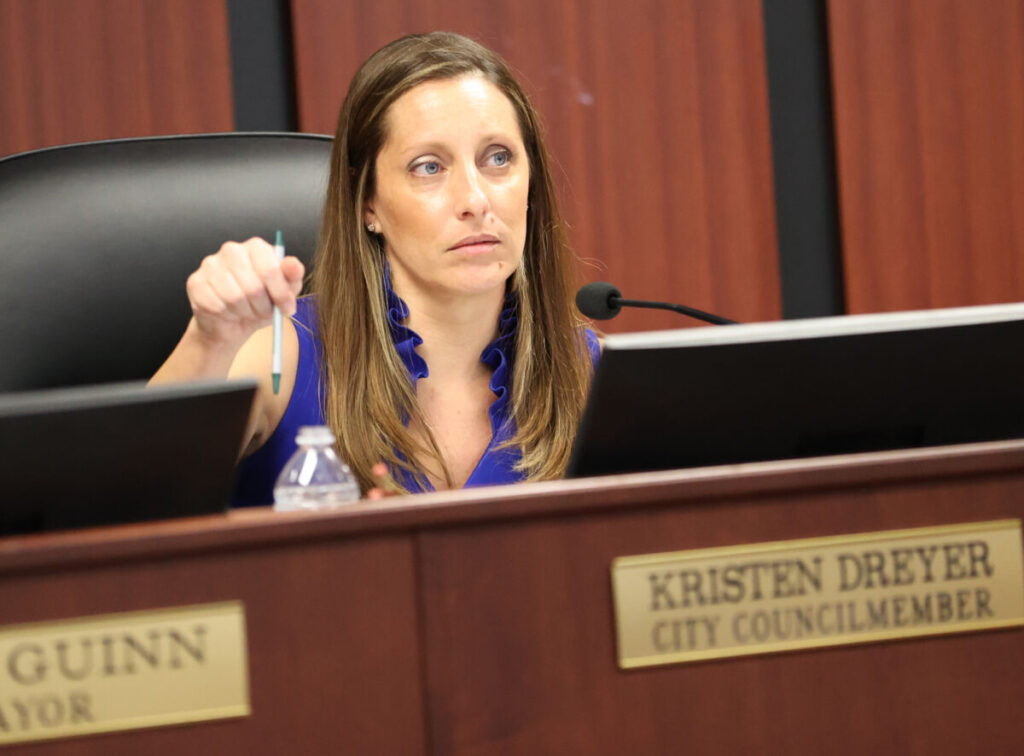
File photo: Ocala City Council President Kristen Dreyer. [File photo by Bruce Ackerman]
The Ocala City Council on May 20 greenlit a $5.95 million, five-year Motorola radio contract for the Ocala Police Department, citing the company’s superior local support and system compatibility over lower bidder L3Harris, which came in at $3.2 million.
L3Harris, represented by Communications International, called on the council to defer the decision due to alleged inaccuracies in the city’s request for an exception to bidding rules, but the council moved forward with the approval in a unanimous vote.
The city’s procurement policy allows bypassing competitive bidding for critical police equipment when justified. OPD’s Director of Information Technology Joshua Sasso justified the decision, citing Motorola’s local service center for rapid repairs and seamless compatibility with Ocala’s 911 and SmartMapping systems.
OPD Public Information Officer Jeffrey Walczak said the agency carefully selects communication equipment like Motorola radios to ensure emergency teams can respond quickly and effectively to keep the community safe.
“We follow strict procurement guidelines to secure reliable, high-quality equipment, ensuring every dollar spent enhances public safety. Our priority is choosing tools that help us respond faster and protect the community better,” Walczak said.
OPD’s exception request, presented by Sasso, highlighted several key elements of Motorola’s proposal. Motorola operates a service center in Ocala, supported by Tri-Co, ensuring rapid response times. L3Harris, according to Sasso, relies on technicians from Brooksville, at least an hour away.
Sasso also pointed out that Motorola’s devices integrate seamlessly with OPD’s existing Motorola P25 system and Vesta 911 mapping system and include GPS functionality and an Advanced Programming Interface Kit for integration with the Fusus platform, supporting OPD’s SmartMapping application. L3Harris’s devices require an additional “BeOn” package for GPS and LTE Push-to-Talk, with integration into Fusus only recently confirmed as feasible.
Motorola’s SmartConnect feature enables automatic transitions between LTE and LMR networks, unlike L3Harris’s “BeOn,” which requires manual switching. Motorola’s pricing is secured under the National Association of State Procurement Officials contract No. 00318 and the State of Florida contract, with pricing valid until May 30, 2025, while L3Harris’s proposal lacks a clear pricing source.
At the council meeting, Meghan Mercer, representing Communications International and L3Harris, raised concerns about the procurement process and said the company was not given a fair chance to present their proposal, which offered savings of $2.74 million compared to Motorola’s quote.
“I respectfully ask that you defer the action on this item to allow time to direct a meeting between city leadership and our team. We were not given the opportunity to present or discuss our solution with city leadership, which I believe is critical, given what’s at stake both financially and operationally,” she said.
Mercer said the city’s procurement form contains inaccuracies about L3Harris’s bid. The company sought a meeting with city leaders to correct inaccuracies and discuss their solution, emphasizing financial responsibility and effective public safety services for Ocala’s taxpayers and first responders.
“Our goal is to support the city of Ocala in providing financially responsible, forward-looking public safety services. Again, we ask for the item to be deferred so we can ensure the city is making the most informed decision possible on behalf of the taxpayers and first responders alike,” she continued.
Daphne Robinson, Director of Procurement and Contracting for the city of Ocala, defended the Motorola contract. She explained that cooperative purchasing through agencies like NASPO ensures the best value for Ocala as outlined in the procurement policy
“Best value … comes from a product or solution that provides the optimal combination of cost, quality, delivery and sustainability,” she said. “OPD outlined a number of operational advantages from utilizing Motorola. They claim to have met with the other agency. It was my determination that the advantages that were outlined in the exception request properly stated the operational advantages that they would face as well as disadvantages if they went with the other product.
“The exception request form has been in use since 2022 to the extent that there is an item placed on an agenda where an exception has been granted to allow that procurement to move forward. That exception request has been attached every single time. This is the first time, however, since I’ve been here, that a vendor with a differentiating opinion has appeared to question the information that appeared on the exception request itself,” she said.
“We allow for the departments to provide procurement with their justification. I look at it with a fresh set of eyes. I incorporate the services of the buyer that is assigned to that department. I talked directly to Mr. Sasso before I made my decision. We went through a battery of conversations about the pros, cons and differences. Once he explained what was at risk, I made the decision that the operational advantages outweigh the cost. It’s my understanding that the CFO was involved in this conversation as well. With regard to the finances, this is a five-year rollout. It’s not all in one fell swoop. Things will be brought in and taken out in a cycle to minimize the impact on the budget,” she continued.
Sasso elaborated on the analysis that went into the decision.
“We started this process over 18 months ago,” he noted. “We’ve been with Motorola for over 20 years. We get supported locally by the vendor, Tri-Co, who is several miles away with staff that work in Ocala. When we looked around, we saw that we wanted to take a look at L3Harris and see what they offer, just to make sure that the offerings for options, for LTE coverage, things like that, are similar between the vendors.
“What we found was, while the equipment is similar, there are a few standout areas that present concerns in the realm of public safety. Number one, their closest location is Brooksville. So, with us having to purchase a third-party equipment and integrate it into our existing Motorola infrastructure, they’re at least an hour away if there was a problem, not to mention however long it takes for the technician to be contacted and brought in to actually get the repair completed,” Sasso continued.
Sasso emphasized that Motorola’s interoperability with neighboring counties’ Motorola systems and proven reliability outweigh the cost difference, as mixing vendors risks functionality issues and accountability during system failures.
He also highlighted a cost-saving strategy: Ocala’s current radios, nearing the state’s eight-year lifespan limit, will be rotated to non-emergency departments, extending their use and avoiding new purchases.
He stressed the importance of a single vendor for critical radio systems.
“In my experience, for over 20 years in IT, there is one thing that is really in the realm of public safety that you don’t want to have multiple vendors for, which is the radio. The radio is the lifeline of the officers, the firefighters and our linemen,” Sasso said.
Mayor Ben Marciano questioned the nearly $3 million price difference between the bids, asking if other vendors were considered. Sasso said only Motorola and L3Harris were viable in Florida.
City Council President Kristen Dreyer supported OPD’s approach to look beyond just the price tag.
“I met with a lot of city departments who said, ‘We’re asking for these things through procurement. We’re giving them a very specific list of our needs, and they’re just basically giving the bid to the lowest bidder, but it doesn’t really meet our needs.’ And so, I appreciate that you’re willing to work with the departments and say, ‘Hey, it’s a lot more expensive than the next one,’” she said.
“But you know better what meets your needs than what sometimes the bottom line is,” Dreyer continued. “It’s not always about who the cheapest one is; it’s who fits the role the best. And so, because I’ve been on the other side of the complaint of they’re not giving us what we need and it winds up costing us in the long run because now we have to double what we order. I think it’s just better to just do the right thing right out of the gate.”
The approved purchase exceeds $50,000 and will be tracked under a new Munis Contract through 2026.
Residents can review the procurement details, including Motorola’s final proposal and L3Harris’s sample quotes, on the city’s website at ocalafl.gov, where additional information about council meetings is available. For further details, contact the Ocala Police Department at (352) 230-7717 or the city of Ocala’s Community Development Services by calling (352) 629-2489.

Support community journalism
The first goal of the Ocala Gazette is to deliver trustworthy local journalism so corruption, misinformation and abuse are not hidden from the public or unchallenged.