
Experts: Budget delay won’t affect storm response
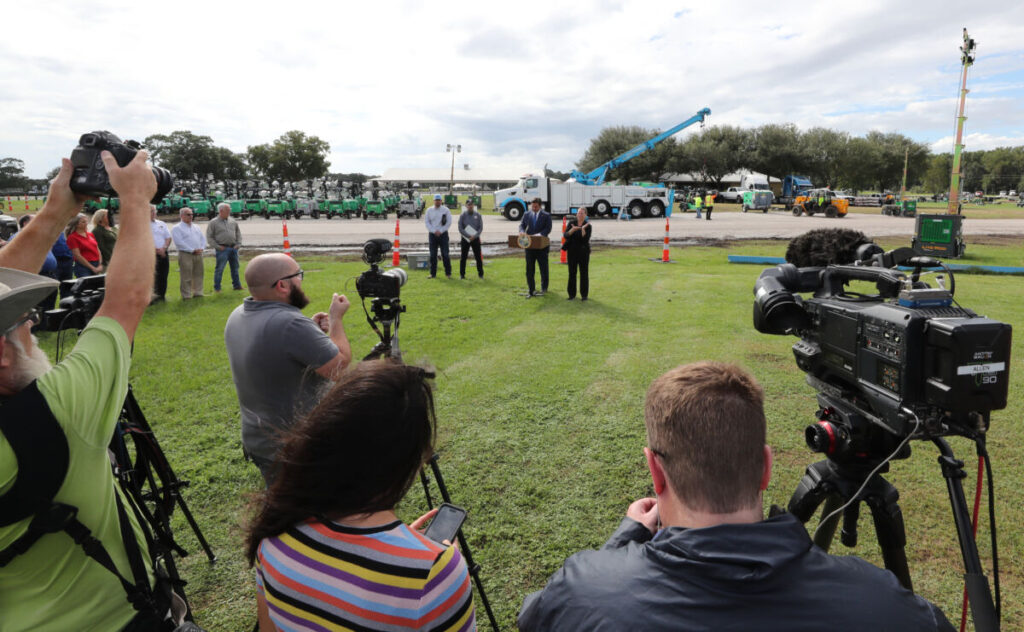
Members of the media record Florida Gov. Ron DeSantis’ press conference about Hurricane Milton at the Florida Agriculture Center and Horse Park in Ocala, Fla. on Tuesday, Oct. 8, 2024. [Bruce Ackerman/Ocala Gazette] 2024.
With the possibility of a state government shutdown due to stalled budget talks, Florida State University experts on Thursday weren’t raising red flags about storm recovery efforts heading into a potentially active 2025 hurricane season.
Senate President Ben Albritton, R-Wauchula, said Thursday that legislative budget leaders have not reached agreement on funding for different parts of the state spending plan, which must be completed before the July 1 start of the fiscal year.
The budget impasse has raised questions about a possible government shutdown. While some other state programs may get “frozen,” the state-backed Citizens Property Insurance Corp. and the Florida Hurricane Catastrophe Fund, known as the CAT Fund, are expected to still be operational if Florida is hit by a storm, according to experts.
“The state-run insurance company, the state-run reinsurance company, those would not be shut down as part of a state government shutdown,” Charles Nyce, a professor of Risk Management and Insurance at FSU, told reporters Thursday. “So they would be fine. People would still get paid if a loss occurs. They’d still be able to get out and adjust claims if necessary, all that kind of fun stuff.”
Some experts expressed concern, however, about the direction of the Federal Emergency Management Agency, which could further shift storm response and recovery funding to state and local governments under President Donald Trump’s administration.
“The message that we’re getting in the (emergency management) community is that the ‘25 season is going to look different than the ‘24 season,” said David Merrick, director of the FSU Emergency Management and Homeland Security Program and director of the Center for Disaster Risk Policy. “We don’t know exactly how that is. I think Florida might be in a much better position than some of the other states when it comes to the ability to respond and recover.”
With generally warmer-than-normal water temperatures across the eastern and central Atlantic Ocean, forecasters are predicting an active six months for the hurricane season that begins June 1.
Colorado State University researchers have forecast 17 named storms during this year’s Atlantic hurricane season, with nine reaching hurricane status and four becoming major storms. That would make the 2025 season close to the 2024 season, which included three hurricanes making landfall in Florida. The National Oceanic and Atmospheric Administration is set to release its outlook next Thursday.

Support community journalism
The first goal of the Ocala Gazette is to deliver trustworthy local journalism so corruption, misinformation and abuse are not hidden from the public or unchallenged.