
Made in the shade
Deciduous trees can add beauty to your landscape and help reduce cooling costs.
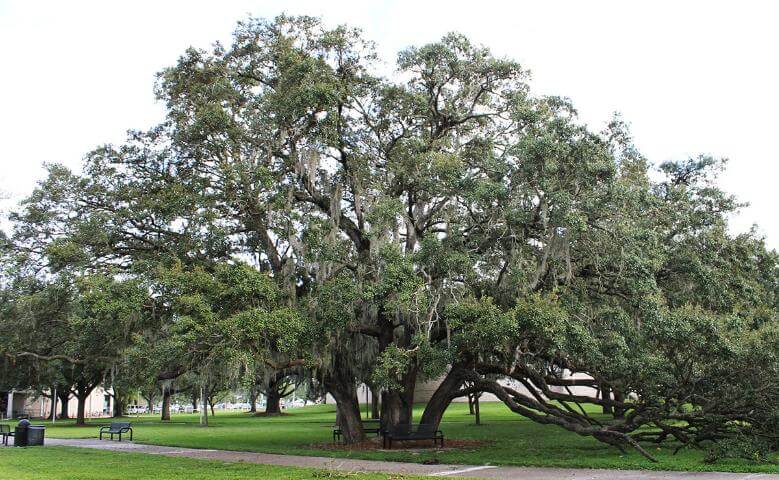
Live oak. [Photo courtesy UF/IFAS]
If not for shade trees, there wouldn’t be any summer backyard barbecues, relaxing in a hammock with a good book or enjoying a cold glass of lemonade under a cool, leafy canopy.
On a hot summer day, there can be at least a 10-degree difference from sun to shade and shade trees can also reduce home cooling costs. According to the U.S. Department of Energy, trees can shade the ground and pavement around a home, reducing heat radiation and cooling the air before it reaches your home’s walls and windows. A single shade tree can save a homeowner up to 20 percent on energy costs.
Additionally, shade trees improve air quality, reduce storm runoff, contribute to a smaller carbon footprint and beautify neighborhoods.
WHAT TO PLANT
The best shade trees are deciduous trees, which shed all or most of their leaves each year and include oaks, birches, elms and sweetgums. In Ocala/Marion County, the iconic live oak is the most recognizable deciduous tree.
Live oaks need lots of room, so they are best suited for large lots. They can grow to 60 feet tall and 60 feet wide and their extensive root system can create issues with power lines, drain fields, driveways, foundations and sidewalks. Also recommended for large lots are shumard oaks and nuttal oaks.
A swamp chestnut oak is a good alternative for an average residential lot. Over time, they may grow up to 70 feet tall but will have a canopy spread of only 40 feet. They have a lifespan of 130 to 150 years.
For smaller lots, medium-sized trees like the dahoon holly or overcup oak might be good options.
The Bob Wines Camellia Gardens and Nursery in southeast Ocala is currently advertising lots of trees for sale, such as 4- to 6-foot live oaks for about $50 to $60, 10- to 12-foot-tall dahoon hollies for about $499, 13- to 18-foot live oaks for $599-$699 and 14- to 19-foot-tall hollies for about $999.
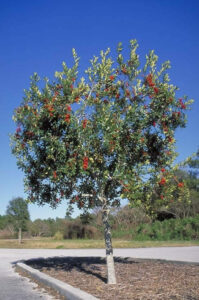
Dahoon holly. [Photo courtesy UF/IFAS]
Trees can be planted any time, but spring is preferable because they are coming out of dormancy and you have better control of the watering schedule. By the time summer temperatures arrive in late May, trees should be on their way to being established.
Choose the location for planting a tree carefully. Keep in mind how big the mature tree will be and plant it away from drain fields, sidewalks, driveways, foundations and roofs. You may even want to call your utility company before planting to avoid overhead and underground power lines.”
And watch for proper depth of planting. The University of Florida/Institute of Food and Agricultural Sciences (UF/IFAS) Extension Marion County recommends planting trees in a hole that is twice as wide as the root ball and slightly shallower, about an inch above the surrounding soil.
And loosen up the root ball as the roots of trees raised in round pots tend to circle. Roots need oxygen to thrive, and 70 percent of all roots are in the top 18 to 24 inches of soil.
WATERING AND BEYOND
When planting a tree, form a shallow moat about 3 feet out from the trunk in all directions, about 8 inches deep. Use a garden hose to fill the moat with water. Refill every day for two weeks.
At the beginning of the third week, water every other day for the next three weeks, then two times a week three and four days apart for an additional six weeks, then once a week until the tree is established.
After the summer rains end, water a new tree once a week during the dry months and while it is entering dormancy.
UF/IFAS recommends that all young oaks be pruned routinely for the first 15 to 20 years. This will develop a healthy branch structure and maintain one dominant trunk for strength and stability.
To learn more, go to sfyl.ifas.ufl.edu

Support community journalism
The first goal of the Ocala Gazette is to deliver trustworthy local journalism so corruption, misinformation and abuse are not hidden from the public or unchallenged.