
State attorneys posture defensively about “non-arrest” policies
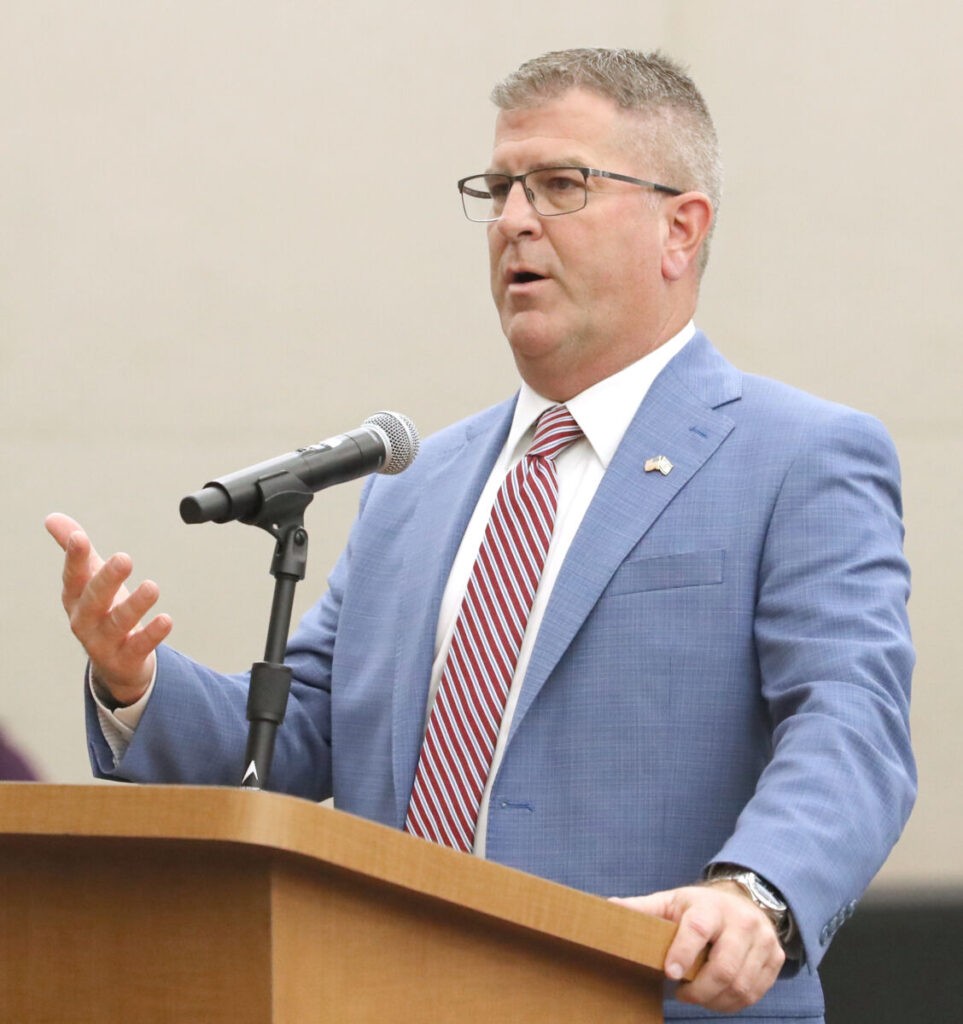
File photo: State Attorney for the Fifth Judicial Circuit Bill Gladson speaks during the Marion County Legislative Delegation at the Klein Conference Center at the College of Cenral Florida in Ocala, Fla. on Wednesday, January 8, 2025. [Bruce Ackerman/Ocala Gazette] 2025.
When voters in Florida’s Ninth Judicial Circuit in November returned Monique Worrell to the post of state attorney, they sent her back to the same hostile political landscape that led to her removal by Gov. Ron DeSantis in 2023.
Worrell also is facing a mountain of complex problems, including a backlog of at least 13,000 non-arrest cases that date back almost a decade in the circuit, which serves nearly 2 million people in Orange and Osceola counties.
Statewide funding for the judicial system has not kept pace with the needs of Florida’s rapidly growing population. An underfunded and strained judicial system impacts the legal community’s ability to protect the constitutional rights of those accused of committing crimes as well as delaying justice for victims of crimes..
Different parts of our judicial system have been sounding the alarm with little relief for years.
Courts nationwide experienced a backlog of criminal and civil cases during the COVID-19 pandemic, and some courts are still wading through the cases. Worrell, a Democrat, was elected as state attorney for the Ninth in 2020, but started her term in January 2021, when courts were gearing up for trials again after COVID-19.
Worrell, insists that the district needs more resources and she has asked the state to provide funding for 13 more prosecutors. Florida Attorney General James Uthmeier has offered to provide four more prosecutors to help with the overload of cases.
Worrell has also created a “non-arrest policy” to help her prioritize cases. However, the Orange County Sheriff’s Office says it would continue to send non-arrest misdemeanor cases to Worrell’s office.
Worrell said her “non-arrest” policy is similar to one used by Fifth Circuit State Attorney William Gladson, whose office serves Marion, Citrus, Levy, Hernando and Sumter counties.
Gladson, a Republican, issued his “non-arrest” policy in 2020. Gladson’s memo said, “Due to a tremendous increase in the number of pending cases and staffing issues resulting from the pandemic, our office is implementing a new policy limiting the number of cases we will accept for non-arrest review. Doing so will allow us to reallocate a lawyer position to prosecute the backlog of pending cases which must be our priority at this time. We will continue to have on-call attorneys available to your officers at any time day or night for the review of warrant requests.”
This policy has exceptions for reviewing non-arrest cases presented by law enforcement: homicide, sex crimes and child abuse, violent first- and second-degree felonies, and trafficking offenses. If there wasn’t an arrest in one of these cases and law enforcement wanted help prosecuting it, Gladson directed the lead officer to schedule a time to meet with a prosecutor to review the case.
The policy raised questions in some quarters because if law enforcement did not have probable cause to make an arrest in a case involving such serious crimes, how would the State Attorney’s Office prosecute the case in court?
Gladson’s memo said cases that didn’t fall into any of those buckets of exceptions would not be reviewed until there was an arrest by law enforcement.
That COVID-19 backlog is still here because Gladson’s office has not reversed its “non-arrest” policy since COVID.
When Worrell announced her lengthier non-arrest case policy this month, she explained, “The majority of these cases are not viable for prosecution due to a myriad of factors, including, but not limited to, no identification of probable cause or lack of admissible evidence, e.g., no independent witnesses, no sworn statements, no identification of the defendant or victim or no photographs/video.”
Worrell said her office received more than 12,000 non-arrest cases from law enforcement in 2024 and she doesn’t have enough staff to catch up on the backlog.
Worrell’s exceptions to the non-arrest policy were similar to Gladson’s policy, but she only identified with more specificity what kinds of cases her office would not review without an arrest, or until law enforcement provided evidence of a crime.
She also carved out an exception for juvenile cases; Gladson’s policy makes no such exception.
Worrell’s memo concluded that, “The state attorney’s office is responsible for reviewing and charging cases suitable for prosecution, meaning there is sufficient evidence to prove guilt beyond a reasonable doubt. If law enforcement cannot collect enough evidence to establish probable cause, there is likely insufficient evidence for prosecution. However, officers should contact the appropriate on-call ASA for guidance or subpoena assistance.”
According to statistics filed with the state, the Ninth Circuit has a higher volume of cases than the Fifth District.
Both districts have experienced significant growth in population.
| Year | 9th Circuit * SAO Worrell
(Orange and Osceola) |
5th Circuit * SAO Gladson
(Marion, Sumter, Lake, Citrus and Hernando) |
||
| Circuit criminal | County criminal | Circuit criminal | County criminal | |
| 2014-2015 | 14,209 | 48,791 | 8,815 | 21,246 |
| 2015-2016 | 13,280 | 43,905 | 9,294 | 20,590 |
| 2016-2017 | 12,435 | 37,670 | 9,534 | 21,846 |
| 2017-2018 | 14,012 | 38,692 | 10,629 | 24,856 |
| 2018-2019 | 12,690 | 37,499 | 10,588 | 25,815 |
| 2019-2020 | 12,200 | 30,115 | 10,723 | 23,144 |
| 2020-2021 | 10,729 | 29,894 | 10,420 | 23,636 |
| 2021-2022 | 10,531 | 29,092 | 10,541 | 22,464 |
| 2022-2023 | 10,421 | 29,633 | 10,801 | 25,007 |
| 2023-2024 | 13,237 | 30,766 | 10,082 | 26,707 |
Worrell and Gladson offer nearly the same “non-arrest” policy, albeit with a different style. Gladson is still operating his office under a policy he created to streamline a backlog of cases due to COVID-19, five years ago; Worrell, meanwhile, is putting a similar measure forward, citing budget constraints in 2025.
Gladson rejected the idea that his policy is similar to what Worrell has begun. Yet, when Worrell’s office sent a public records request for Gladson’s “no-arrest policy” this month, they were provided Gladson’s 2020 “non-arrest” policy, according to public records.
Notably, Gladson hasn’t faced the political headwinds Worrell has.
Gladson has been the state attorney for the Fifth Circuit since 2020, after he coordinated with his predecessor Brad King to be the only candidate on the ballot. King, who served as the circuit’s state attorney since 1988, now serves as a circuit judge. Gladson ran unopposed in 2024 and was re-elected to another four-year term.
The largest differences Gladson pointed to from his policy to Worrell’s was that his office website had a place for lodging criminal complaints with his office instead of the responding LEO agency. According to internet archives, that feature on his website has been available for approximately a year. Gladson’s office would not answer questions about the timing of the public complaint process.
Gladson’s office would also not answer questions about doing intake for cases from the public. According to records obtained by the “Gazette,” the Gladson’s office stopped intaking cases from the public in 2018, and victim’s rights brochures were amended to reflect that the first step was to file a complaint with law enforcement.
This arrangement, however, could hamper those who claim they are victims of law enforcement.
This extends to those who have died while in the custody of law enforcement. When the “Gazette” asked Gladson’s office how many of the in-custody deaths the Marion County Sheriff’s Office had investigated, they had files for only three of the 31 deaths.
In an April 9 statement, Gladson said he had superior relationships with the law enforcement agencies. He said his office “fights with them, not against them,” a swipe at Worrell, who has been targeted by some law enforcement officials who insist she is soft on criminals.
Worrell maintains that she continues to prosecute criminals to keep the public safe, but she needs the evidence to get a conviction from law enforcement officers and enough prosecutors to process the growing number of case intakes.

Support community journalism
The first goal of the Ocala Gazette is to deliver trustworthy local journalism so corruption, misinformation and abuse are not hidden from the public or unchallenged.