
Sen. McClain advocates for bill that would weaken local control of rural lands
The reason? "We" need more houses for the people moving to Florida.
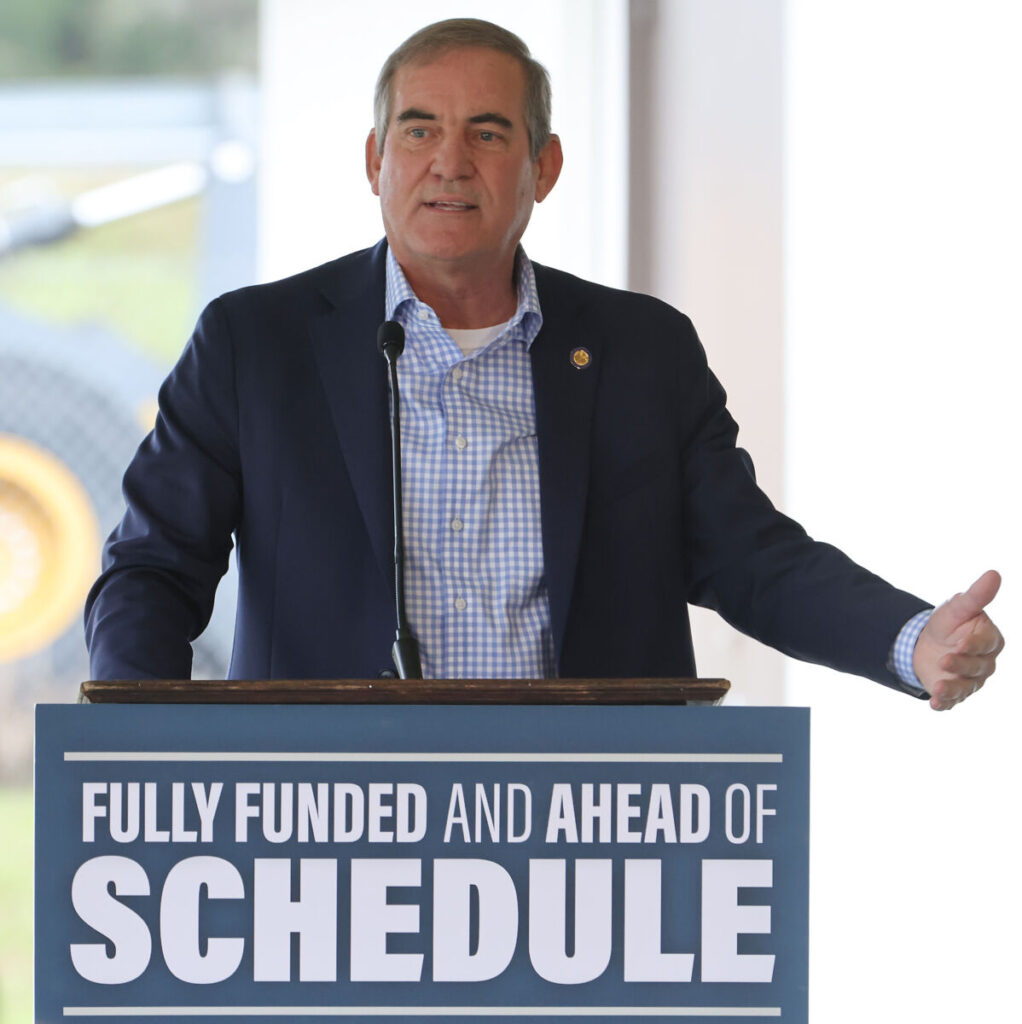
File photo: Sen. Stan McClain speaks during a Florida Gov. Ron DeSantis press conference about I-75 improvements at Big Daddy Don Garlits Museum of Drag Racing south of Ocala, Fla. on Tuesday, February 25, 2025. [Bruce Ackerman/Ocala Gazette] 2025.
|
Getting your Trinity Audio player ready...
|
State Sen. Stan McClain this week explained his rationale for proposing a bill that, if approved, would take much of the control over land-use decisions from local governments while opening hundreds of thousands of agricultural acres to developers without any local review or oversight.
McClain, a residential builder and owner of McClain Construction LLC, spoke to the Senate Community Affairs Committee on Monday about the controversial measure Senate Bill 1118, which has generated significant concern and opposition since it was introduced earlier this month.
A longtime politician who served on the Marion County Board of County Commissioners for 12 years and then termed out as a State Representative for District 27, McClain is now Marion County’s sole State Senator (District 9.). His son, Matthew McClain, is a Marion County Commissioner.
McClain has not responded to numerous “Gazette” requests to discuss his controversial bill, but his comments during the committee meeting provide some insight into his intentions.
“Members, you know the challenges with growth management is that people haven’t stopped moving to Florida and it doesn’t look like they’re going to do that anytime soon. Certainly, for those of you that maybe follow development or the housing market, it actually it has slowed down some,” said McClain citing “headwinds created through tariffs and that kind of stuff.”
“But you know one of the things that we have to always grapple with is how do we supply enough homes for the people that are moving here and certainly then we get into a back-and-forth between the communities that we live in and how much growth is taking place,” he continued. “But it doesn’t change the fact that we have to find ways to make sure that housing is available for those people that are moving here.”
McClain and State Rep. Kevin Steele, R-Pasco, have each filed identical bills that would wrest local control of development from cities and counties across the state. If passed, the new laws would supersede any local overlay zones of protection, including Marion County’s revered Farmland Preservation Area.
SB 1118 and House Bill 1209 summary sections state, in part, the measures authorize property owners “…to instead apply for administrative approval of a development regardless of future land use designations or comprehensive plan conflicts under certain circumstances;” require “that an authorized development be treated as a conforming use…;” and prohibit “local government from enacting or enforcing certain regulations or laws.”
The bills would also require “administrative approval of such development if it complies with certain requirements.”
The bills propose no restrictions on minimum lot size and assumes that maximum densities per any current land development code would be automatically put into effect. The city of Ocala and the Marion County Board of County Commissioners would lose their authority to restrict the number of units per acre in a housing project.
McClain did not specify the source, but said he read a study that associated 30% of the cost of a new home is caused by “government regulatory issues.” He said his bills “merit discussion” due to “inconsistent application of the current laws that we have. So, we’ll end up one day we’re approving developments and the next day we try to stop development, and that’s not consistent.”
McClain indicated it was his intention to continue the efforts in the Senate as he had expended them during the eight years he served Florida House, streamlining the development process.
McClain reported on his last personal financial disclosure that the bulk of his income comes from his residential construction company, McClain Construction LLC.
He also received approximately $12,324 in personal income from the Marion County Building Industry Association. In the past five years, McClain has consistently disclosed he receives income from the Marion County Building Industry; in 2020, that was as high as $46,000.
That same financial disclosure identified Tillman and Associates as one of the largest customers of McClain Construction, LLC, and has been so noted since 2022. The principal of Tillman and Associates is David Tillman, who is also the president of the Marion County Building Industry Association and likely the largest developer doing business in Marion County.
Additionally, McClain’s political campaign contribution disclosures reflect significant contributions from Tillman and the building industry.
The Florida League of Counties spoke to the Senate Committee against McClain’s bill saying it fast tracked rural lands subject for development leaving out the wishes of local communities.
“Chapter 163 [of the Florida Statutes] is called the Community Planning Act. When we talk about the Act, the focus is on the word “community.” We really don’t want to remove the community from these processes,” the spokesperson said.
A representative from the Florida Home Builders Association spoke in favor of the measure since the bill sought to further restrict local governments from increasing impact fees by more than 50%.
State Sen. Shevrin D. “Shev” Jones, D-Miami-Dade, expressed concern about the definition related to ethanol production in McClain’s bill, a concern that was echoed in public comments to the senate committee.
Additionally, Jones asked McClain why the bill sought to impact land use regulations that had been in place since June 1, 2011.
McClain answered, “I believe it just goes back and reaches into some things that there was the ability to develop certain properties.”
“Are you not concerned by the potential overreach the bill represents by the state government when looking at local zoning and local communities that have already made the decisions about what does and does not meet the criteria for development?” Jones asked McClain.
“I think that is why we are here, to have a discussion about what things that we need to do to help local governments move forward with development,” McClain answered.
Most of the Senate committee members indicated they had received hundreds of calls and emails on McClain’s bill.
Matthew Groholski from Orange County told the committee that over 70% of Orange County residents voted for a rural boundary and they did not want to lose it.
“I’ll just remind you that Republicans, Democrats, Libertarians, hell, everybody in Orange County, voted for a rural boundary and rolling back those protections is an infringement on our county charter and our county constitution. I respectfully ask you vote nay on this harmful amendment,” Groholski said.
State Sen. Jason W. B. Pizzo, D-Broward, expressed concern that McClain’s bill was being presented to support a Central Florida builder developing in environmentally sensitive areas.
Pizzo said McClain would need to remove some of the “ickiness” from the bill before he could support it.
State Sen. Randy Fine, R-Brevard, and State Sen. Kathleen Passidomo, R-Collier, both expressed concerns with McClain’s bill but ultimately voted in favor of it to move it to the next committee.
Passidomo offered assurances that she’d work with McClain to make the bill something she could support on the Senate floor.
To watch the full meeting, visit this link: https://thefloridachannel.org/videos/3-17-25-senate-committee-on-community-affairs/ and start listening at the 1:52 timestamp.
Contact information for state legislators is:
State Sen. Stan McClain, [email protected], (352) 732-1249
State Rep. Ryan Chamberlin, [email protected], (352) 635-0450
State Rep. Richard Gentry, [email protected], (386) 251-1100
State Rep. Yvonne Hinson, [email protected], (352) 264-4001
State Rep. JJ Grow, [email protected], (850) 717-5023
State Rep. Judson Sapp, [email protected], (352) 496-3430

Support community journalism
The first goal of the Ocala Gazette is to deliver trustworthy local journalism so corruption, misinformation and abuse are not hidden from the public or unchallenged.