
Marion County Mental Health Court
This specialized judicial program provides an alternative for vulnerable offenders to get back on track.
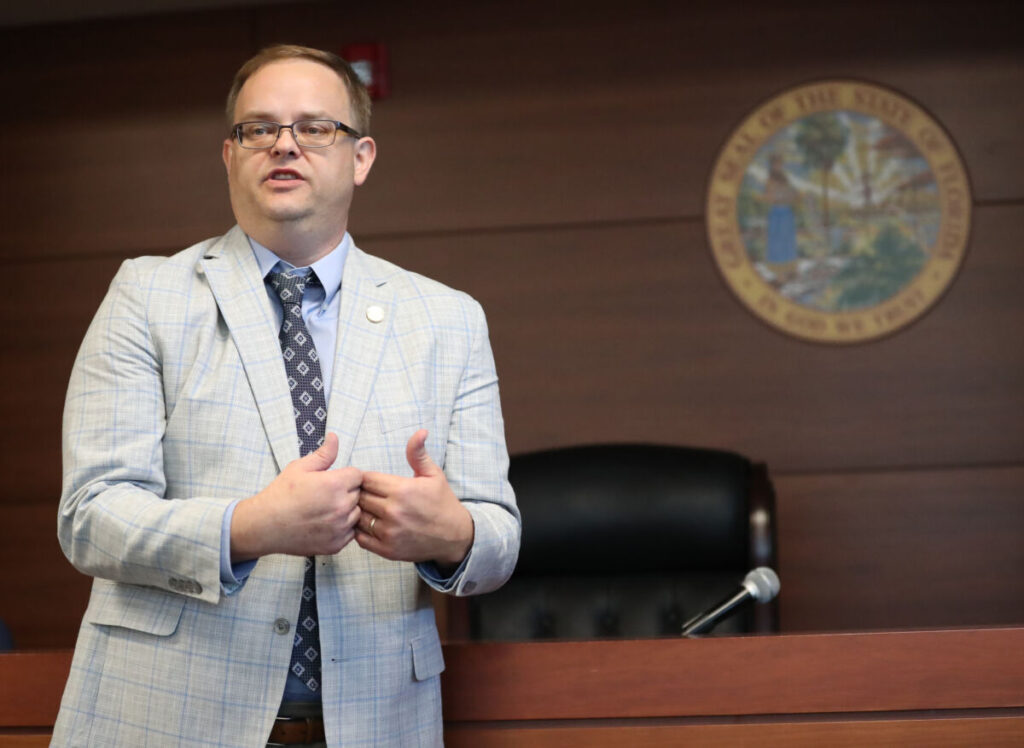
File photo: Marion County Judge Tommy Thompson [Bruce Ackerman/Ocala Gazette] 2022.
|
Getting your Trinity Audio player ready...
|
Crime isn’t always black and white. Think of the age-old parable of a man imprisoned for stealing a loaf of bread to feed his starving family.
Now, imagine you are someone, or you know of someone, with a severe mental illness who falls down the wrong path, with the cards now stacked against them, who can’t get the support they rightfully need for their condition. Before you judge, imagine how quickly your life could turn in the wrong direction even with just one bad choice.
There is a part of our judicial system in Marion County that works overtime to ensure that such citizens get the treatment they deserve. In the Marion County Mental Health Court program under Judge Tommy Thompson, mentally ill offenders who have fallen into crime have the opportunity to work through a treatment and advisory program rather than go through traditional court proceedings and spend unneeded time in jail with the general population.
Thompson treats each participant of the program who stands in court before him with compassion and patience, referring to them by their first names—and not just a case number.
“My personal wish for everybody that’s in this program is that we get you in the program, we get you through, and you learn some things about yourself and how you cope with mental illness,” Thompson said. “When you’re done with the program, I want that you are happy, that you’re healthy, that you wake up every morning with a smile on your face and a good attitude and you’re not weighed down by mental illness.”
There are currently about 40 individuals in the program, which on average serves anywhere from 25 to 50.
During the Oct. 23 session of mental health court, Thompson greeted each candidate warmly and asked how each person fared through the recent hurricane.
The judge remembers details about the candidates, their spouses, children, jobs and even pets. For every person in the program, Thompson gives the same token piece of advice: “When you do good things, good things happen to you.”
The program consists of three phases and is individualized for each person depending on their illness, needs and crime committed. To successfully get through the program, everyone must adhere to the same rules—take your medication as prescribed, don’t drink alcohol, don’t do drugs and don’t break any laws.
Most people graduate from the program within six months to a year, and upon graduation have their charges dropped by the state and their cases resolved. Participants must have an Axis I mental health diagnosis, which includes mood disorders, anxiety disorders, dissociative disorders, eating disorders and psychotic disorders.
To be eligible for the program, the individual must have been arrested for or charged with a misdemeanor in Marion County, must be represented by an attorney, must meet a residency requirement and must be able to comprehend and conform to the diversion court program. In doing so, participants waive their right to a speedy trial.
After each court hearing, participants take a 12-panel drug and alcohol test to ensure their sobriety, starting on day one.
“If you did test positive for something on your first screening, what we’ll do is we’ll take that first screen and use that as a baseline, and then in future screens if whatever level of that substance goes down over time, that will be indication that if you were using, you stopped,” Thompson told a participant.
Between appearances in court, participants meet with case managers from the court, attend counseling, receive treatment and medication, go through social programs and work with their peers. Depending on the offense, some might be assigned to an anger management course, a batterers’ intervention program, an intensive outpatient program, a parenting course, a shoplifting course or whatever work they are deemed to need for rehabilitation.
Mental health court works with NAMI (National Alliance on Mental Illness) Marion County, SMA Healthcare and the Beacon Point program to provide resources and services to participants. The program also partners with the Florida Assertive Community Treatment (FACT) program to provide assistance in individuals’ homes to provide more personal assistance with everyday activities and work-related training.
The case managers also work to ensure that the participants adhere to all requirements from the state for their charges, such as paying restitution by the time of graduation. The court has sympathy for the hard work it takes for many individuals to stay on track, and even asks anyone who needs to attend work on the day of their hearing to come forward first.
Punishment for not adhering to the program can be decided on a sliding scale, depending on the severity and frequency of occurrences. A lower sanction option might be to watch a video and write an essay about what you learn or do community service.
A higher sanction could be to spend a few days in jail, something Thompson said could emphasize the severity of the possibilities if someone can’t complete the program. The ultimate sanction is removal from the program.
“If we can’t get you on the right path and you continue to violate the program rules, we’ve got to discharge you, we’ve got to kick you out, and you go to see another judge for resolution on your case,” Thompson said.
And if the opportunity for reform and dismissal of charges isn’t reward enough, the staff also makes sure to offer incentives and positive reinforcement at every turn. Everyone moving onto the next phase of the program receives a certificate of achievement and a gift card.
For someone who may have never had anyone acknowledge their achievements or hear that someone’s proud of them, positive reinforcement can go a long way, Thompson said.
“Stay focused and do the right thing,” Thompson said. “We’re here for people who want to help themselves.”
To learn more, go to circuit5.org/programs-services/mental-health-court-programs/marion-county-mental-health-court

Support community journalism
The first goal of the Ocala Gazette is to deliver trustworthy local journalism so corruption, misinformation and abuse are not hidden from the public or unchallenged.