Bill Cotterell: Education Doesn’t Need Party Labels
Florida voters approved non-partisan school board races in 1998, and there’s no reason to change, a Capitol Columnist writes.
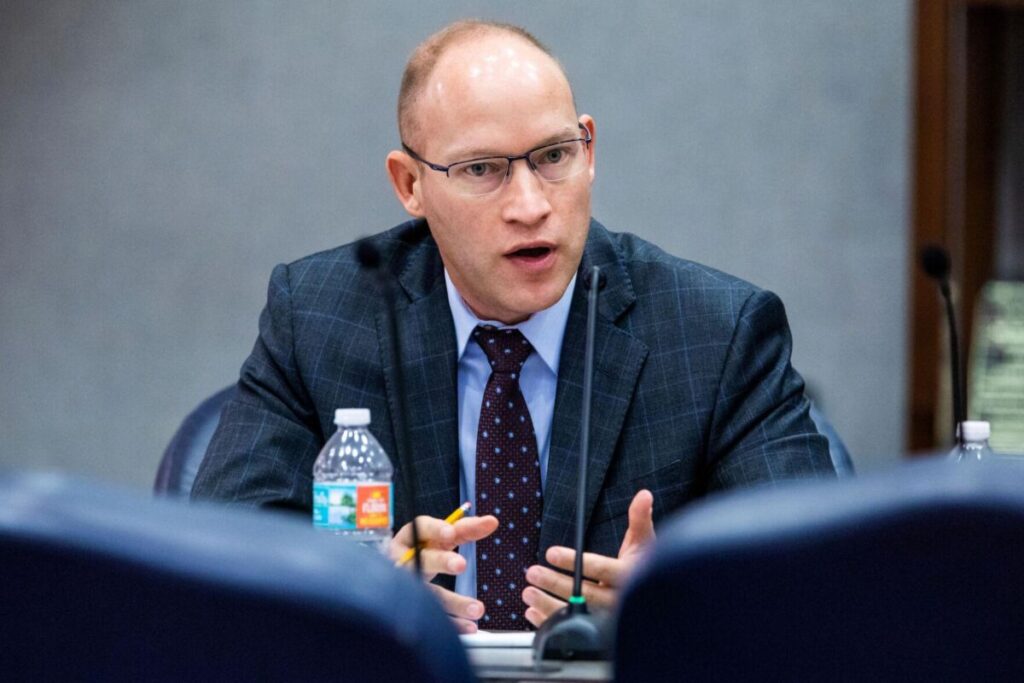
Rep. Spencer Roach, R-North Fort Myers, helped sponsor a proposal that would move to partisan school board elections. [Colin Hackley/Florida News Service]
Can you name any public office that used to be non-partisan and has been improved by having political parties compete for it?
Yeah, neither can I.
And it’s hard to imagine how injecting partisanship into public education — the most important and expensive thing state government does — will be good for the kids or the voters. Yet the top referendum on Florida’s Nov. 5 ballot proposes to make school board races partisan.
The Republicans who run the Legislature approved asking voters to pass what will appear on the ballot as Amendment 1. Their decision last year coincided with parental pushback in several counties where usually humdrum school board meetings were turning into prolonged and bitter spats over removing library books and forbidding classroom discussion of some sexual topics.
Some of the material was pretty raw, especially for the elementary grades, and Gov. Ron DeSantis happily seized on the culture wars as one element of his ill-fated presidential campaign.
Candidates for school boards used to run as Democrats or Republicans, but more than 2 million voters supported a constitutional amendment in 1998 to make the races non-partisan. The change hasn’t caused a marked improvement in student reading or math scores, or attracted an apolitical breed of high-minded education experts to serve on the boards or caused school taxes to go up or down — but it hasn’t done any harm, either.
There’s nothing stopping school board candidates from telling voters their party affiliations. Their voter registrations are public record anyway and anyone whose vote is swayed by the R or D next to a politician’s name can just ask that person in any public forum.
Having them run with a party label, though, invites a needless form of team loyalty that has no place in something so important as education. If you want to base your vote on irrelevant stuff — like supporting all the Gators on the ballot — that’s your privilege, but it cheapens the result.
Besides, if you pay attention to local races, you know which candidates are the liberals and conservatives. Identifying them by party is redundant.
The immediate impact of having school board members run in primaries, identified by party, would be to disenfranchise about 30 percent of the voters who register with no party affiliation. Those NPAs, as they’re commonly known, have kids in the schools and pay property taxes to support education, but Florida has closed primaries so they would be excluded from the crucial first round, when most races are essentially decided.
Making these races partisan would mean making them as nasty as the top-of-ballot races, like contests for governor of the U.S. Senate. With few exceptions, the farthest-right Republicans would win primaries by appealing to the Moms for Liberty crowd and other culture warriors, while Democrats would nominate the farthest-left contenders — probably slates backed by the teacher unions.
Moderation and compromise would be wistful memories. School boards would be split, with the Republicans using their customary fund-raising advantage to dominate agendas. Democrats might control in a few counties.
In other words, your county school board would start to resemble the Florida Legislature — or, worse, Congress — with members who value winning first and accomplishing anything a distant second in importance.
When faced with a complex and costly issue of education, do we want school board members thinking, “How will this improve learning?” Or should they be worrying, “The party executive committee will hate me if I vote for this”?
In Washington and Tallahassee, they call it “getting primaried.” Stray from Democratic or Republican dogma a time or two, and the party will finance a candidate to challenge you in the next primary. If you make a show of putting public service ahead of party, you might as well switch teams — punishment is swift and severe.
Some lawmakers still say, “If it ain’t broke, don’t fix it.” School board elections are working well and need no fixing.
Bill Cotterell is a retired Capitol reporter for United Press International and the Tallahassee Democrat. He can be reached at [email protected]

Support community journalism
The first goal of the Ocala Gazette is to deliver trustworthy local journalism so corruption, misinformation and abuse are not hidden from the public or unchallenged.