
Marion County continues to get bad health grades. But who is at the helm to fix?
Since 2005, the state’s life expectancy rate dropped by 1.2 years while Marion County’s rate dropped by more than 4.1 years.
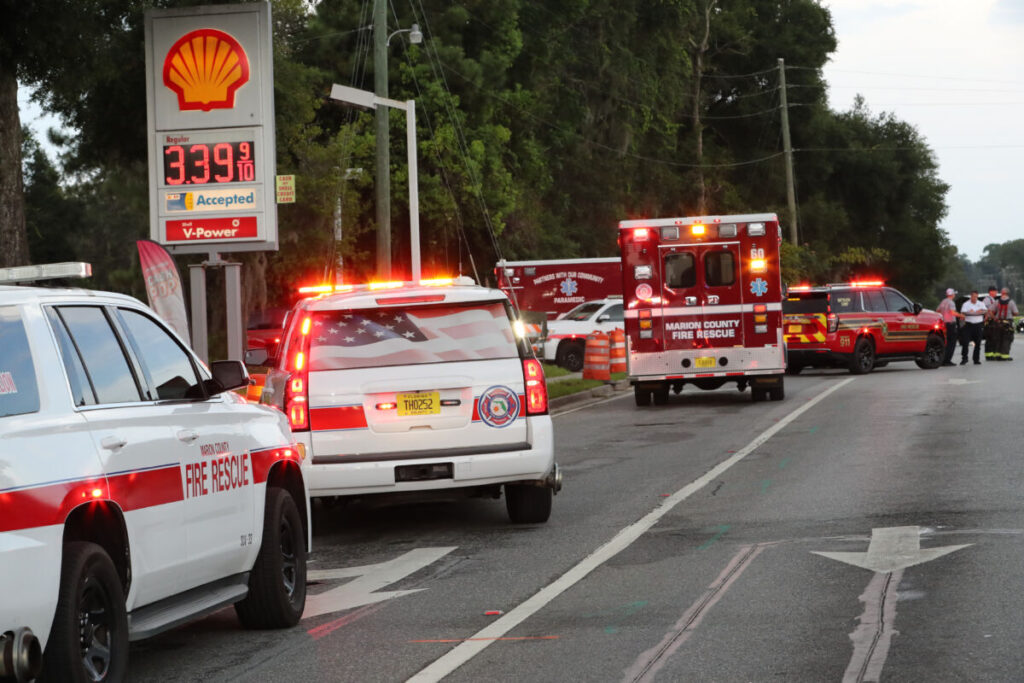
File photo: Numerous agencies including Ocala Fire Rescue and Marion County Fire Rescue and the Ocala Police Department responded to the scene of a large explosion at the Classic Laundromat store on Northeast 25th Avenue in Ocala, Fla. on Tuesday, July 30, 2024. [Bruce Ackerman/Ocala Gazette] 2024.
Since 2005, life expectancy has fallen steadily for Marion County residents.
According to the data from the Florida Department of Health, life expectancy for the three-year span of 2005-2007 in the state was 79.2, but in Marion County it was 77.8 overall. It was 74.5 if you were a Marion County male and 81.1 if you were female. Marion Hispanics had a higher life expectancy at 81.9; non-Hispanics 77.6, white 77.8, Black 76.3.
Fast forward to the last three-year data set released, for 2020-2022, and you find that the state’s life expectancy rate had only dropped 1.2 years but Marion County had dropped more than 4 years to 73.7. Statistics like these may show living in Marion County to be bad for your health.
Recent data from the Florida DOH reflected Marion County males having a life expectancy of 70.4 and females 77.1. Marion Hispanics are still outliving the rest, with a life expectancy of 76.8. whites 73.6, Black 72.7, and non-Hispanics 73.2
Our leading causes of death are like the rest of the state’s—heart disease and cancer. However, the third highest cause of death in Marion County is unintentional injury. And it’s at a remarkable rate.
Florida DOH data shows Marion County’s rate of unintentional death in 2022 was greater than that of every other county in the state except for Glade and Lafayette counties, whose populations combined make up less than 30,000 residents.
The DOH defines unintentional death as “injury not intended as self-harm or as intentional harm to another person.”
When you look at the 10-year trends in unintentional deaths for Marion County, they grew from 75.2 (for every 100,000 population) in 2015, to 91.6 in 2019, and to 124.5 in 2022.
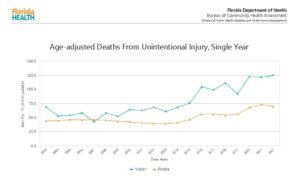
Source: Florida Department of Health
In 2022, according to the last reported DOH data, the age-adjusted rate per 100,000 population of deaths from motor vehicle crashes, which includes pedestrians, cyclists, motorcyclists and three-wheeled vehicles, in Marion County was 27.7 compared to Florida at 15.8.
Analysis
Thanks to data collected by the U.S. Centers for Disease Control and Prevention and state health departments, it’s easy to get a glimpse of each community’s health grades so communities can make decisions to improve them.
The question is, Who is responsible for implementing policy and finding the resources to improve the health grades?
The answer in this community equals a lot of different siloed organizations, but there seems to be no single local organization making strides toward significant improvement.
The Florida Department of Health in Marion County, or DOH-Marion, issues its health assessments based on data and meetings with stakeholders.
Then there’s the Marion County Hospital District, now in its 10th year, who’s currently reassessing health needs to define what health incentives it will continue to support. The trustees’ two roundtable workshops with one consultant have been informal with no reporting supplied to the trustees from the consultant regarding needs, other than what has been shared during meetings, according to the district’s attorney Robert Batsel following the last workshop. The “Gazette” has been recording the workshops so the public can gauge their effectiveness, and we will follow up with a report when the direction becomes clear.
The Marion County Public Policy Institute did a health needs assessment of Marion County in the summer of 2007. At the time, they recommended that a lead agency be formed to address findings such as shortages of medical providers, lack of insurance, transportation for patients to care, and the timeliness of emergency services.
Since that 2007 report, a few good things have happened, and a few not so good things have happened. We are going to point out some of both.
Good news
In 2010, The Affordable Care Act was passed. The Florida Department of Financial Services summarized how it impacted Florida residents this way: “The law puts in place a significant number of health insurance reforms that have rolled out since 2010.”
“Starting January 1, 2014, you will no longer be declined coverage or charged extra for health insurance because of a health issue you have now or have had in the past. You will also be guaranteed a minimum set of health benefits known as ‘Essential Health Benefits.’”
The website also said the law included assistance for individuals and families to purchase health insurance.
When that law went into effect, 59,754 Marion County residents under the age of 64 did not have any health insurance. As of the last data set, in 2022 there were 45,577 residents without insurance. In those eight years, Marion County population also increased by roughly 50,000 residents.
The College of Central Florida is currently under expansion to increase affordable nursing education. In addition to offering low state tuition, the Citrus County Hospital District decided to put money towards grants for those who want to go into nursing at CF, making it possible for some nurses to have their tuitions completely covered in exchange for agreeing to work in Citrus County for a certain period of time.
The college’s nursing expansion has received direct financial support from multiple state and local governmental bodies.
Additionally, 10 years ago, the Marion County Hospital District (MCHD) started investing approximately $213 million when the county, with approval from Marion County voters, decided to lease the county hospital, then named Munroe Regional Medical Center, to a private healthcare company. The hospital lease has changed hands a few times since then and is now held by AdventHealth and is known as AdventHealth Ocala.
The money from the lease came to the MCHD trustees to be used to meet the health needs of Marion County residents. It now totals almost $300 million.
The MCHD has focused primarily on fighting obesity and the diseases that come with it, such as diabetes, with contributions to nonprofit clinics that offer treatment and preventive care, and for mental health and substance abuse support through other nonprofits and the creation of Beacon Pointe in the last few years, as a hub connecting people with mental health and substance abuse support.
As far as emergency services go, the 2007 report complained of lagging emergency response times. Marion County Fire Rescue took ambulance services back under its wing shortly after the report was issued by the private provider, the Emergency Medical Services Alliance (EMSA). EMSA had been a joint effort among the city, county, HCA hospitals and Munroe Regional for ambulance service.
It has taken some time, but ambulance response times have improved throughout the county due to significant investment in 911 dispatch technology, personnel and equipment by the county.
Practically speaking, MCFR takes the lead on most medical calls since they operate the ambulances- including in the city limits. This arrangement has freed up Ocala Fire Rescue to spearhead the start of paramedicine programs for opioid recovery and for community outreach to homebound residents struggling with new or chronic medical conditions.
The local paramedicine programs pioneered by OFR have expanded into the county and continue to be a shining star in Marion’s cap as an example to emulate in other counties.
Bad news
When it comes to emergency response times, however, recent reports have revealed that city residents do not always fully benefit from the county’s quick ambulance response due to deconsolidated emergency communications between the county and city.
How might that impact our health grades? In a big way when you consider that unintentional injury is the number three cause of death in Marion County.
The city has ignored national recommendations for consolidation of emergency communications, issued since 2016, as well as calls for the use of common computer aided software between responding agencies. Instead, they did the opposite and deconsolidated more from the county in 2020. City officials also have ignored recommended staffing levels by their own consultants, as well as operational structure. While the county has the benefit of automated fire/medical dispatch when 911 calls come in, the city dispatchers are still scrolling a PDF matrix (emergency dispatch circa 1990).
The “Gazette” asked the city if there had been any changes since our last report in the spring. They have been minimal, and still don’t meet recommended standards.
In 2019, at the time the city made a decision to deconsolidate further, then-police chief Greg Graham told city council members during a workshop that all six chiefs, including himself, Marion County Sheriff Billy Woods, Marion County Fire Rescue Chief James Banta, then Ocala Fire Chief Shane Alexander and police chiefs in Belleview and Dunnellon agreed the deconsolidation would only work if they all used the same CAD software, but the transition would come at significant cost and require consensus about which CAD software would work for all.
Five years later, they are still working on different CAD systems and ignoring multiple national authorities who recommend consolidation of 911 communications and dispatch software.
We asked Sheriff Woods if his position had changed since Graham presented the opinion of the chiefs to city council and he said he could not comment.
Banta, who oversees ambulance services for the entire county, maintains that the county and city would be best served by consolidated 911.
As the needs grow locally, given our ever-increasing population, we should expect the fractured 911 system to show more cracks.
When it comes to Marion County’s uninsured population, our county is still in the top quarter percentile of uninsured in the state. We got as low as 39,099 in 2019 following ACA, but by 2022 had increased almost 9% in the number of uninsured.
Mirroring the rest of the country, our physician count has only gotten worse since the PPI’s 2007 study. The American Medical Association warned in 2022 that there was already a shortage nationwide and since it takes 10 years to train a physician, immediate action is necessary.
In Marion County it is 1 primary care physician per 1,720 people. Throughout the state, it’s 1,370:1 and nationally it’s 1330:1.
Dentists in Marion County are 2,400:1, whereas statewide it’s 1,560:1 and nationally 1,360:1.
Mental health providers in Marion County are 870:1, whereas statewide it’s 490:1 and nationally 320:1.
How do we get to the bottom of this?
Other than regular recruitment from hospitals, we have not noticed any significant physician recruitment strategies for our county. You would think that local government would include addressing the physician shortage in their economic development plans since it is such a critical industry.
When it comes to the MCHD’s impact after 10 years, we can certainly point to an increase in fund growth, but diseases like diabetes and food insecurity have gotten worse in Marion County despite their financial investment in those areas- according to data from the DOH.
As for DOH-Marion, each county in the state has a health officer in charge of the department. Ours is Mark Lander, was appointed in 2017 with approval by the Marion County Board of Commissioners. But then at the end of 2020, he was also appointed as the Deputy Secretary for County Health Systems, which oversees all the county departments across the state.
This means, Marion is the only county in the state without a dedicated health officer since 2020. We requested Lander’s schedule from DOH-Marion to try to glean how much of his time is spent working in Marion County and received a bill for records in the sum of $187. The “Gazette” may pay the fee to get the information.
We reached out to Marcas M. Bamman, Ph.D., a senior research scientist with the Florida Institute for Human & Machine Cognition. Bamman serves as the director of Healthspan, Resilience and Performance Research for IHMC.
He gave the “Gazette” an overview of what an in-depth study to identify potential contributors to Marion County’s life expectancy rates would look like.
Bamman said multidimensional methods would be required to find which factors were linked to early morbidity and disease for Marion County residents. This would include environmental studies of air, water, and soil; various social metrics such as stress, education, family structure and income levels; and behavioral/lifestyle metrics such as physical activity, nutrition/diet, sleep, and healthcare access and utilization. Even age at retirement is relevant, Bamman said.
We don’t think a thorough study like that has ever been done in Marion County by any one agency—at least not in our lifetime.

Support community journalism
The first goal of the Ocala Gazette is to deliver trustworthy local journalism so corruption, misinformation and abuse are not hidden from the public or unchallenged.