
Loran Cole executed for horrific crimes committed in 1994 in the Ocala National Forest
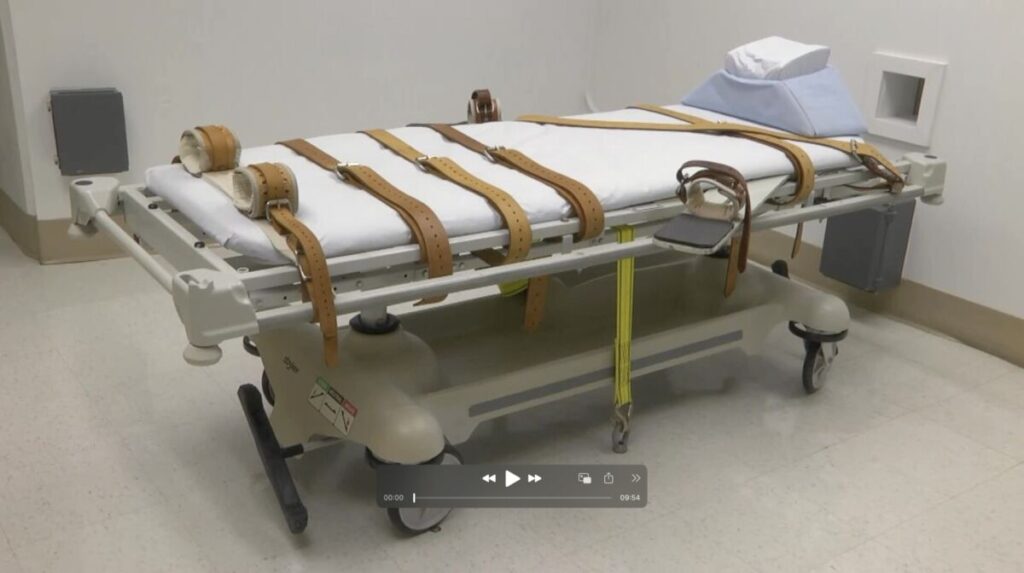
This is a still photo taken from a video prior to the execution of Loran Cole on Aug. 29, 2024, at the Florida State Prison. [Photo provided by the Florida Department of Corrections]
Loran Cole was executed at 6:15 p.m. on Aug. 29 by lethal injection at the Florida State Prison for his role in the brutal 1994 kidnapping of a brother and sister camping in the Ocala National Forest and the subsequent murder of the brother and sexual assault of the sister.
The execution was witnessed by seven reporters and 23 other witnesses, including Fifth Circuit State Attorney William Gladson.
Cole’s legal counsel had objected to the method of execution because Cole, 57, has Parkinson’s disease. They claimed his involuntary movements could affect the placement of the needle, creating unnecessary suffering.
When the shade was drawn back in the witness room at 6 p.m., witnesses sat cramped in a small room with only a 12-foot-wide window that was even with the execution room where Cole was strapped to a medical gurney, his hands restrained on armrests.
Cole’s team had filed a legal petition requesting the U.S. Supreme Court stay the execution so that an evidentiary hearing could be held on whether execution by lethal injection would be appropriate. Earlier Thursday morning, the Supreme Court declined to take up the appeal or grant a stay.
Once the witnesses were set, a member of the prison’s execution team called the Governor’s Office for a short call. At 6:02 p.m., Cole was asked if he wanted to say anything, to which Cole responded, “No sir.”
Cole then raised his head for a moment to look over at the witnesses.
Cole was first injected with etomidate, an anesthetic agent that sedated him, and saline. He began having trouble breathing and trembled until 6:05 p.m. when the execution member checked Cole’s level of sedation by touching around his eyes and yelling his name once.
Confirming Cole’s sedation, they moved forward with injections of Rocuronium bromide and Potassium acetate, and witnesses observed continued labored breathing but no more trembles. By 6:07 p.m., Cole stopped moving and his breathing was no longer noticeable.
The witness room was silent except for the air-conditioner. At 6:14 p.m., a woman in a white lab coat checked Cole’s eyes and his pulse using a stethoscope.
The execution member looked at the witnesses and announced, “The sentence of the State of Florida vs. Loran Cole has been carried out at 6:15 p.m.”
Cole’s last meal of the day was pizza, ice cream, M&Ms and a soda, according to Ted Veerman, communications director for the Florida Department of Corrections.
Cole had two visitors the day prior to execution, his son, and his lawyer, Ali Andrew Shakoor.
Cole was executed for the death of John Edwards and the rape, kidnapping and assault of his sister at Hopkins Prairie in the Ocala National Forrest on Feb. 18, 1994. The brother and sister, both of whom were college students at the time, met there for a camping trip. The “Gazette” is not identifying the sister in accordance with its policy not to reveal the names of sexual assault victims.
Cole and another man, William Paul, walked into the pair’s campsite and befriended Edwards, according to court records. Paul then attacked Edwards’ sister and when Edwards attempted to defend her, he was overpowered and murdered. For the next two days, Edwards’ sister was raped and beaten. When Cole and Paul left the scene, they left the woman tied to a tree. She eventually managed to free herself and, unable to find her brother, went to find someone to take her to call 911.
Cole and Paul were convicted in 1995 of first-degree murder, two counts of kidnapping and other charges related to the attack on the siblings. Paul received a life sentence, while Cole was sentenced to death.
The victims’ family did not attend the execution, but the parents of the victims, Victoria and Timothy Edwards, issued a statement that was read by a spokesperson for the state following the execution.
In their statement, they thanked prosecutors for their efforts against Cole and reflected no mercy toward Cole, noting that their children begged Cole and Paul for mercy and received none.
In the statement, the parents said their family has struggled for many years to find a will to live following the loss of their son and the horrific ordeal suffered by their daughter. Three decades later, they said, their daughter has finished college and is now a professor, a wife and a mother.
Cole’s attorneys have previously argued that the abuse their client endured as a 17-year-old at the now-infamous Dozier School for Boys in 1984 was key evidence that was not presented to the jury as a reason to mitigate his sentence.
Approximately 55 people from Our Lady of Lords Catholic Church in Daytona Beach gathered outside the prison for a vigil for Cole and for the victims, according to Tammy Shoemaker, who told the “Gazette” that the church members often hold vigils for executions.
“It doesn’t make sense to kill people who kill people so they can’t kill anyone else, and 30 years later?” Shoemaker told the “Gazette.”
Cole was the first execution in the state of Florida in 2024. Shoemaker said she has written to the governor’s office many times asking how he picks whose warrant to sign, but she has never received a response.
There are 275 men and women on death row in Florida; 168 white males, 94 Black males and two Black females.
According to the DOC, the following inmates who were prosecuted in Marion County are on death row:
- Ian Lightbourn, 65, on death row since May 1, 1981, for a murder committed on Jan. 16, 1981.
- Anthony Ponticelli, 57, on death row for a 1987 murder. He was sentenced to death on Sept. 6, 1988.
- Michael Bargo, 32, on death row for a 2011 murder. He was sentenced to death on Dec. 13, 2013.
- Michael Jones, 43, on death row for a 2019 murder. He was sentenced to death on April 28, 2023.

Support community journalism
The first goal of the Ocala Gazette is to deliver trustworthy local journalism so corruption, misinformation and abuse are not hidden from the public or unchallenged.