
Marion Schools watch and wait for fallout of new rule
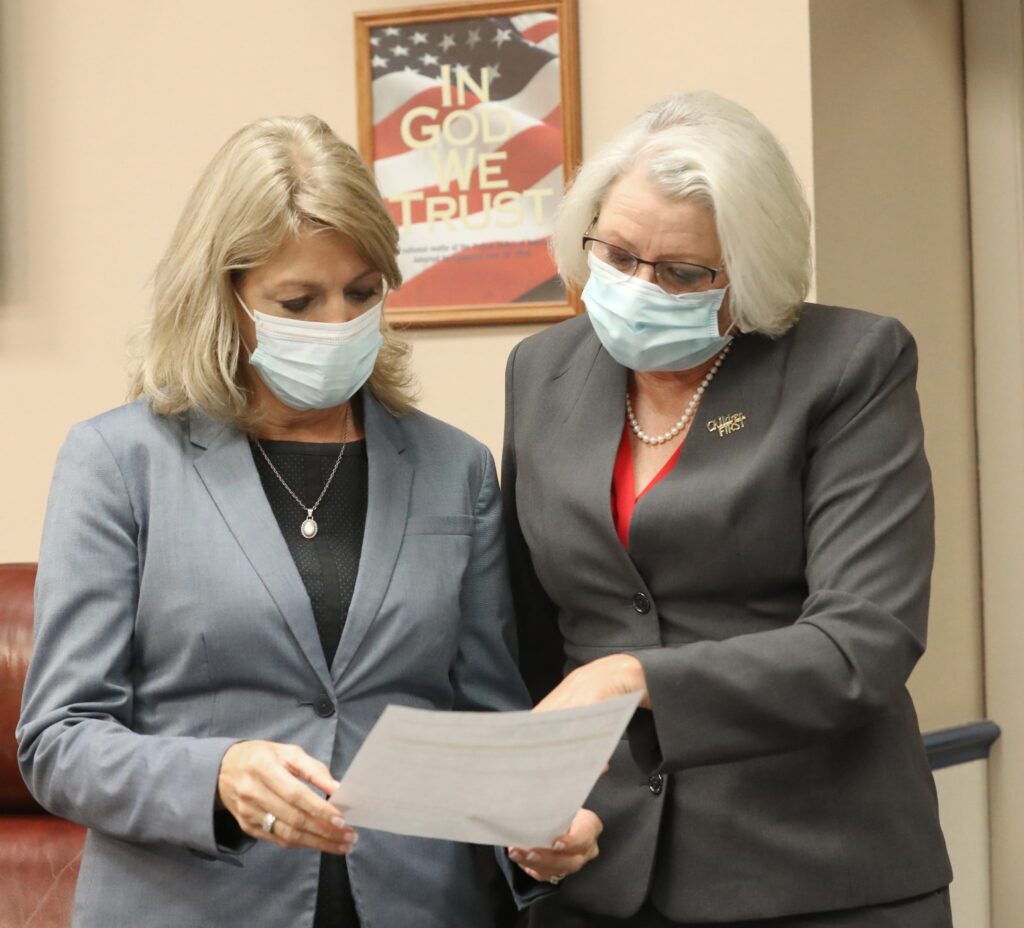
Dr. Diane Gullett, the Superintendent of Marion County Public Schools, left, talks with Nancy Thrower, the board chair, right, during a meeting at the Marion County Public School Board in Ocala, Fla. on Tuesday, Sept. 7, 2021. [Bruce Ackerman/Ocala Gazette]
Dr. Diane Gullett, the Superintendent of Marion County Public Schools, left, talks with Nancy Thrower, the board chair, right, during a September meeting at the Marion County Public School Board. [Bruce Ackerman/Ocala Gazette]
Marion County School Board Chairwoman Nancy Thrower said the school district had the plan ready to go by the following day.
While the new rules are clear, how they will affect COVID-19 cases in schools remains uncertain.
The recent order revised the rule governing when students exposed to COVID-19 can return to school.
Previously, any child exposed to the virus had to quarantine for at least four days and not show symptoms before returning to school. The revised rule leaves the decision to parents, assuming the student is asymptomatic.
Thrower said the revision hopes to keep kids physically present during learning times and not disrupting their learning experience.
“And I certainly understand the spirit in which the emergency order is intended, and it’s all of our intention, which is for kids to be face to face in school as much as possible because we know that’s what’s best for them,” Thrower said.
Dr. Rena Harrington, a pediatrician in Ocala, agreed face-to-face learning is valuable for children on multiple levels.
“We like to keep children in school not just for their academic development, but also because from a developmental and a psychological standpoint, we feel school benefits children,” Harrington said.
But she also sees the benefit of quarantines.
“For me personally, I do feel like they [quarantines] can be helpful. They could be implemented well and helpful,” she said. “Everybody uniformly wants to keep children in school, but we also have to balance with how to keep them physically safe.”
She points to current research showing the efficacy of quarantines on slowing the spread of COVID-19. She also said if there is information showing quarantines are not as effective as thought, Florida should share the numbers.
“But if there is data coming from the state level that suggests quarantines are not effective, it would be really helpful for us as the medical community to see that data.”
Quarantines were one of several steps taken to help reduce the spread of COVID-19 in schools. Others include hand washing, social distancing and masks.
“I do right now very much feel the school district is doing the right thing by continuing to encourage CDC best practices unless we have information that says otherwise,” Harrington said.
She hopes the different local groups can work together to keep the infection rate low.
“I think that our school board, pediatricians locally, the medical community locally and all parents generally want what’s best for their students and for children in general in Ocala,” Harrington said.
Thrower said focusing on preventative measures needs to be on the top of everyone’s mind.
“It’s all that layered mitigation, and if you do that with fidelity, then I think we’ll continue to stay on this good trend,” she said.
The “good trend” Thrower referenced was the recent steep decline in COVID-19 in local schools.
“I think it’s a very good sign that the school numbers are dropping. I think we are seeing the school numbers mirror what’s happening in the community. I just want to make sure that we’re doing the right things to continue that trend,” Harrington said.
Thrower will be watching to see if the new rule revision has any effect on local cases.
“We’ll see what the next couple of weeks brings with this new emergency order and the implementation of it, and hopefully, our numbers will continue to decline even more steeply because that’s what we need,” she said.
Harrington hopes Ocala and Marion County will continue the downward trend.
“I think the endpoint of it all is that everybody wants what’s best for children. If we share data, trying to find ways to keep them as safe as possible but also limit burdens to them as much as possible, it will all work out,” she said.
Thrower agreed.
“In the end, it’s all about continuing to provide grace and compassion to each other and trying not intentionally in any way to put each other and at any more risk if we can avoid it,” she said.

Support community journalism
The first goal of the Ocala Gazette is to deliver trustworthy local journalism so corruption, misinformation and abuse are not hidden from the public or unchallenged.