United Way of Marion announces strategic shift
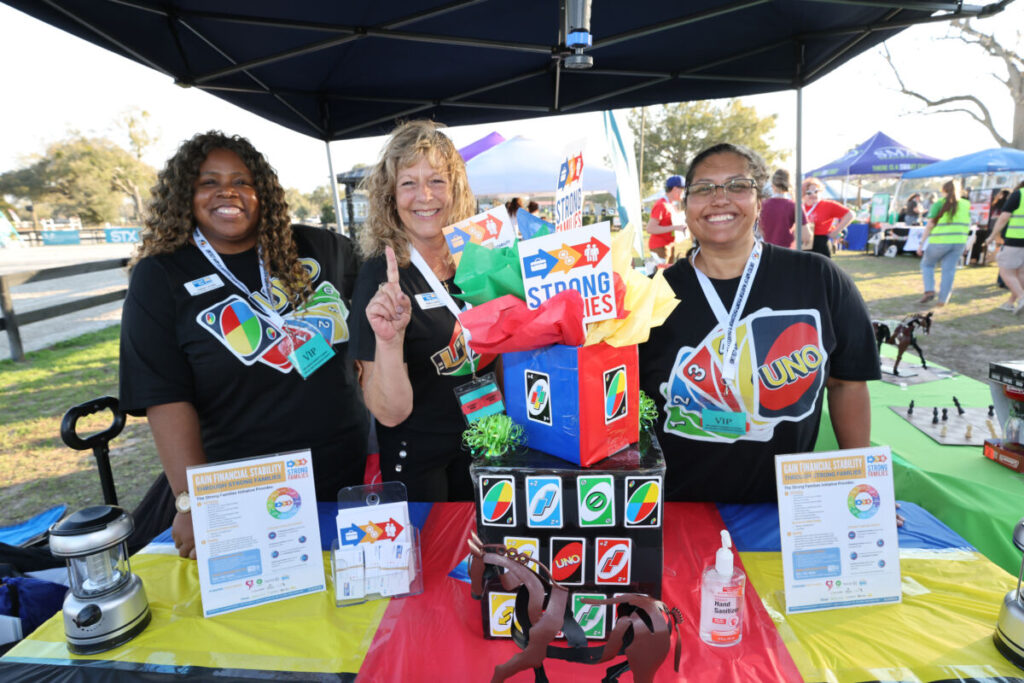
File photo: Chrissy Vickers, Pebbles Vance and Mayra Usme, left to right, pose together at their United Way UNO booth during the Children’s Charity Classic at HITS Post Time Farm in Ocala, Fla. on Friday, Feb. 20, 2026. [Bruce Ackerman/Ocala Gazette] 2026.
By Jennifer Hunt
The United Way of Marion County (UWMC) is undergoing a major transition this summer. Along with launching a new strategic framework that shifts its funding model toward four targeted community impact pillars, the organization has announced Natalie McComb as its new interim president and CEO following the retirement of President and CEO Robert Haight.
Historically, UWMC operated under what Haight described as a model of “deficit funding” and “vision councils,” acting as a “pass-through organization.” Under that approach, UWMC issued requests for proposals and awarded smaller grants to community agencies, funding 19 organizations last year.
Haight explained the limitations of that model, noting, “we’re not very deep in any organization. If you have a $3 million budget and we’re giving you 20,000 maybe it’s important, and it probably was, but it’s not critical.”
To have a greater impact, UWMC is shifting away from spreading funding across numerous small grants and instead taking a “deeper dive” into four community priorities: Youth Opportunity, Financial Security, Healthy Community, and Community Resiliency.
“These changes represent an important step forward for our community. As Chair of the United Way of Marion County, I’m proud that we’re focusing our resources where they can make the greatest measurable impact—helping children succeed in school, strengthening financial stability for families, improving access to healthy food, and ensuring our community is better prepared to recover from future challenges. This strategic framework reflects months of listening, collaboration, and careful planning. By bringing together businesses, nonprofits, government, and volunteers around our community’s most pressing needs, we’re creating lasting solutions rather than simply responding to problems. That’s how we build a stronger, more resilient Marion County for everyone,” wrote Alan Keesee, chair of the United Way of Marion County Board of Directors.
Haight said the new strategic framework is not a departure from UWMC’s mission but the next logical step, stating, “as the communities changed, [United Way is] trying to change with it.”
McComb, who assumes leadership July 27, told the Gazette, “the strategic framework reflects the focused, measurable impact our community deserves, and I’m honored to step into this role at such a pivotal moment. It gives us a clear roadmap, and I’m eager to lead our team in turning that vision into tangible outcomes for youth, families and individuals across our community.”
Here is a breakdown of the four pillars, highlighting what is new and what is changing from existing programs:
Youth Opportunity
This pillar allocates $1 million to foster learning, improve literacy and remove barriers to education.
What’s new: The Thrive Tutoring Program is a new $200,000 initiative. Instead of providing grants to outside agencies to operate after-school programs, UWMC is collaborating directly with Marion County Public Schools to provide about 180 hours of in-school tutoring across seven Title I elementary schools. The tutors will be district employees.
What’s continuing: UWMC will continue its Community Partnership Schools at College Park and East Marion, funded largely through an approximately $700,000 contract with UCF. The organization is also expanding recruitment for its ReadingPals mentoring program. While the program has relied heavily on retirees, UWMC is now targeting younger professionals and local businesses to adopt schools and mentor students.
Financial Security
With a $500,000 budget, this pillar aims to address generational poverty, improve family stability and remove barriers to employment.
What’s new: Champions for Employment is a new $100,000 collaborative initiative. The program will partner with the business community to connect employers with hard-to-fill entry-level positions to individuals facing social or cultural barriers to employment. The initiative also aims to provide on-site coaching and mentoring to improve retention and soft skills, although agreements are still being finalized. Haight told the Gazette the program could help people with criminal histories find employment.
What’s continuing: UWMC is investing an additional $300,000 into its Strong Families program. With new grant funding from Marion County, the organization is doubling the number of participants supported through that grant from 15 to 30. UWMC will also continue operating the free Volunteer Income Tax Assistance (VITA) program through a $100,000 IRS grant.
Healthy Community
Reframing nutrition as a health care issue, this pillar dedicates $200,000 to addressing food insecurity and food deserts in Marion County.
What’s new: UWMC determined that food access is often limited by transportation and storage rather than a lack of donated food. The organization is launching the 2.4 Million Meals Campaign, investing $100,000 to lease a facility and partner with Second Harvest Food Bank to establish short- and long-term refrigerated storage. The project will allow 48 food pantries throughout Marion County to store and distribute more perishable food.
What’s continuing: UWMC has long supported Marion Senior Services’ Meals on Wheels program through grants. A new campaign, Nourish Now, will provide an additional $100,000 for the program that delivers prepared meals five days a week to homebound seniors. Recognizing the approximately 1,000 seniors on the waiting list, UWMC hopes to work with Marion Senior Services and Second Harvest Food Bank to establish mobile food pantries that can deliver food directly into neighborhoods while seniors await approval for home-delivered meals.
Community Resiliency
This pillar focuses on disaster preparedness and long-term recovery following emergencies.
What’s new: UWMC is making an initial $35,000 investment to serve as the administrative host for a new Long-Term Recovery Group. Working with the Marion County Sheriff’s Office Emergency Management Division and the Florida Department of Health, the group will conduct tabletop exercises, establish subcommittees for housing, employment and other needs, and secure reserve funding.
Haight told the Gazette the structure is entirely new for Marion County and is designed to manage long-term recovery efforts and incoming funding after state and federal agencies, including FEMA, leave the area. He added that state and federal agencies often rely on organizations like this to distribute disaster relief funding.

Support community journalism
The first goal of the Ocala Gazette is to deliver trustworthy local journalism so corruption, misinformation and abuse are not hidden from the public or unchallenged.