
Policy vs. practice
Records show ‘suicide precaution’ rules were ignored for two Marion County jail inmates.
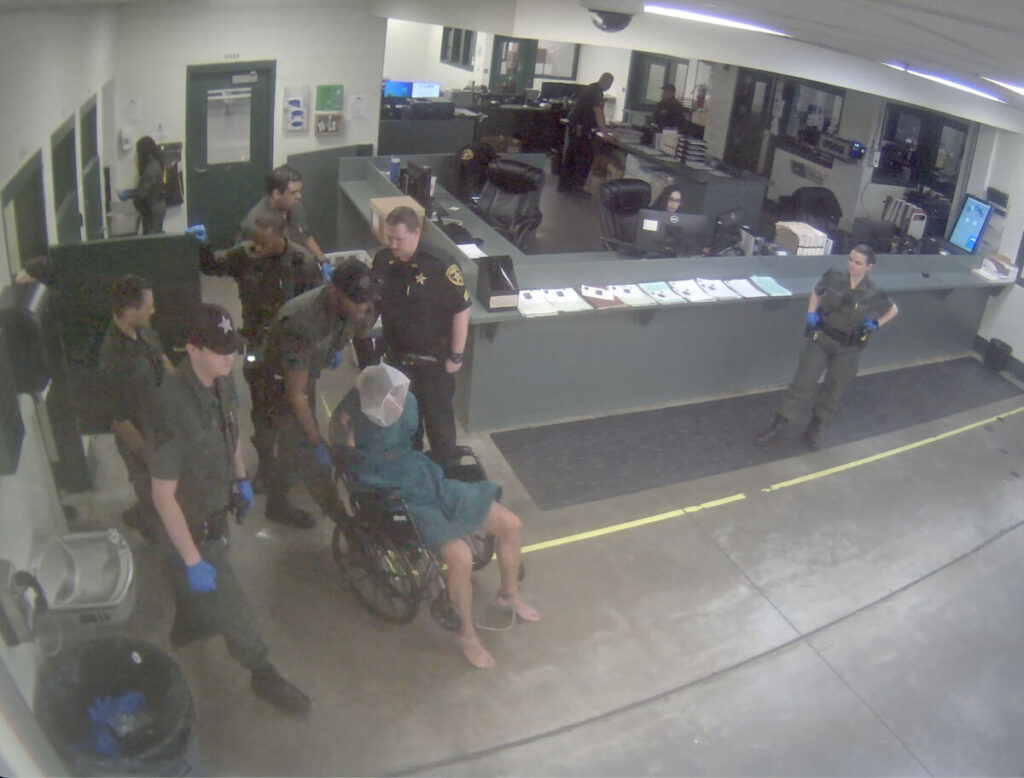
Zachary Altom being wheeled out of the changing room in booking at the Marion County Jail after an altercation involving eight detention deputies on Jan. 2, 2025. Altom is slumped in the wheelchair, hands and ankles shackled, with a spit guard over his head. He was immediately wheeled to a nearby nursing station after. [Screenshot from Marion County jail footage]
Two men. Two violent encounters inside the same booking room at the Marion County Jail. Both were placed on “suicide precaution” after the use of force, a designation intended to trigger heightened medical monitoring and protection. Instead, records and jail video reviewed by the “Ocala Gazette” show both men were housed in the same cell, denied key safeguards required by policy and left vulnerable to serious harm.
Under state standards and the Marion County Sheriff’s Office’s internal policies, the protocol for handling an inmate on “suicide precaution” is designed to be a rigorous medical and security safety net. According to the Florida Model Jail Standards (FMJS), any inmate identified as a suicide risk must be monitored under “close supervision or direct observation,” which requires documented physical checks by correctional or medical staff at intervals not exceeding 15 minutes.
Furthermore, Marion County Sheriff’s Office Policy 6766.00 strictly dictates that “single-cell occupancy shall be made available” for inmates suffering from serious mental illness or who exhibit a demonstrated history of aggressiveness, which leaves us with the question: If jail staff genuinely believed the men posed a danger requiring significant uses of force by detention deputies because of their behavior, why immediately following were they placed in a shared cell with other inmates requiring heightened protection and monitoring?
A review of the jail video and medical records obtained by the “Gazette” for inmates Dennis DiGenova and Zachary Altom, with the help of their families, reveals a terrifying reality. In both cases, the written policies meant to protect constitutional rights were abandoned after both men were subjected to violent uses of force, resulting in severe medical neglect and unsafe housing placements.
The case of Dennis DiGenova
In July 2023, 73-year-old Vietnam veteran Dennis DiGenova was brought into the jail’s booking room, where he refused to comply with a strip search. In response, deputies deployed pepper gel into his face, forced him to the ground, drive-stunned (TASER electrodes directly against a subject’s body) him and shot him with Taser probes.
Following this violent takedown and a decontamination shower, nurse Jamie Leacock evaluated DiGenova and explicitly noted that he was to be placed on suicide precaution because he was repeatedly stating, “You better Baker Act me.”
The state’s Baker Act allows for the involuntary detainment and psychiatric examination of an individual who is experiencing a mental health crisis.
Despite DiGenova’s suicidal status, his age and the violent encounter he had just experienced, deputies locked him in Medical Pod Delta, Cell 107, with five other inmates. Instead of receiving the urgent medical and psychiatric care his condition demanded, DiGenova was left to languish in the small cell, racking up multiple “disciplinary” reports over the next two days for “refusing” his meals.
Jail surveillance video footage from cell 107 shows guards leaving DiGenova on the floor of the cell. He would never stand again and languished in his own urine and feces for two days until the morning of July 20, when a nurse found him lying on the cell floor in the same position he had been in the day prior. He was unable to answer questions or make his needs known and had labored breathing with a dangerously low oxygen saturation level of 75%.
He was eventually transported to a hospital, where doctors discovered the horrifying truth: DiGenova had suffered a C7 spinal cord transection—a broken neck that paralyzed him and ultimately led to his death.
The case of Zachary Altom
A year and a half later, the same systemic failures repeated themselves with Zachary Altom, a 29-year-old disabled veteran.
In January 2025, Altom was arrested by Ocala Police Department officers while experiencing a psychiatric crisis. At the jail, he was beaten by eight detention deputies in the same small booking room where DiGenova had been held.
Evaluating Altom after the struggle, nurse Tyra Gordon alleged that he was “shadow boxing and punching the air” and acting aggressively, prompting her to place him on suicide precaution.
But the jail footage does not reflect that. Instead, it shows Altom being wheeled out of the booking room to the nurses’ station, seemingly unconscious, with his hands and ankles shackled.
He would recall the beating to the “Gazette” more than a year later as “the worst beating he’s every received.”
It was at this point that Altom’s constitutional right to adequate medical care was bypassed entirely. In a glaring violation of contracted medical policy, nurse Gordon marked “Referral NOT required” on Altom’s medical plan. This single checkmark effectively ensured that Altom would not be evaluated by a licensed psychiatric professional, despite his highly visible, active psychotic breakdown.
Then, defying the sheriff’s policy requiring single-cell housing requirement for allegedly aggressive and mentally ill inmates, deputies placed Altom in Medical Pod Delta, Cell 107—the same cell where DiGenova was previously confined.
According to jail reports that have not been verified yet with video evidence, Altom was locked in with two other inmates. Just over an hour later, MCSO jail reports indicate a fight broke out in the cell. Jail personnel say Altom attacked his cellmates, forcing deputies to extract him and leaving Altom with severe, unexplained facial and abdominal injuries.
A broken safety net
Neither the Florida Department of Law Enforcement nor the State Attorney’s Office has independently investigated the death of DiGenova or the severe beating of Altom.
DiGenova’s family, however, has brought a lawsuit in federal court against Marion County Sheriff Billy Woods for violating the prisoner’s constitutional rights.
The Florida Model Jail Standards exist to prevent the cruel and unusual punishment of inmates, most of whom are being held in jail awaiting a court date and who have not been convicted of a crime.
Yet, in Marion County, the “suicide precaution” status failed to provide any actual precaution. By failing to provide immediate psychiatric referrals post-force, ignoring mandatory single-cell housing policies and abandoning vulnerable, beaten men in cell 107, the system stripped both DiGenova and Altom of their right to basic safety and medical care.
Internal affairs for MCSO have not corrected use of force reports that omitted blows by detention officers despite the audio and photographic evidence that it happened. Instead, the agency concluded that there were no policy violations.
Case law related to the Eighth Amendment prohibiting “cruel and unusual punishment” and the 14th Amendment of the U.S. Constitution, which holds that no state shall “deprive any person of life, liberty, or property, without due process of law; nor deny to any person within its jurisdiction the equal protection of the laws,” clearly require more than just medical malpractice or negligence. An element that must be established is, “knowing disregard.”
In the landmark opinion “Estelle v. Gamble,” the Supreme Court concluded “deliberate indifference to serious medical needs of prisoners constitutes the ‘unnecessary and wanton infliction of pain,’ Gregg v. Georgia, supra, at 182-183, 96 S.Ct. at 2925 (joint opinion), proscribed by the Eighth Amendment.
This is true whether the indifference is manifested by prison doctors in their response to the prisoner’s needs or by prison guards in intentionally denying or delaying access to medical care or intentionally interfering with the treatment once prescribed. Regardless of how evidenced, deliberate indifference to a prisoner’s serious illness or injury states a cause of action under § 1983.
In the deposition transcript, the whistleblower, Mary Coy, testified she told then-Major Clint Bowen and Capt. Alesia Chisholm, who oversaw the jail, that she felt compelled to speak of her concerns regarding inmate health and care.
Coy said that in response to her concerns, Bowen said her statements could bring litigation against Sheriff Billy Woods, to which she said, “I am a nurse as well, and that makes me a mandatory reporter.”



Support community journalism
The first goal of the Ocala Gazette is to deliver trustworthy local journalism so corruption, misinformation and abuse are not hidden from the public or unchallenged.