
Horse Farms Forever hosts Corridor Connect conservation expo
Keynote speaker Ben Masters informed attendees with a wide-ranging talk about wild mustangs, the Florida panther and Texas ocelots.
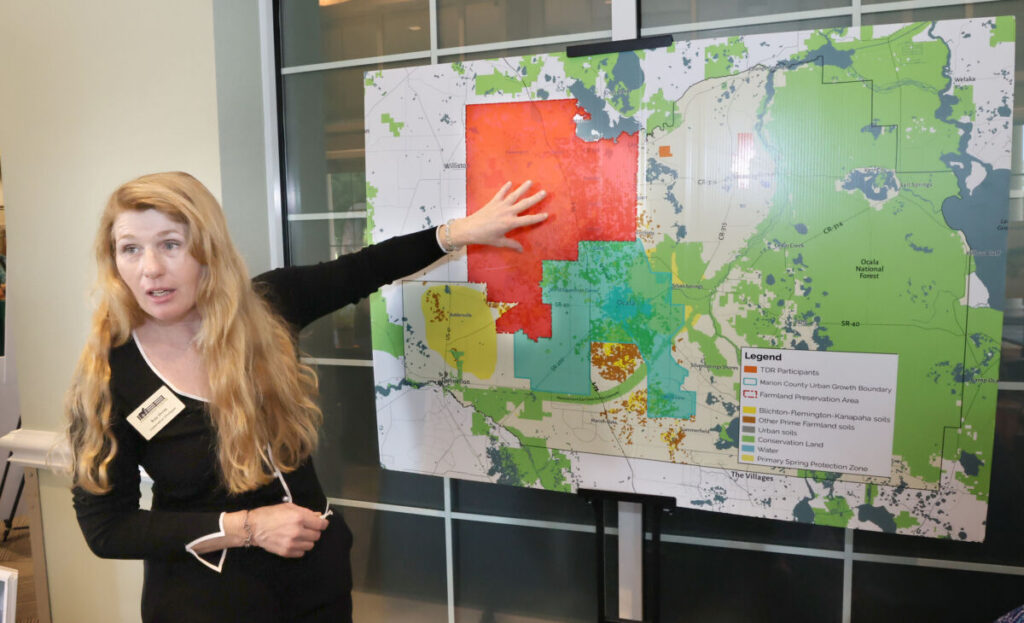
Busy Shires, the director of Conservation Strategies for Horse Farms Forever, talks to people about boundaries on a Horse Farms Forever map during Corridor Connect+ LIVE hosted by The Florida Wildlife Corridor Foundation, in partnership with Horse Farms Forever, at the Circle Square Cultural Center in Ocala, Fla. on Wednesday, May 20, 2026. [Bruce Ackerman/Ocala Gazette] 2026.
With self-deprecating humor and nods to the Florida-Texas wildlife connections, National Geographic Explorer and filmmaker Ben Masters entertained more than 300 people at the 2026 Horse Farms Forever spring speaker series.
The partnership with the horse-centric Marion County conservation organization and the Florida Wildlife Corridor Foundation included a panel discussion about conservation and a landowners expo offering more than a dozen statewide organizations promoting conservation easements and others ways to protect private lands.
In a bid to save the endangered Florida panther species that were so inbred as to have kinks in their tails, cougars from Texas were imported and released to expand the gene pool in 1995. Since then, panther populations have increased to an estimated figure of more than 200 cats today and the species has benefited from genetic diversity.
“We solved your kinky tails problem,” Masters said with a laugh.
Speaking with a subtle Texas drawl, Masters acknowledged the similarities between the two states, such as large ranching operations and the importance of agricultural in the economy as well as important connections between Florida panthers and Texas cougars.
Masters, who headlined the May 20 event at the Circle Square Cultural Center at On Top of the World, is a renowned conservationist and filmmaker. His award-winning movie “Unbranded” was his first foray into wildlife storytelling. It tells the journey of four cowboys, 16 wild mustangs and traveling 3,000 miles from Mexico to the Canadian border. Masters filmed it while riding with the group and to bring attention to the wild mustangs that can be adopted through Bureau of Land Management programs.
“Films can have a large impact” for positive change, he said, noting that movies can show audiences the many challenges that wildlife faces and create an emotional connection to the animals, which can encourage preservation and conservation of lands.
Masters showed excerpts from two other of his films, one about Texas cougars and his work-in-progress about endangered ocelots that live in the southernmost portion of east Texas. It’s estimated there are fewer than 120 ocelots in the United States and he has been encouraged by the positive response he has had from ranchers who want to preserve their land and co-exist with carnivores on their lands.
“They can create safe harbors for these small cats,” Masters explained, and provide places for them to hunt, live and breed alongside cattle and horses.
Marion County a critical link for wildlife in Florida
Pegeen Hanrahan, the associate director of conservation finance with the Trust for Public Land, reminded the audience how crucial the Marion County area is to Florida’s wildlife.
“Ocala is one of the most important wildlife environments,” in the state, she said.
The proximity of Silver Springs, Rainbow Springs, the Ocala national Forest, the Marjorie Harris Carr Florida Greenway and the Rainbow River create an enclave of opportunities for conservations that can benefit both humans and wildlife, she said.
Marion County is a key part of the Florida Wildlife Corridor that ranges from the Everglades to the Panhandle. In Marion County, it’s comprised of the forest and the Greenway, which crosses part of the state from the St. John’s River to the Gulf of Mexico in Citrus County. The swath of ranches, agricultural areas and native forest and swamp areas statewide comprise 10 million acres of safety for wildlife to travel, live and breed.
Everyone can help
You don’t have to own hundreds of acres to help conservation efforts, said Keith Fountain, an attorney who specializes in conservation easements, tax incentives and purchase contracts for those wanting to preserve and protect lands.
For a typical suburban homeowner, he said, people can donate to various organizations and ensure state representatives provide funding and political support for state programs, such as Florida Forever. Another program that warrants support, he suggested, is the Rural and Family Lands Protection Program, which focuses on land preservation for working agricultural lands.
Fountain said one-third of document stamps fees are earmarked specifically for land conservation in Florida and the programs need $250-300 million per year to continue their work.
To learn more, go to horsefarmsforever.com



Support community journalism
The first goal of the Ocala Gazette is to deliver trustworthy local journalism so corruption, misinformation and abuse are not hidden from the public or unchallenged.