
Rural rules revised
New law shifts oversight of farmland development away from local authorities.
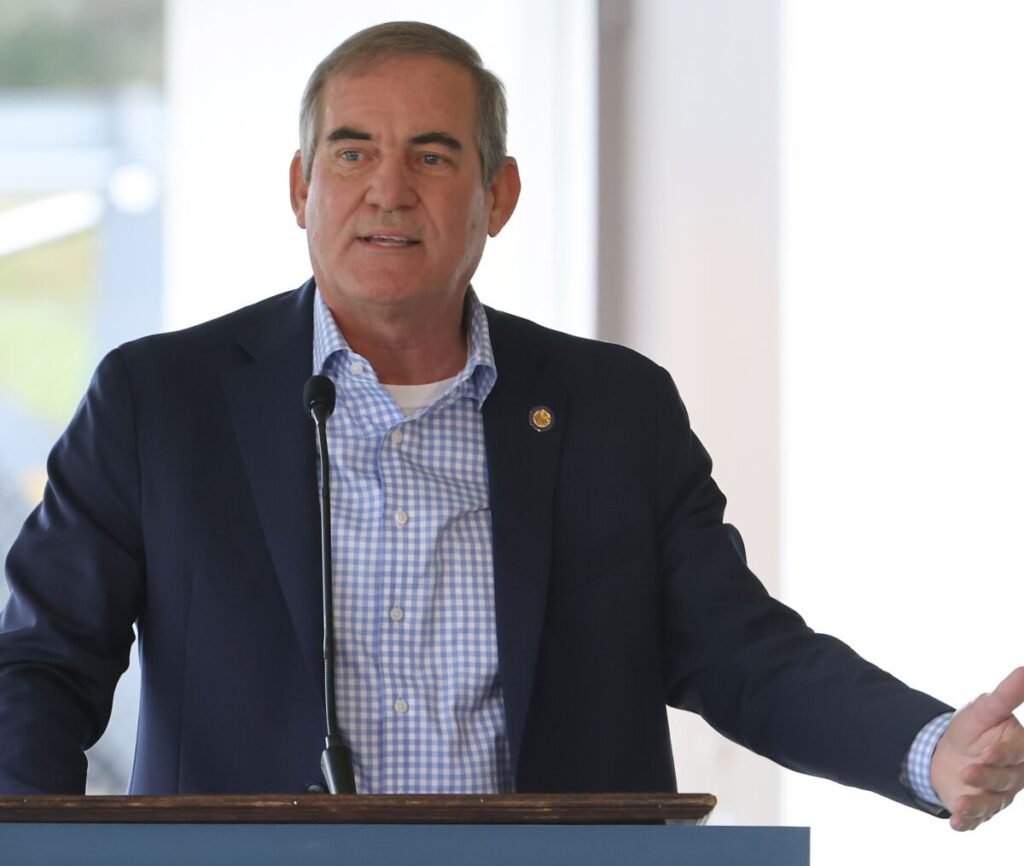
Sen. Stan McClain, R-Ocala, speaks during a press conference in Marion County on Feb. 25, 2025. [Bruce Ackerman/Ocala Gazette file photo]
A new measure aimed at expediting the development of certain agricultural lands is now law, marking a significant shift in how local governments can manage growth and development.
Gov. Ron DeSantis signed Senate Bill 686, sponsored by State Sen. Stan McClain, on April 20. The legislation passed the Florida House of Representatives with support from local representatives Richard Gentry, Ryan Chamberlin, and J.J. Grow, while Yvonne Hayes Hinson did not cast a vote.
The law fundamentally rewrites Florida’s development review process for properties classified as “agricultural enclaves.” These properties are specifically defined as unincorporated, undeveloped parcels in counties with a population of 1.75 million or less that meet the following criteria as of Jan. 1, 2025:
- Owned by a single person or entity and in continuous use for bona fide agricultural purposes for at least five years.
- Surrounded on at least 75% of their perimeter by industrial, commercial, or residential development.
- Alternatively, the 75% perimeter can be met if the surrounding land is designated for such development in the local comprehensive plan and is already 50% developed, or if it is a combination of an interstate highway and parcels within an urban service district.
- Other eligible configurations include parcels under 700 acres that are 50% surrounded by land designated for development and 50% surrounded by an urban service district, or parcels located within an established rural study area intended for residential use.
- The property must have public services available, scheduled, or funded by the applicant.
- The enclave cannot exceed 1,280 acres, unless it is 75% surrounded by authorized residential development resulting in a density of at least 1,000 residents per square mile, in which case it can be up to 4,480 acres.
The legislation could impact local policies, specifically overriding key elements of the Marion County Comprehensive Plan 2045. Under Marion County’s current plan, the conversion of “Rural Land”—which typically restricts density to one dwelling unit per 10 acres—to more intense residential or commercial uses requires a strict comprehensive plan amendment.
Applicants must demonstrate that the conversion will not result in urban sprawl, that public infrastructure is available, and they must justify the development’s relationship to the county’s established Urban Growth Boundary (UGB). The county relies on the UGB to discourage urban sprawl and direct long-term capital improvements to specific areas.
SB 686 allows property owners to bypass this rigorous local process. Under the new law, local governments must hold a public hearing and certify qualifying applications within 90 days of the application being filed; if they fail to do so, the property is certified automatically. Once certified, the owner can submit development plans for single-family residential housing that matches the density and intensity of adjacent parcels and the local government must treat these development plans as a conforming use, regardless of any conflicts with the local comprehensive plan, future land use designation, or existing zoning.
In a statement to the “Gazette,” McClain – whose district represents all of Marion- said “the Marion County Urban Growth Area and Farm Preservation Area do not overlap, meaning the vast majority of the 200,000 acres of the FPA is unaffected by the amendment.
“Because of the protections in the amendment, there are possibly only a handful of small parcels outside and along the boundary of the UGA that could qualify, though conducting that analysis is fact intensive. Because of these carefully crafted protections, it likely means over 99.9% of the FPA remains protected. Additionally, the language reverts to the pre-2026 amendments in 18 months, and I have not heard of any owners of parcels abutting the UGA and within the FPA that looking to utilize the new process,” McLain said in the statement.
This state-level override has sparked significant concerns among local government advocates. The Florida Association of Counties warned that the bill severely reduces local discretion over land use decisions. The association highlighted that counties are now forced to process these applications on a strict statutory timeline—including entering into a written approval schedule within 30 business days and wrapping up the entire process within 180 days, without requiring another quasi-judicial hearing.
Furthermore, counties are prohibited from imposing requirements that are more burdensome than those applied to comparable development applications and must treat enclaves adjacent to an urban service district as if they are already inside that district. The fast-tracked system is expected to create administrative pressure on planning, legal, and infrastructure review staff, increase litigation risks, and trigger unforeseen growth-management challenges.
These enclave provisions take effect on July 1 and are slated to automatically expire and revert to the previous statutory language Jan. 1, 2028, unless amended by future legislation.

Support community journalism
The first goal of the Ocala Gazette is to deliver trustworthy local journalism so corruption, misinformation and abuse are not hidden from the public or unchallenged.