
Initial water tests after Dunnellon rail tie fire
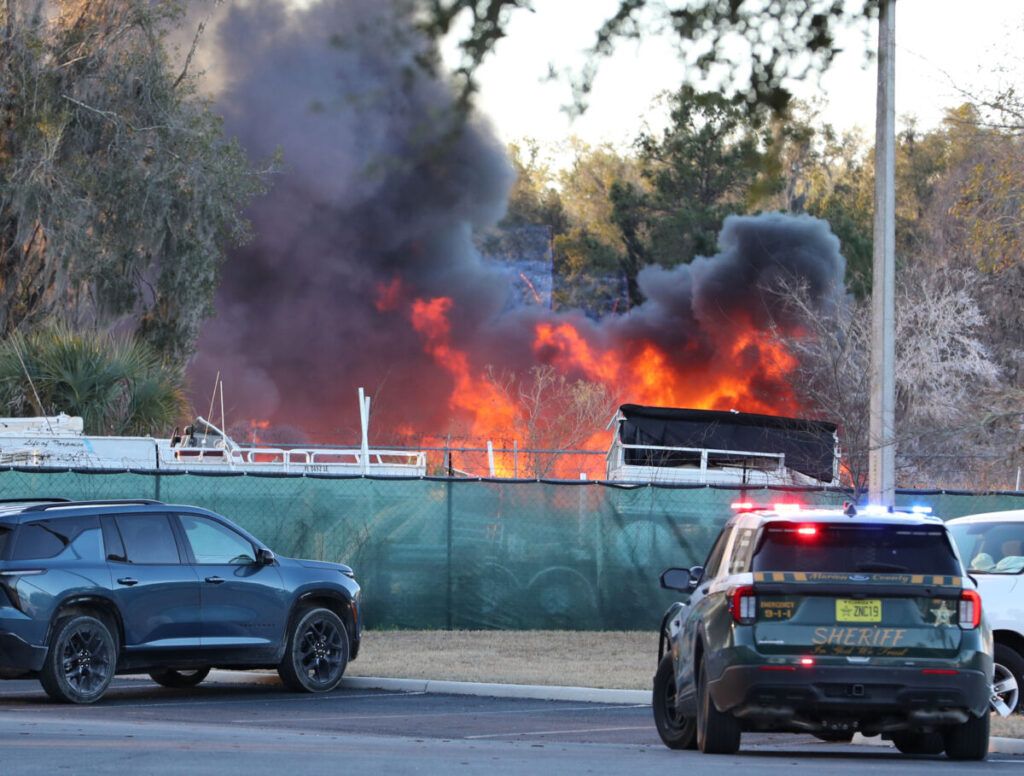
A raging inferno is shown as raliroad ties burn behind the Comfort Suites in Dunnellon, Fla. on Sunday, February 1, 2026. [Bruce Ackerman/Ocala Gazette] 2026.
By Jennifer Hunt Murty
Editor’s Note: This story was updated on Feb. 25 with additional information from the Florida Department of Health.
Preliminary results of water tested after the massive fire that burned thousands of creosote-soaked railroad ties earlier this month in Dunnellon indicate that contamination levels have not breached state safety limits, records show.
A closer look at the testing protocols, however, reveals gaps.
While public wells were tested for Volatile Organic Compounds, or VOCs, the surface water testing only looked for heavier Semivolatile Organic Compounds, or SVOCs. Highly soluble and mobile chemicals found in creosote, such as benzene and toluene, were not analyzed by the CSX contractors.
Despite public pleas at a Feb. 9 Dunnellon City Council meeting to test for highly toxic dioxins, which can form when treated wood burns, a representative of CSX Transportation confirmed they were sticking to the approved plan and were not testing for dioxins “at this time.”
The ties, owned by Track Line Rail, were stored on a rail line leased to Florida Northern Railroad on land owned by CSX Transportation.
Early on Feb. 1, a fire ignited a stockpile of approximately 100,000 railroad ties. The blaze burned intensely, blanketing nearby neighborhoods in heavy smoke and raising immediate environmental concerns. Those worries soon spread to include the groundwater, after firefighters sprayed water on the blaze for hours before extinguishing it.
Authorities and contractors waited several days after the fire before testing the local water supply and surface waters to determine if contamination had spread.
Public and private well testing
The first water testing occurred on Feb. 5. The Florida Governmental Utility Authority (FGUA) contracted Advanced Environmental Laboratories (AEL) to collect samples from four public drinking water wells located within a mile of the incident: Dunnellon Wells #1 and #3, and Rio Vista Wells #5 and #6.
The lab analyzed these samples for metals, VOCs, and SVOCs. On Feb. 19, FGUA issued a press release confirming that none of the results exceeded the maximum contaminant levels.
The detailed lab reports showed no detections of creosote indicators like benzene, toluene, or naphthalene. The lab did detect trace, estimated amounts of arsenic (0.49 µg/L) in Dunnellon Well #1, well below safety limits, which FGUA attributed to natural deposit erosion rather than the fire. Trace chloroform was also detected, but considered a standard by-product of drinking water disinfection.
When it comes to private well testing, residents like Michael Pierce, who lives along the Rainbow River and who estimates his well to be a half mile from the fire, said he believes the health department tested his well, but he’s yet to receive the results.
Pierce said a health department official told him that they would monitor his well for a year.
According to a Feb. 25 email from DOH-Marion spokesperson Nina Mattei, the agency sampled a total of seven private wells within a half-mile radius of the fire between Feb. 11 and Feb. 18. These water samples are currently being analyzed for heavy metals—specifically copper, chromium, and arsenic—along with volatile and semi-volatile organic contaminants (VOCs and SVOCs). The health department is still awaiting the final laboratory analysis, with results anticipated to arrive by late February or early March Mattei wrote.
Surface Water Testing by CSX Contractors
Surface water testing was delayed even further, taking place on Feb. 7, six days after the fire began. CSX’s environmental contractor, Arcadis, collected five surface water samples from Blue Cove Lake, Blue Cove, the Rainbow River downstream of the boat ramp, Blue Run Park, and a background sample at KP Hole Park.
These samples were sent to Eurofins Environment Testing in Orlando and analyzed exclusively for SVOCs) using EPA Method 8270E. According to a statement from CSX, “All SVOCs reported in the five samples were detected at concentrations less than their respective [FDEP] surface water cleanup target levels.”
The lab data did reveal trace, estimated detections of specific chemicals, including naphthalene at 0.036 µg/L in the river sample downstream of the boat ramp, and 2,4-Dichlorophenol at 0.22 µg/L in Blue Cove.
CSX’s Future Plan for Water Monitoring
Currently, there is no mandate for immediate, active groundwater monitoring at the burn site. According to the “Source Removal and Surface Water Sampling Work Plan” prepared by Arcadis and approved by the FDEP, groundwater evaluation is entirely conditional.
The plan dictates that crews will excavate the burn area up to two feet deep and collect confirmation soil samples from the bottom and sides of the excavation. CSX will only install downgradient groundwater monitoring wells (one shallow and one intermediate) if the analytical results from those soil samples exceed the FDEP Soil Cleanup Target Levels (SCTLs) for leachability. If the soil passes the leachability test, no deep groundwater wells are slated to be installed at the site.
__________________________________
View air and water test results received using this link: https://www.dropbox.com/scl/fo/vfjjfze1g0zqxwjnoax4f/AKAIIqc5TzBPR4IIFuKwTFE?rlkey=hxbnd3tsiuej6kpi2inq3kqmp&st=og30klp9&dl=0

Support community journalism
The first goal of the Ocala Gazette is to deliver trustworthy local journalism so corruption, misinformation and abuse are not hidden from the public or unchallenged.