
Marion County Fire Rescue staffing data highlights costly recruitment challenges amid contract talks
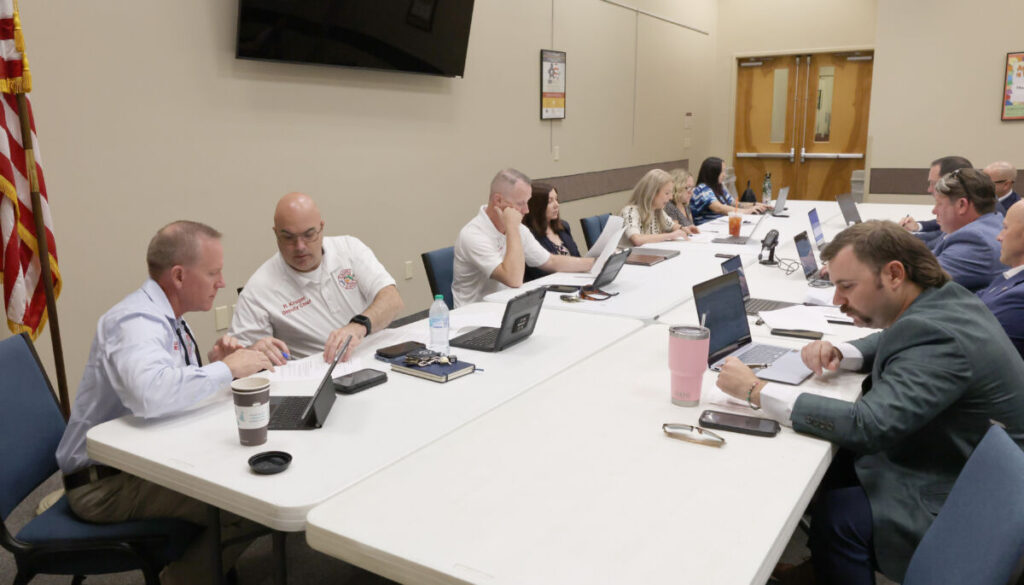
File photo: Marion County Fire Rescue Chief James Banta, left, and Deputy Chief Robert Kruger, second from left, confer during a meeting with the Marion County Board of County Commissioners and the Marion County Professional Firefighters Local #3169 at the Ocala Public Library Headquarters in Ocala, Fla. on Monday, Nov. 17, 2025. [Bruce Ackerman/Ocala Gazette] 2025.
|
Getting your Trinity Audio player ready...
|
By Jennifer Hunt Murty
As Marion County Fire Rescue and the Professional Firefighters of Marion County continue contract negotiations, staffing data presented during bargaining sessions shows the department has struggled to recruit experienced firefighters and paramedics, leading to an increasing reliance on noncertified trainees.
Union representatives said low non-competitive starting wages and work schedule have made it difficult for the department to compete with neighboring agencies that offer higher pay and alternative staffing models. Those agencies, union officials said, have been drawing experienced personnel away from Marion County.
Staffing losses and hiring trends
During a Feb. 9 negotiation session, union officials said the department lost 528 employees over the past five years, averaging more than 100 departures per year. According to data shared during negotiations, experienced dual-certified firefighter/paramedics have largely stopped applying.
In the past two years, the department hired only one dual-certified firefighter/paramedic. Instead, hiring has shifted toward noncertified “trainees” or “cadets” who must complete required training before becoming operational.
Internal hiring figures show that of the 129 employees hired in 2023, 66 were trainees. In 2024, 77 of 134 new hires were trainees. So far in 2025, 57 of the department’s 93 new hires fall into that category.
Trainees receive salary and benefits for 32 weeks—approximately eight months—while attending the fire academy and EMT school. During that period, they cannot staff ambulances or fire apparatus.
Union officials estimated during negotiations that replacing experienced personnel with noncertified hires has cost taxpayers approximately $4.5 million over the past three years.
According to figures presented, the estimated cost of a single trainee includes:
- 32 weeks of pay and benefits: approximately $36,111
- Academy tuition: approximately $7,480
- Uniforms and gear: approximately $4,738
- Orientation costs: thousands of dollars in instructor hours
Employment records show that some trainees don’t stay with the department. In 2025, 44 of the 69 who left the department did not stay for even two years. In 2024, approximately 52 of the 92; and in 2023, 57 of 100 who left the department also worked for less than two years.
Union President Rolin Boyd addressed the issue during bargaining sessions, telling county officials, “We’re not going to be able to keep staffing our department with noncertified individuals… and be the ALS department that our community deserves.”
Work schedules and pay comparisons
Recruitment challenges were also discussed in comparison to nearby departments in the way of schedules and salaries.
“We’re not going to be able to recruit people with $15 to $15.25 [an hour],” Boyd told county negotiators. “That’s the reality of the situation.”
Boyd also pointed to neighboring Citrus County, which he said starts EMTs and paramedics at $6 more per hour.
Marion County firefighters currently work a 24-hour-on, 48-hour-off schedule, averaging a 56-hour workweek. Gainesville Fire Rescue operates under a “Safer Staffing Model” that provides 24 hours on followed by 72 hours off, reducing the average workweek to 42 hours.
Starting pay also differs between the departments. In Marion County, a starting Firefighter/EMT earns $15 per hour, or $43,680 annually based on 2,912 hours worked. Under Gainesville’s recently ratified contract, a starting Firefighter/EMT earns approximately $51,540 annually while working 2,184 hours.
Additional certification pay also varies. Gainesville provides a base salary increase and 10% supplemental pay for paramedics, while Marion County offers a flat hourly add-on.
Gainesville union president David Shuford told the “Gazette” the 24/72 schedule has helped their department recruit experienced personnel from other departments so they were less reliant on the more expensive pipeline of cadets.
Proposals and budget considerations
The county has proposed transitioning paramedics to a 24-hour-on, 72-hour-off schedule, while maintaining a 24/48 schedule for other personnel using a “Kelly Day” system that provides one additional day off every few weeks.
Union leaders said the proposal does not adequately address pay disparities and complicates payroll. They have proposed a $3-per-hour raise for dual-certified staff and a $2-per-hour raise for single-certified staff.
Assistant County Administrator Amanda Tart said the county faces budget limitations.
“We have the budget that we have,” Tart said. “We need to figure out a way to make that budget work.”
Florida’s minimum wage is scheduled to increase to $15 by September, which would place Marion County’s current starting wage at the statewide minimum.
Staffing expansion and recruitment incentives
Last June, Gov. Ron DeSantis signed House Bill 929, which called for firefighter gear free of harmful chemicals, enhanced mental-health monitoring and suicide-risk tracking, and—critically—encourages limiting standard shifts to 42 hours per week to reduce burnout.
However, the state provided no funding for the measure, leaving the counties to figure it out and generating a competitive market for people to switch to departments that could offer more.
MCFR Chief James Banta told county negotiators that implementing a new schedule would require additional staffing. Banta said the department would need to hire 114 new personnel at a cost of $12 million by Oct. 1, 2027, to support 48-hour and 42-hour weekly averages.
Banta and union representatives have previously stated that recruiting experienced personnel from other departments would be necessary to maintain supervisory balance during expansion.
Marion County’s collective bargaining agreement includes provisions that allow recruitment incentives not available in some neighboring departments union contracts reviewed by the “Gazette.” Under the agreement, the fire chief may offer sign-on incentives of up to $5,000 for paramedic or paramedic/firefighter positions, however, Chief Banta indicated the “incentive was used sparingly as it did not yield significant results. It became problematic because half of the payment must be given at six months and the other half once the probation period is completed. Unfortunately, it did not attract additional candidates.”
The current three-year contract expires in June. Once negotiations conclude, any agreement will require approval by union members.

Support community journalism
The first goal of the Ocala Gazette is to deliver trustworthy local journalism so corruption, misinformation and abuse are not hidden from the public or unchallenged.