
Private Henry Thomas: The unrecognized soldier
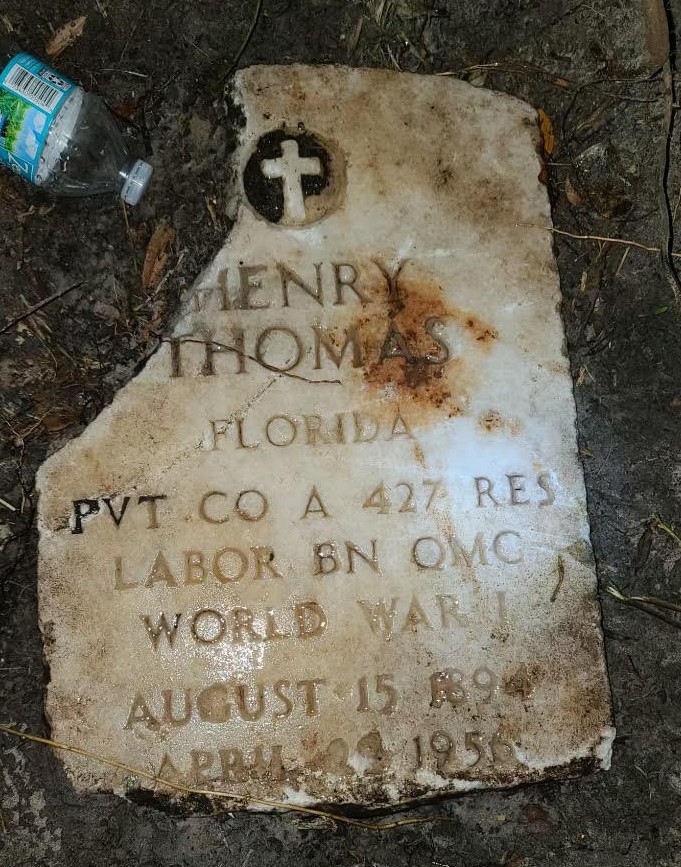
The broken headstone of Pvt. Henry Thomas. [Photo courtesy George Albright]
In 2021 a member of Vets Helping Vets received a phone call that a headstone of a World War One veteran had been found on a farm in Chiefland, in nearby Levy County. It was determined this was the only headstone found and was not part of an old, rural cemetery. With the help of Florida’s Department of Veteran’s Affairs, the life story of Henry Thomas, whose name was on the headstone, came to light, along with his service to our country.
Thomas was an African American man who was born in Jackson, Mississippi in 1894, but grew up in Brooksville, in Hernando County. Growing up, he worked in the wild pine groves, gathering pine sap from the trees to make turpentine.
While WWI was raging, Thomas responded to the call and was inducted into the U.S. Army on April 25, 1918. Immediately, he was shipped to Camp Mills, on Long Island, New York, as a member of the Army Company A, 427th Reserve Labor Battalion. There, the primarily African American battalion of soldiers handled labor intensive projects for the war effort, thus supporting active combat soldiers in the U.S. and Europe. In essence, Thomas and his fellow Black soldiers provided the necessary support and resources for front line troops to win the war overseas.
WWI ended on Nov. 11, 1918, and Thomas was honorably discharged from the Army on March 13, 1919. He returned to his native town of Brooksville, then years later moved to the tiny town of Bell, in Gilchrist County, northwest of Gainesville.
Thomas continued to work in the local wild pine groves, now harvesting pine sap with which to make soap. It was a brutal way to make a living. He lived a quiet, rural life in Bell and died on April 29, 1956, at the Veteran Administration Hospital in Lake City, at the age of 61. The listed causes of death were pneumonia, heart disease and malnutrition. According to his death certificate, he was buried in Cedar Field Cemetery, in Bell, days after his death. In August of 1956, a relative of Thomas’ applied to the VA for a military headstone for him.
Thomas’ headstone was erected on his grave in Bell in late 1956 or 1957. The partially broken headstone was found in a farmer’s field in 2021, 65 years later, in Chiefland, 40 miles away from Bell. We will never know whether vandals possibly removed and discarded the headstone, miles away from the grave site, decades after Henry’s death. What we do know, however, is that these events have publicly brought to life the deeds and service of Private Thomas to his country during a time of world war.
Thomas endured a life of hard labor in Brooksville and Bell, during the Jim Crow era of separate but equal laws in the south. He also endured institutional racism in the U.S. Army, which used African American soldiers mainly for supply, support and labor tasks here in the U.S., rather than being sent to Europe to fight on the front lines. He served his country at the time of war and then returned home to live a quiet unassuming life. But for this abandoned headstone, few if anyone alive would ever remember Henry Thomas of Bell, Florida.
Thomas is one of the countless unrecognized men and women who answered the call to serve our country and asked nothing in return, other than dying with dignity in a VA hospital and receiving a government issued gravestone to proudly display their service to our country.
A diligent search of the town of Bell and the surrounding area concluded that the Cedar Field Cemetery no longer existed, having possibly become a victim of the overgrowth of nature. This sad ending haunts many rural cemeteries in our country nationwide.
Thus, Thomas’ headstone is probably permanently separated from his grave site. However, this broken piece of marble is the tangible symbol of a giant who answered the call to his country, when the very foundations of our country were being threatened by evil abroad a century ago. Henry Thomas, job well done!

Support community journalism
The first goal of the Ocala Gazette is to deliver trustworthy local journalism so corruption, misinformation and abuse are not hidden from the public or unchallenged.