
Locals ponder how to help those who can’t help themselves
Screenshot
By Jennifer Hunt Murty
National data underscores the growing urgency of local discussions about the need for mental health resources to serve a growing population, who, if left untreated, could become a threat to the public.
According to the 2023 National Survey on Drug Use and Health, approximately 58.7 million adults—nearly one in four of the adult U.S. population—experienced some form of mental illness in 2023. Of those, an estimated 14.6 million adults suffered from a serious mental illness (SMI) that substantially limited major life activities.
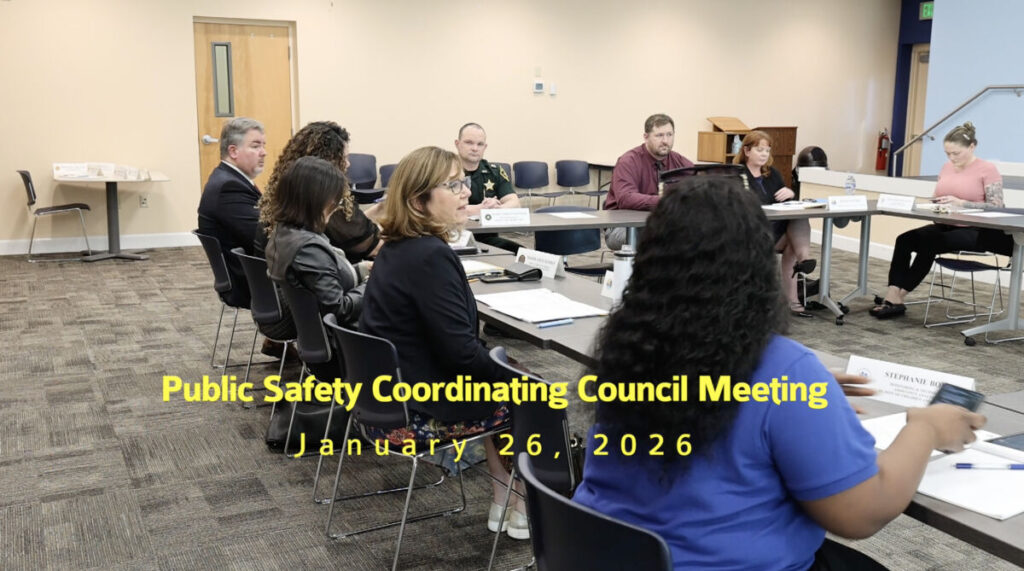
The intersection of mental health and criminal justice has become the focal point of recent Public Safety Coordinating Council (PSCC) meetings, as local officials grapple with a lack of state hospital beds, rising costs and concerns regarding the treatment of mentally ill detainees.
The PSCC is tasked under Fla. Stat. 951.26 with assessing the county’s jail population, coordinating public safety initiatives between agencies, and overseeing criminal justice reinvestment grants. The board has spent its last two quarterly meetings acknowledging something needs to be done to address the challenges faced by the local Marion County jail from becoming a holding facility for individuals who require psychiatric care rather than incarceration. The group meets quarterly in publicly noticed meetings and is subject to the state’s Sunshine Law.
A system strained by a lack of resources
During the council’s October 2025 meeting, Marion County jail officials reported a downward trend in the overall inmate population, attributed largely to the court system processing cases more efficiently. However, a specific segment of that population remains stuck in a “revolving door,” officials said.
Major Charles McIntosh of the Marion County Sheriff’s Office highlighted the strain caused by the lack of state resources. As of October, 33 inmates were in the jail waiting for a bed at a state hospital. “The state has no beds. So unfortunately, they stay with us until a bed becomes available,” McIntosh said.
While the jail provides medical services, McIntosh emphasized that a county jail lacks the capacity to provide the level of care found in a state mental health facility. McIntosh noted that some of the mentally ill are in jail for “petty crimes.”
Although the county does have a mental health diversion court program, it is very limited in its capacity and most individuals charged with resisting officers with violence due to a confused mental state don’t qualify.
Commissioner Kathy Bryant, who has served as the board’s chair since its inception, said during an October meeting that the county may need to build a special facility, possibly near the jail, to house that population so their unique needs could be met. Bryant asked Alina Stoothoff, Senior Court Operations Consultant for the Fifth Circuit Problem Solving Courts, to provide information at the January meeting to the council some options that could be considered.
At the Jan. 26 meeting, Stoothoff told the council there were potential legislative solutions, specifically Senate Bill 168, known as the “Tristin Murphy Act.” Signed into law in June 2025, the act aims to expand mental health diversion programs and is named after a man who died by suicide in a Florida prison.
Public Defender Mike Graves, who also sits on the council, called the act “the best kept secret anywhere in the state because few people are doing anything about it,” noting that it earmarks grant money to assist counties in creating mental health diversion programs. The act encourages communities to establish misdemeanor and felony mental health diversion programs to move clinically appropriate defendants from jails to treatment.
Stoothoff also explained state officials are watching the “Miami Model,” a reference to the Miami Center for Mental Health and Recovery. This “one-stop shop” facility acts as a diversion center to keep the mentally ill out of the criminal justice system entirely. While acknowledging the high cost of such a facility, Stoothoff noted that the cost of housing this population in jail—due to medication and special housing requirements—is already high.
Stoothoff expressed deep concern for the mentally ill in the system in her January presentation to the council describing the population as “marginalized.”
“When they hit the criminal justice system it’s just so difficult for that population to navigate the system to get out of jail they cause more problems for the jail law enforcement officers who are at higher risk because of a nonviolent population… they’re not getting any better,” she told the council.
Stoothoff noted the necessity of community support: “It’s a population that that can’t always fend for themselves.”
Robin Lanier, vice president of SMA Marion County Services, echoed Stoothoff’s concern about the availability of proper treatment of the mentally ill at the jail.
The PSCC meeting on Jan. 26 was the last one chaired by Bryant, and Commissioner Matt McClain has agreed to chair it next. Additionally, Stoothoff, who has played a vital role in the court’s local diversion courts, is set to retire this week.
The meeting ended with no actionable plan for how the group could work towards a plan to face the continued challenge. The council’s next meeting is April 20.

Support community journalism
The first goal of the Ocala Gazette is to deliver trustworthy local journalism so corruption, misinformation and abuse are not hidden from the public or unchallenged.