
Campy classic blooms at The Civic
After more than 20 years, Audrey II again takes root in Ocala with catchy tunes, dark humor and a fresh cast.
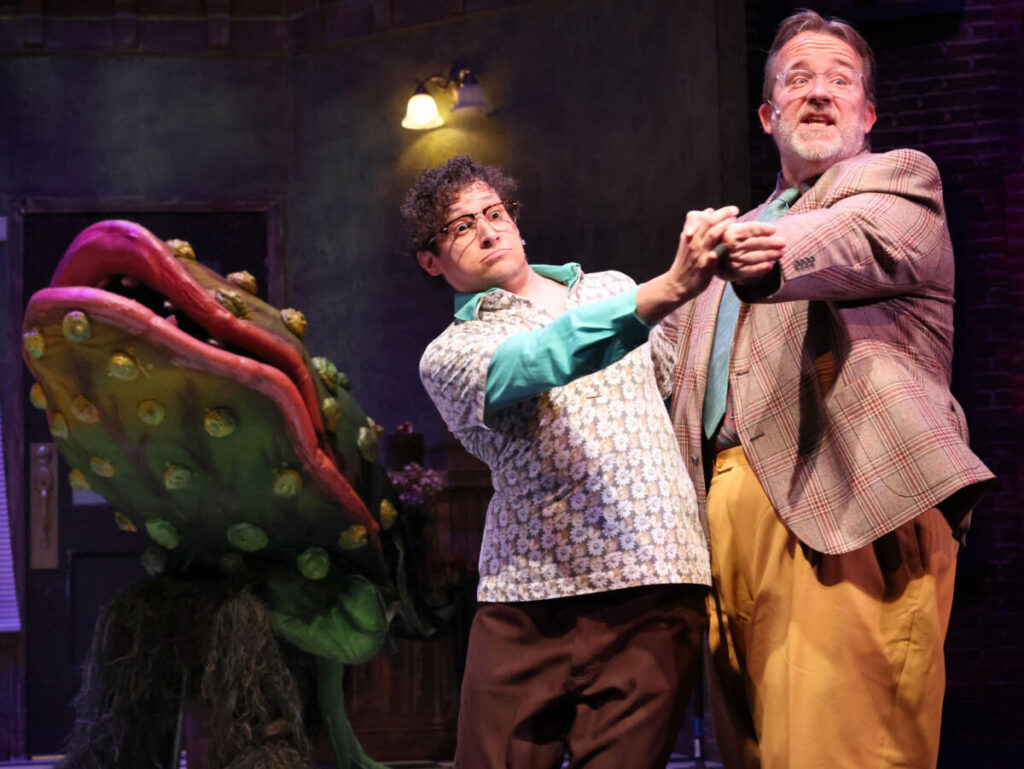
Timothy Rodd as Seymour Krelborn, left, and Patrick Stanley as Mr. Mushnik, right, rehearse a scene from “Little Shop Of Horrors” at the Ocala Civic Theatre in Ocala, Fla. on Tuesday, January 27, 2026. The play will be live on stage at The Civic from January 29 to February 15, 2026. [Bruce Ackerman/Ocala Gazette] 2026.
After more than two decades, the infamous man-eating plant Audrey II is making a triumphant, tendril-waving return to the Ocala Civic Theatre stage, ready to sink its teeth into a fresh crop of theatergoers as part of the 75th season.
According to Melody Murphy, director of marketing and public relations, it has been decades since the “Little Shop of Horrors” terrorized the local stage.
“It’s been 20+ years since we did the show the last time and the time before that was the late ‘80s/early ‘90s, so if we have a few audience members who have seen both previous productions, it’s been long enough that this time around will feel very new and fresh,” Murphy said.
Murphy said “Little Shop of Horrors” continues to resonate because of the distinct and offbeat world it creates, paired with the lasting popularity of the 1986 film adaptation.
“It’s so incredibly specific in the bizarre universe it creates. People also remember the cult-classic 1986 movie version of the musical so fondly and the nostalgia is a big factor in people wanting to see the live version on stage. The music is great, really catchy, the kind you’ll be humming for days, but you won’t mind. ‘Little Shop’ is just a fun show. Audrey II keeps reeling in new victims,” she said.
OCT, also known as The Civic, brings the beloved cult musical” to life from Jan. 29 through Feb. 15 at its home at 4337 E. Silver Springs Blvd., Ocala. Directed by Rob A. Lott, with music by Alan Menken and book and lyrics by Howard Ashman, this gleefully twisted tale unfolds in the gritty Skid Row of 1960s New York City, where catchy doo-wop harmonies, pitch-black humor and one very hungry houseplant collide in a story of love, ambition and the perils of getting what you wish for.
In a rundown flower shop, meek, nerdy floral assistant Seymour Krelborn pines for his sweet coworker Audrey while dodging the wrath of her abusive, leather-clad dentist boyfriend. When a bizarre, solar-eclipse-born plant appears and starts growing at an alarming rate, Seymour names it Audrey II after his crush. What begins as a quirky discovery quickly turns sinister: the plant can talk, demands blood to thrive and has grand plans that go far beyond a bigger pot.
Guiding the audience through the mayhem is a sassy trio of street-smart urchins who narrate with Motown flair while the shop’s cranky owner and a host of colorful characters get pulled into escalating chaos. It’s a deliciously dark ride that mixes campy thrills with surprisingly heartfelt moments.
Timothy C. Rodd makes his debut at The Civic, starring as Seymour. His credits include Archibald Proops in “Jekyll and Hyde,” Bun Foo in “Thoroughly Modern Millie” and the wizard in “Once Upon a Mattress” at Miami Children’s Theatre; Benny Southstreet in “Guys and Dolls” at the Coral Gables Youth Center in Miami; and Rapunzel’s prince in “Into the Woods” at The Art Center of Citrus County.
Rodd described Seymour’s transformation in the show as more than a shift from a “nerdy florist” to a lead character.
“To approach Seymour’s transformation, it’s helpful to see him as a character trapped in a Faustian bargain. His journey takes him from a person defined by inaction and insecurity to one consumed, and ultimately destroyed, by ambition and guilt,” Rodd said.
“His role is as an underdog who represents universal human desires, the longing for a better life, the search for love and the pressure of success,” he said of what makes Seymour relatable. “Balancing Seymour’s inherent ‘goodness’ with his descent into becoming a literal accomplice to murder is the central challenge of the role. To make the character work, you have to play him as a man who is reacting to impossible choices rather than someone seeking out evil.”
For Rodd, the goal is for audiences to recognize Seymour’s situation.
“The performance must highlight the tragedy of his entrapment. You want the audience to walk away feeling that while Seymour’s actions were inexcusable, his circumstances were nearly inescapable. Audiences empathize with Seymour when they see him as a product of Skid Row. He isn’t seeking power for the sake of being powerful; he is seeking safety for the first time in his life. The audience empathizes because they know that if he hadn’t made those dark choices, he never would have felt ‘worthy’ of Audrey. It’s a classic tragic arc where the hero’s greatest virtue (his love) becomes his greatest downfall,” he said.
Ali Shea Kells makes her debut at The Civic, in the role of Audrey. Kells played Audrey in “Little Shop of Horrors” at the Flag Theatre in Hutchinson, Kansas, and Velma Kelly in “Chicago” at the McPherson Community Theatre. Locally, she appeared in “Evil Dead: The Musical” with the Bay Street Players in Eustis.
She said “Little Shop of Horrors” is her favorite musical.
“I absolutely adore everything about it, from the score to the dialogue to the giant plant,” Kells said.
Kells said she sought to portray Audrey as gentle and strong, pushing back on the idea that those qualities cannot coexist. In shaping the character, she said she embraced moments of humor or silliness in the script as sources of resilience.
“You can be sweet and vulnerable and even a little ditzy but still be extraordinarily powerful and strong,” Kells said, adding that Audrey’s continued kindness and ability to see the best in others, even while facing abuse, ultimately define her strength.
Kells said Audrey’s solo, “Somewhere That’s Green,” reveals the character’s vulnerability and quiet resilience. She said the song is “lovely and iconic,” but also underscores how limited Audrey’s dreams are because of her circumstances.
“All she wants is a toaster and a husband who doesn’t abuse her,” Kells said, noting that even those modest hopes reflect Audrey’s ability to “still dream and find beauty in simplicity.”
While “Little Shop of Horrors” is largely a comedy, Kells said it confronts serious and relevant issues, particularly domestic violence. She said it was important that the production not minimize those realities.
“Audrey is a victim of domestic violence, and while the show itself is more of a comedy, it was very important to me that we didn’t gloss over the real-life traumas that a lot of women have gone through,” Kells said.
Kells said she hopes audiences recognize Audrey’s strength beneath her lighthearted exterior.
“While she is a little silly, she is also very strong,” she said, adding that enduring abuse and emerging with dignity “takes a tremendous amount of strength” and ultimately defines Audrey’s character.
Sebastian Lombardo portrays the sadistic Orin Scrivello. His Ocala credits include Nicky/Trekkie in “Avenue Q” and Cosme McMoon in “Souvenir” at the Insomniac Theatre.
Lombardo said he approached the role of Orin by leaning into the contrast between humor and danger, using each to sharpen the other. He said he constantly adjusted his performance, dialing up menace when the character risked becoming too likable and injecting charm when the threat lingered too long.
“The contrast alone heightens both the comedy and the menace if done well,” Lombardo said, adding that the key to the role is remembering that Orin’s humor is inseparable from his threat.
“The real thing to remember, though, is that his comedy is menacing,” he continued.
“My absolute favorite thing about Orin’s personality is just how extreme every emotional swing could get at the drop of a hat. One minute, he could be very personable and almost endearing, but one thing sets him off and immediately you get a small taste of what’s hiding behind that façade,” he shared.
“The mental trick to unlocking him was holding onto his most grotesque motivations. No matter what he says or who he’s talking to, there is no good intent. He needs to be in control at all times and definitely doesn’t view anyone as an equal, especially not women. He’s grounded and believable because he’s a controlling, domineering misogynist at his core,” Lombardo said.
Lombardo said he hopes audiences leave with an intense dislike for Orin, to the point that his removal from the story feels justified, at least at first.
“I hope they hate him with every fiber of their being,” Lombardo said. “I want them to find him so repulsive that they’d prefer to risk time with the plant! But then I want them to consider whether that actually justifies the actions of the other characters.”
La’Nya Solomon returns to The Civic to play Crystal, one of three street urchins, along with Ronnette and Chiffon. Often dressed in 1960s girl-group style, the trio functions as a Greek chorus, commenting on the action, advancing the story and occasionally interacting directly with the other characters.
Crystal is typically portrayed as the most outspoken and assertive of the three, often delivering sharper observations and pushing the narrative forward with confidence and sass. Together, the street urchins provide musical narration, humor and social commentary, grounding the show’s fantastical elements in the harsh reality of Skid Row.
Solomon previously played Sandy Cheeks in “The SpongeBob Musical” and Cinderella in Roger and Hammerstein’s “Cinderella.”
She said the chemistry among the urchins developed quickly during rehearsals, driven by the trio’s constant reliance on one another for dialogue and musical numbers. She said their bond was established early in the process.
“We all became cousins at the start of the table read,” Solomon said, adding that working alongside her castmates Jalis Redmond and Iyanna Lynell, whom she described as hardworking collaborators, was essential to bringing the trio to life on stage.
“Crystal is bubbly, knows what she wants and is very direct. We all have little stuff that we do, but onstage we hold ourselves differently from each other,” she said.
Solomon said several musical numbers highlight the urchins’ influence on the story, calling “Prologue,” “The Meek Shall Inherit” and the finale especially powerful to perform. She said “Ya Never Know” is her favorite.
“I hope that people have a wonderful time on Skid Row. This show is funny and such a classic. I hope some can find themselves in Crystal and the urchins. I hope they know the urchins are both narrators and Skid Row citizens,” Solomon said.
Resident Music Director Justin Davis called the actors playing the urchins the “storytellers.”
“They are the Greek chorus; they are also the personification of street people in Skid Row. They are very dynamic. As a music director, I was also blessed with the innate singing gifts of our three actors. I often sit back and just let them sing. Because they are stellar,” he said.
“Being that it is a classic score from early ‘80s, before computer-edited music being the norm, the actual physical representation of the music is a challenge. Once we dug through that part, everyone locked in and enjoyed the prep. We are blessed with three talented, gifted singer-actors who portray our urchins and give life to those tight harmonies. Anything that mirrors life, I think, has value, and the rapid shifts in tone of musical tone as well as emotional tone are easy to perform when we relate them to those skills in our real lives.”
According to Davis, the themes of “Little Shop of Horrors” remain timeless.
“This story, while set in music and scene of 1960’s NY Skid Row, is also a timeless story of growth, love, redemption, conflict and the concerning issues of unrestricted power. What better concepts to tell and make come alive than the ones we see right in front of our eyes,” Davis said.
According to Murphy, “Little Shop of Horrors” is a strong fit for The Civic audiences this season because it delivers high-energy entertainment and familiar music.
“Our audience is ready for a good jolt of pure musical fun, catchy tunes they know, a wild romp of a story, some silliness, a little horror, some great special effects and just a campy good time,” Murphy said.
As the show blends comedy with moments of unease, the production’s prop design plays a key role in maintaining that balance.
“Comedic horror lives in a really specific space. You’re not just trying to make something funny or serious; you’re balancing both at the same time. Props have to support the humor without undercutting the stakes, and they have to be eerie without becoming too realistic or disturbing. It’s all about walking that line where the audience can laugh, feel a little uneasy and still stay fully engaged in the story,” said prop designer Tara Oathout.
She said she hopes the audience does not notice the props at all, or notices them very intentionally.
“Ideally, most of the props should feel so natural in the world of ‘Little Shop’ that they disappear into the storytelling and just belong there. But when a prop does stand out, I want it to do so in a way that reminds the audience that this is a heightened, campy universe that doesn’t follow our everyday rules. Whether subtle or bold, every piece is there to quietly support the tone, the characters and the world they live in,” she said.
Murphy said audiences will be impressed by the cast’s talent and the production values of The Civic’s creative team.
“You will have a great time, and we will make it a memorable, warm, welcoming experience for you, because we want you to keep coming back,” she said.
Performances are at 7:30 p.m. Thursdays and Fridays; 2 and 7:30 p.m. Saturdays; and 2 p.m. Sundays. The show is rated PG. For tickets, go to ocalacivictheatre.com or call the box office at (352) 236-2274 from 10 a.m. to 2 p.m. Monday–Friday.



Support community journalism
The first goal of the Ocala Gazette is to deliver trustworthy local journalism so corruption, misinformation and abuse are not hidden from the public or unchallenged.