
Ocala fire union wins pension dispute
The cost of litigation cost more than the benefits in dispute.
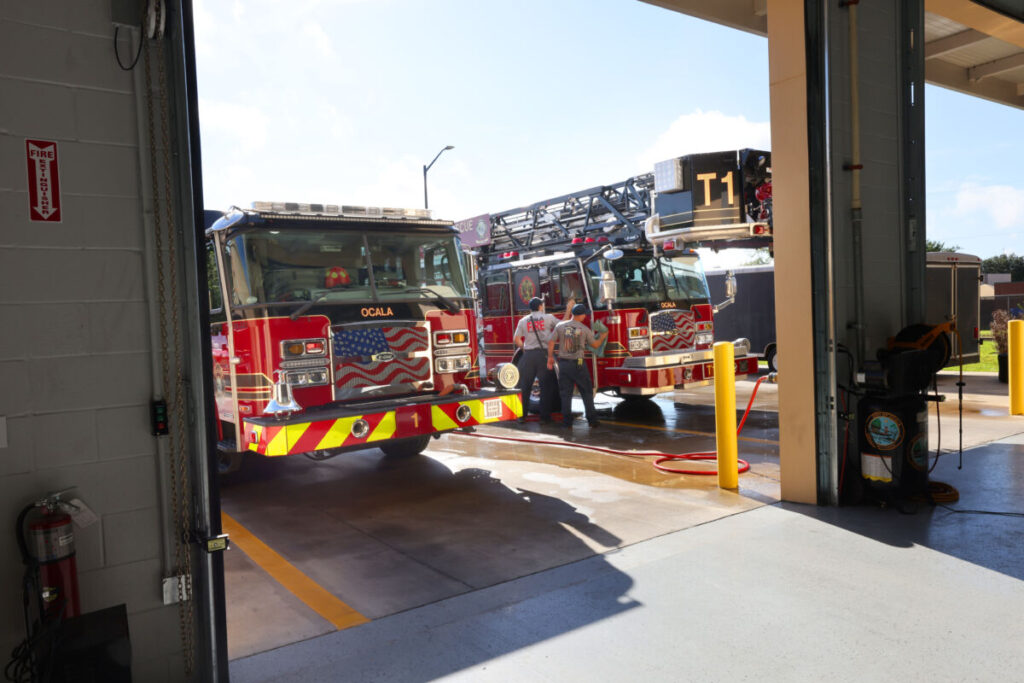
File photo: Ocala Fire Rescue Engine 1 and Tower 1 are shown pulled out of their bays as they get washed at Ocala Fire Rescue Headquarters on Northwest Martin Luther King Avenue in Ocala, Fla. on Wednesday, Sept. 15, 2021. [Bruce Ackerman/Ocala Gazette] 2021.
|
Getting your Trinity Audio player ready...
|
A years-long legal battle over firefighter pension benefits has concluded with a victory for the Professional Firefighters of Ocala, IAFF Local 2135, after the Fifth District Court of Appeal affirmed a ruling that the City of Ocala cannot rely on legislative action to cap bargained overtime calculations for long-serving first responders.
The appellate court’s Oct. 23, 2025 opinion upheld a decision by Judge Gary L. Sanders in the Circuit Court for Marion County, ending a dispute that began with conflicting interpretations of state pension reforms enacted more than a decade ago. The litigation, which formally entered the courts in February 2022, was necessary to resolve an administrative deadlock that left the city’s pension board unable to calculate benefits without risking a lawsuit.
In a transcript of an Oct. 1, 2024 hearing, the union’s attorney, Paul Donnelly, told the judge the dispute affects a “really small set of firefighters.” Specifically, he noted there were “approximately nine people still in the A group” (active members) and “only a handful more who’ve retired.”
According to the city’s pension fund records, the litigation impacted approximately 29 members, and the amount of pension money in dispute since 2015 was approximately $252,923.
A tale of two components
At the heart of the dispute was how the city calculated “earnable compensation” for veteran firefighters following the passage of City Ordinance 2016-36. That ordinance divided firefighters into two classifications based on their proximity to retirement as of Nov. 1, 2015:
Component A: Firefighters who were within five years of normal retirement under the “Rule of 70.” (The rule includes age plus years of service equals 70).
Component B: Firefighters who were not within five years of normal retirement.
The union argued that “Component A” firefighters — those within five years of retirement as of 2015 — are exempt from any overtime cap. The union’s position was based on:
- The collective bargaining agreement: The union asserted that the 2014-2017 CBA and the subsequent City Ordinance 2016-36 explicitly defined “earnable compensation” for Component A members to include “overtime” without any limiting language.
- Comparison to Component B: The union pointed out that the ordinance places a specific 300-hour cap on Component B firefighters, implying by omission that no such cap exists for Component A.
- Constitutional rights: The union argued that under Article 1, Section 6 of the Florida Constitution, public employees have a right to bargain collectively. The union contended that its specific agreement with the city to define compensation for Component A supersedes the general statutory cap found in Chapter 175.
The city argued it was legally obligated to cap pensionable overtime at 300 hours for all members, regardless of the contract, due to state mandates. It sought to apply a statutory 300-hour cap on the amount of overtime that could be included in pension calculations for both A and B groups of firefighters.
Conflicting legal theories
Before the lawsuit was filed, the city and the union were entrenched in opposing legal theories regarding state pension reforms passed in 2011.
Ocala argued that Chapter 112 of the Florida Statutes imposed a mandatory 300-hour overtime cap on all public pension plans receiving public funds, regardless of local contracts. In correspondence before the lawsuit, the city contended that state law prevailed over local ordinances and that it had no obligation to negotiate a cap lower than the statutory maximum.
Furthermore, the city argued it did not qualify for exemptions because it had repealed its “supplemental plan” in 2000, merging it into the general pension fund.
Conversely, the union asserted that veteran firefighters were “grandfathered” in under a specific exemption in Chapter 175 for “supplemental plan municipalities.” The union argued that the collective bargaining agreement trumped the general statutory cap and that the city’s status as a supplemental plan municipality allowed it to continue using the definition of compensation in effect on March 12, 1999 — a definition that did not limit overtime.
The “horns of a dilemma”
Caught in the middle was the Board of Trustees of the City of Ocala Firefighters Retirement Plan. In its initial complaint, the board described itself as being on the “horns of a dilemma.”
If the board applied the overtime cap as the city demanded, it faced a lawsuit from the union for diminishing vested benefits. The union took the position that “there is absolutely no limit on pensionable overtime hours for Component A earnable compensation.”
Seeking clarity, the board reached out to the State Division of Retirement in 2020 and 2021 for a formal opinion. However, state officials declined to intervene, stating that the division would not offer an opinion on the specific compliance of the plan and deferred to the board’s legal counsel.
Left with no administrative remedy, the board filed for declaratory relief in February 2022, asking the court to settle the matter.
The final judgment
In November 2024, Sanders granted summary judgment in favor of the union. The court ruled that Ocala met the statutory definition of a “supplemental plan municipality” because it operated a supplemental plan as of the statutory cutoff date in 2000.
“The plain language and meaning of Chapter 175 is consistent with the plain language and meaning of the Ocala ordinances, which do not contain any overtime limit for Component A firefighters,” Sanders wrote.
The city appealed to the Fifth District Court of Appeal, but the appellate court affirmed the lower court’s decision in October 2025, cementing the exemption for the veteran firefighters.
The time has run out for the city to appeal to a higher court, so the union prevailed.
Costs of litigation
Despite the city’s request in earlier motions for the court to award attorney’s fees, the court ultimately denied the request. In the final judgment, Sanders ordered that “the parties shall each bear their respective attorneys’ fees and costs,” leaving both the city and the union responsible for funding their own legal defenses in the multi-year dispute.
City Attorney William Sexton confirmed the city paid 48 invoices from Lewis, Longman & Walker, dating from 2019, with a total expenditure of $113,845 for the issue. The city also paid the firm Gilligan & Gooding, which represented the city during that time, to oversee the dispute.
The pension board indicates it has spent $273,682.17 to Klausner, Kaufman Jensen & Levinson, P.A. since 2020.
The union estimates it paid approximately $30,000 in attorney’s fees to Donnelly & Gross.
Sexton, who was hired by the city to create an in-house legal department in September 2022, could not find any prior financial analysis about the amount of money in question.
The city has no “shade meeting” minutes to provide as a public record explaining why it chose to appeal Sanders’ decision and incur additional attorney’s fees.
Pull out box: About the Ocala Firefighters Retirement Plan
The City of Ocala Firefighters Retirement Plan is a defined benefit plan, meaning it provides a guaranteed monthly retirement benefit based on a formula involving salary and years of service rather than investment performance alone. The plan is a “local law plan” governed by Chapter 43 of the City Code and regulated by Chapter 175 of the Florida Statutes, which establishes minimum standards for firefighter pensions.
Funding sources: The plan is funded through three primary streams:
- Member contributions: Active members contribute 8.17% of their salary.
- City contributions: The city acts as the plan sponsor and makes annual actuarially determined contributions.
- State funds: The plan receives a portion of the 1.85% tax on fire insurance premiums collected by the State of Florida on policies covering property within the city.
Normal retirement: Available at age 55 with 10 years of service, upon completing 25 years of service regardless of age, or when age plus years of service equals 70.
Vesting: Members are 100% vested after 10 years of credited service.
DROP: The plan includes a Deferred Retirement Option Plan (DROP) allowing members to accumulate benefits in a separate account for up to 60 months while continuing to work.
Financial status: The last financial records filed on the city’s website reflect the plan’s fiduciary net position of approximately 103 million with pension liability of roughly 18.6 million.
General membership (as of Sept. 30, 2023): According to the September 30, 2024 GASB report (using data from the 2023 fiscal year), there were 233 total members in the plan:
- 124 active plan members.
- 106 inactive plan members and beneficiaries currently receiving benefits.
- 3 inactive plan members entitled to but not yet receiving benefits.

Support community journalism
The first goal of the Ocala Gazette is to deliver trustworthy local journalism so corruption, misinformation and abuse are not hidden from the public or unchallenged.