
Legislative update: Marion County discusses the legislative 2026 session
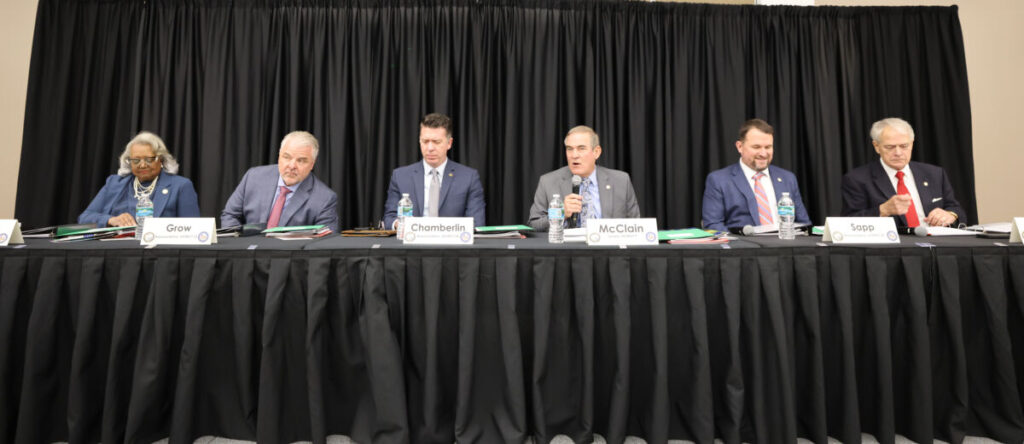
FILE PHOTO: Legislators, from left, Rep. Yvonne Hinson, Rep. J..J. Grow, Rep. Ryan Chamberlin, Sen. Stan McClain, Rep. Judson Sapp and Rep. Richard Gentry, sit together during the Marion County Legislative Delegation at the Klein Conference Center at the College of Cenral Florida in Ocala, Fla. on Wednesday, January 8, 2025. [Bruce Ackerman/Ocala Gazette] 2025.
During the Jan. 6 Marion County Board of County Commissioners meeting, Legislative Manager Matthew Cretul presented a preview of the 2026 Florida Legislative Session, which is scheduled to run from Jan. 13 through March 13.
Cretul highlighted that property taxes and growth management are expected to be the dominant issues in Tallahassee this year. The Florida House has released a tax package consisting of eight bills, seven of which are joint resolutions that would ultimately require voter approval. While there is a high volume of property tax bills filed, Cretul noted the House, Senate, and governor’s office are not on the same page, which may slow drastic legislative changes unless a consensus is reached.
Frustration over the lack of progress towards Silver Springs swimming
Commissioner Michelle Stone requested a status update regarding the return of swimming to Silver Springs State Park. Cretul reported that while the St. Johns River Water Management District has completed its permitting portion, the project currently sits with the Florida Department of Environmental Protection (DEP) pending a funding request of $2.5 million.
Both Stone and Chairman Carl Zalak are frustrated with the stalled progress. Zalak noted that despite funding being secured previously, the state has not fulfilled the promise made to the community in 2014 to return swimming to the springs. The board discussed escalating the issue by sending a letter directly to Gov. Ron DeSantis’ office to outline the original agreement and demand action.
Frustration over limitations for use of Tourist Development Tax revenue
Commissioner Kathy Bryant raised concerns regarding the statutory restrictions on the use of Tourist Development Tax (TDC) dollars. With revenue from the tax – also referred to as tourist tax, bed tax or resort tax – growing to approximately $7 million, she argued these funds should be available for local improvements that benefit both residents and visitors, such as needed upgrades to Shocker Park in Ocala.
“The Tourist Development Tax is a 4% charge on the revenue from rentals of six months or less. This tax applies to the short-term rental of any living quarters or accommodations in any hotel, apartment hotel, motel, resort motel, apartment, apartment motel, rooming house, tourist camp, trailer camp, condominium, room or home. The tourist development tax shall be charged by the person receiving the consideration for the lease or rental, and it shall be collected from the lessee, tenant, or customer at the time of payment,” according to the Marion County Tax Collector’s Office website.
According to the county’s park website, Shocker Park hosts girls’ fast-pitch softball tournaments and “contributes hundreds of thousands of dollars each year in economic impact to our community.”
“We love our visitors… but quite frankly, it is a strain on our infrastructure, and we need to be able to recoup some of those dollars to put back into our community,” Bryant stated.
Zalak urged caution, noting that opening the statute for debate could lead to the state redirecting those funds elsewhere rather than granting local flexibility. As previously reported, local control of tourism tax revenue has contributed $4.3 million for signs over Interstate 75 in Ocala as well as $275,000 in last year’s budget to produce and promote on social media videos featuring Zalak giving “insider” advice for those visiting Marion County.
Florida statute governing how the revenue can be used allows for acquiring, constructing, extending, enlarging, remodeling, repairs, improvements, maintenance, operations, or promotion of one or more “publicly owned and operated convention centers, sports stadiums, sports arenas, coliseums, or auditoriums within the boundaries of the county or subcounty special taxing district in which the tax is levied,” so it is unclear what state impediment exists for the county to use the TDC funds for the benefit of county parks.
The “Gazette” asked the county attorney and Bryant for clarification but has not received a response.
Cretul noted that bills such as SB 454 and SB 976 have been filed regarding TDC uses, though the political landscape remains complex. For example, in October, state officials discussed using tourism tax dollars as an option to offset the cost of 911 infrastructure since they do not collect enough fees on phone bills to sustain it.
Bills Marion County is watching in the 2026 session
The following legislative items have been identified as top priorities or bills of interest for Marion County:
SB 208: Land Use and Development Regulations
- Lawmaker: Sen. Stan McClain
- Analysis Status: Public-facing analysis available
- Analysis Summary:
- Compatibility: The bill redefines “compatibility” to specify that land uses do not need to be identical to be compatible. It establishes that all residential land uses are deemed compatible if they fall within the same residential land use category in the comprehensive plan.
- Infill development: The bill mandates administrative approval (without public hearings) for “infill residential development” on parcels of 100 acres or less surrounded by residential use, provided they meet density standards.
- Design preemption: The bill prevents local regulations on building design elements (e.g., paint, style) from being applied to Planned Unit Developments unless adopted in the original approval documents.
SB 48: Housing
- Lawmaker: Sen. Don Gaetz
- Analysis Status: Public-facing analysis available
- Analysis Summary:
- Tenant screening: The bill authorizes landlords to accept “reusable tenant screening reports” prepared by a consumer reporting agency within the previous 30 days. This allows tenants to pay for one background check and use it for multiple applications, though landlords are not required to accept them.
- Accessory Dwelling Units (ADUs): The bill requires all counties and municipalities to adopt an ordinance by Dec. 1 allowing ADUs in all single-family residential zones. Local governments cannot require the owner to live in the primary dwelling.
- Military housing: The bill expands density bonuses for land donated to local governments to include housing for military families receiving the basic allowance for housing.
CS/SB 380: Legal Notices
- Lawmaker: Sen. Jay Trumbull
- Analysis Status: Public-facing analysis available
- Analysis Summary:
- Website publication: The bill designates municipalities, clerks of court, and tax collectors as “special governmental agencies,” granting them the option to publish legal notices on their own official websites or a county website rather than in local newspapers.
- Cost requirement: To use the website option, the cost of publication must be less than the cost of publishing in a newspaper.
- Timeframes: Notices regarding the status of government activity must be published continuously for two weeks.
SB 948: Local Government Land Development Regulations (“Florida Starter Homes Act”)
- Lawmaker: Sen. Stan McClain
- Analysis Status: Waiting for public analysis (bill text reviewed).
- Summary: This bill prohibits local governments from regulating lot sizes on residential property connected to public utilities to be greater than 1,200 square feet. It prohibits requiring setbacks larger than 10 feet (rear) or 20 feet (front). It also mandates administrative approval for “lot splits” (dividing a parcel into up to eight lots) within 20 business days.
HB 0027: Term Limits
- Lawmaker: Rep. Jeff Holcomb
- Analysis Status: Waiting for public analysis (bill text reviewed).
- Summary: This joint resolution proposes a constitutional amendment to limit county commissioners and school board members to 12 consecutive years in office. A member who hits this limit cannot appear on the ballot again until four years after their last term expires.
SB 354: Blue Ribbon Projects
- Lawmaker: Sen. Stan McClain
- Analysis Status: Waiting for public analysis (bill text reviewed).
- Summary: This bill creates a category for “Blue Ribbon Projects” that must be at least 10,000 contiguous acres with 60% designated as reserve area. These projects must be administratively approved by local governments without the need for comprehensive plan amendments or rezoning. Development rights would be vested for at least 50 years.
HB 927: Local Land Planning and Development
- Lawmaker: Rep. Judson Sapp
- Analysis Status: Waiting for public analysis (bill text reviewed).
- Summary: This bill requires local governments to adopt a “land planning and development program” by Oct. 1 that would allow private providers to perform application reviews. If a local government fails to adopt such a program, applicants may select a private provider from a registry to perform reviews, and the local government must accept the application. It also creates an expedited permitting process for residential subdivisions.
SB 548: Growth Management
- Lawmaker: Sen. Stan McClain
- Analysis Status: Waiting for public analysis (bill text reviewed).
- Summary: This bill requires impact fee studies to use a plan-based methodology. It defines “extraordinary circumstances” (required to increase impact fees beyond statutory limits) as specific conditions like rapid population growth or failing transportation standards. Increasing fees under these circumstances requires a two-thirds vote of the governing body.
SB 718: Water Management
- Lawmaker: Sen. Stan McClain
- Analysis Status: Waiting for public analysis (bill text reviewed).
- Summary: This bill preempts the regulation of water quality, water quantity, pollution control, pollutant discharge, and wetlands to the state. It prohibits local governments from adopting laws or policies regarding these issues and repeals the statute regarding land management review teams.
SB 686: Agricultural Enclaves
- Lawmaker: Sen. Stan McClain
- Analysis Status: Waiting for public analysis (bill text reviewed).
- Summary: This bill allows owners of certain agricultural parcels to apply for “agricultural enclave” certification. If approved, the owner may submit development plans for single-family housing consistent with adjacent densities, and the development must be treated as a conforming use.
SB 218: Land Use Regulations (Impacted Local Governments)
- Lawmaker: Sen. Don Gaetz
- Analysis Status: Waiting for public analysis (Bill text reviewed).
- Summary: This bill prohibits “impacted local governments” (counties with federal disaster declarations for Hurricanes Debby, Helene, or Milton) from adopting construction moratoriums or more restrictive comprehensive plan amendments until October 2027. Violations are considered void from the beginning and retroactive to Aug. 1, 2024.
SB 840: Land Use Regulations (Disaster Recovery)
- Lawmaker: Sen. Nick DiCeglie
- Analysis Status: Waiting for public analysis (bill text reviewed).
- Summary: This bill applies to local governments within 50 miles of a hurricane track. It prohibits enforcing moratoriums that delay repair or reconstruction for one year after landfall. It generally prevents requiring repairs to comply with more restrictive amendments effective after the hurricane.

Support community journalism
The first goal of the Ocala Gazette is to deliver trustworthy local journalism so corruption, misinformation and abuse are not hidden from the public or unchallenged.