
Superpower at sunrise
Adrienne Bunn masters Ironman competitions by letting autism work for her.

Adrienne Bunn, an Ironman competitor, swims freestyle in the pool at Florida Aquatics Swimming and Training (FAST) in Ocala, Fla. on Friday, Dec. 19, 2025. Bunn, 20, who is autistic, competed in her last Ironman at the Ironman World Championships in Kona, Hawaii on Oct. 11, 2025. She has also run and finished both the Boston Marathon and the New York Marathon and plans to run in both again, besides competing in Ironman World Championships. [Bruce Ackerman/Ocala Gazette] 2025.
When her alarm pierces the pre-dawn silence at 3:30 a.m. on swim days, Adrienne Bunn does not hit snooze. She is up and out the door before most of Ocala even stirs.
In the stillness of her home, she gets ready and heads to the Florida Aquatics Swimming and Training (FAST) facility for a 5 a.m. start. There, she powers through her assigned distance in the pool, focused and steady, before she showers and, if she remembers, grabs breakfast.
“I forget to eat sometimes, and I’m a very forgetful person. But if it’s a long training day, I’ll eat a Jimmy Dean breakfast bowl. I like the bacon breakfast bowl because it contains protein, potatoes and carbs, which are all essential for my body,” Bunn said.
For Bunn, 20, her first cup of coffee in the morning isn’t just a ritual; it’s a quiet counterintuitive ally in managing her autism. While caffeine can send some people into overdrive, for her, it has the opposite effect, gently steadying her mind and easing the sensory buzz that can start the day off kilter.
“I usually start my morning with a cup of coffee. It helps me. Coffee calms me down. I don’t think it hypes me up,” she said.
By the time the sun peeks over the horizon, she has already logged miles in the water and is preparing for classes or cross-country practice at the College of Central Florida, where she majors in equine studies.
“I spend three days a week [swimming] and I run just about every day, and I bike two or three times a week,” she said.
This unrelenting dawn routine isn’t just training for Bunn; it’s a way of life. It is how she harnesses what she sees as a superpower: her autism.
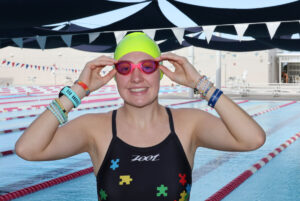
Adrienne Bunn, an Ironman competitor, gets ready to get in the water at Florida Aquatics Swimming and Training (FAST) in Ocala, Fla. on Friday, Dec. 19, 2025. [Bruce Ackerman/Ocala Gazette] 2025.
This quiet determination caught the eye of Ocala Mayor Ben Marciano on Nov. 3, when he met with Bunn during a morning session. Impressed, he shared his admiration on Facebook.
“I had the privilege this morning of meeting Adrienne Bunn, a truly extraordinary young woman from right here in Ocala. Adrienne is a two-time Ironman World Championship finisher. That means a 2.4-mile open water swim, a 112-mile bike ride and a full 26.2-mile marathon — all in one race — and she has done it twice,” Marciano wrote.
“What makes her journey even more inspiring is that Adrienne is autistic and she continues to show the world that a diagnosis does not define a person’s potential. She has pushed past doubt, challenged expectations and proven that strength comes in many forms,” he continued.
Marciano highlighted that at 18, Bunn became the youngest female athlete ever to complete the Ironman World Championship.
“Adrienne finished it, returned and did it again. Her resilience and determination speak louder than any label ever could,” Marciano said.
Diagnosed with autism spectrum disorder at age 4, Bunn faced developmental delays, hyperactivity and struggles with social interaction, communication and focus. Early experts recommended medication, but her parents, Bob and June Bunn, pursued natural forms of support, such as therapeutic horseback riding.
At age 8 at Crossroads Elementary School, behavioral issues led administrators to push for medication. June was skeptical of the effectiveness of the medication after witnessing its side effects.
“Adrienne just basically became lethargic. She was drooling. She had gained weight. She just was like a shell. So my husband and I really felt like that’s not the direction we want this to go,” June stated.
A physical education teacher at Crossroads Elementary sparked Adrienne’s love for running with a simple challenge: for every lap she completed around the parking lot, Adrienne earned a colorful plastic foot charm. As she added each one to a chain she could wear, she could see it grow.
“She got a foot for every lap she did. And that’s really what connected with her because she could see her progress. She loved getting little feet. They were different colors… a tangible goal that she could see how far she’d come,” June noted.
That small, visual reward system gave Adrienne something concrete to track and celebrate by turning laps into milestones and laying the foundation for the endurance that would one day carry her across Ironman finish lines.
According to June, running transformed Adrienne’s behavior, so the family weaned her off the medication.
“She flourished, and they didn’t even realize we had taken her off,” June said.
For Adrienne, running became a place of peace.
“Running calmed me a lot. It makes me feel calm. It makes me feel very good about myself,” she said.
Social challenges persisted, however.
According to June, making friends was hard and school transitions were tough, but physical exercise opened doors. At 13, Adrienne began to compete in the Florida Special Olympics triathlon pilot program.
“Adrienne was the only girl. She was the youngest,” June recalled. “My husband and I are like, ‘What is an Ironman?’ But Adrienne was hooked after her first race, and the program grew with dedicated guides from the Ocala Triathletes Club. They basically helped her get started. Adrienne was hooked. She loved it.”
At 17, Adrienne began intense training with coach and guide Doug Guthrie.
“He had no experience with someone with autism. He just basically treated Adrienne like any other athlete. Doug helps with nutrition as she sometimes forgets to eat; he helps with pacing and open-road bike navigation that once intimidated her,” June said.
Over time, triathlons became Adrienne’s special interest.
“I realized it was my thing when I noticed how focused and calm it made me feel. I could spend hours training and learning about it,” she said.
After completing her first extended training session to prepare for a 70.3 triathlon, also known as a half-Ironman, consisting of a 1.2-mile swim, 56-mile bike and 13.1-mile run, she reflected on the impact it had.
“My body felt strong and my mind felt quiet at the same time. That’s when I knew endurance sports were something special for me,” she said.
Inspired by friend Chris Nikic, the first person with Down syndrome to finish an Ironman triathlon, Adrienne targeted Kona.
Kona refers to the Ironman World Championship, considered the most prestigious and iconic long-distance triathlon event in the world, held annually in Kailua-Kona on the Big Island of Hawaii. The race features a 2.4-mile open-water swim in Kailua Bay, a demanding 112-mile bike ride across volcanic lava fields and windswept highways and a 26.2-mile marathon run under intense heat and humidity, finishing on historic Aliʻi Drive.

Adrienne Bunn, an Ironman competitor, bites her medal from her last Ironman in Kona, Hawaii, as she poses at Florida Aquatics Swimming and Training (FAST) in Ocala, Fla. on Friday, Dec. 19, 2025. [Bruce Ackerman/Ocala Gazette] 2025.
As much as she loves competing, the stimulation of the race environment presents sensory overload challenges.
“Crowds and loud noises are probably the hardest for me,” Adrienne said.
For relief, she manages by sticking to routines, breathing, fidgeting, listening to music and finding stillness in pre-race solitude. She tackles the chaos of open water by breaking it into parts and trusting her training. Strict race structure is a comfort.
“I like knowing the schedule and what’s expected,” Adrienne said.
The deafening roar of the Ironman finish line, with its blaring music, booming announcers and roaring crowds, hit Adrienne hard when she finished her first race, amplifying every sensory challenge she faces as an autistic athlete. But the moment she spotted her family waiting there, everything shifted.
“It was really loud and overwhelming, but seeing my family at the finish line quieted all the noise. I remember thinking, I actually did it. I felt so proud of myself for pushing through it all,” she said.
Adrienne thrives as an Ironman Foundation Ambassador, Special Olympics athlete, college cross-country runner, equine studies student, and artist who loves coloring, friendship bracelets and diamond art.
She said she performs best under coaching that is direct, calm and highly structured, preferring instructions given quietly and, ideally, in written form to reduce any potential for confusion or overload.
“Written plans help me a lot,” she explained. “When things are explained simply and ahead of time, it makes training less overwhelming.”
Adrienne pointed out the strengths she sees in autistic athletes: discipline and focus.
“A lot of autistic athletes are really disciplined and focused. Things that are challenging for us also teach us how to be strong and adaptable,” she said.
To those who say they could never complete an Ironman, Adrienne offers gentle encouragement.
“Start small and keep trying. You must believe you can do it,” she said.
And for advice for young autistic individuals dreaming of big races but feeling afraid, she spoke from the heart: “It’s okay to be scared. You don’t have to do everything at once. Just take one small step at a time and believe in yourself.”
Adrienne’s deepest hope for her legacy is simple yet powerful.
“I hope people remember that I didn’t change who I am to succeed. I learned how to work with my autism, not against it,” she said. “I want others to know they can do big things, too. Believe in yourself and surround yourself with others who believe in you.”

Support community journalism
The first goal of the Ocala Gazette is to deliver trustworthy local journalism so corruption, misinformation and abuse are not hidden from the public or unchallenged.