
HUD funding shift
Grants to be directed toward transitional housing and supportive services and away from a “failed housing first” policy.
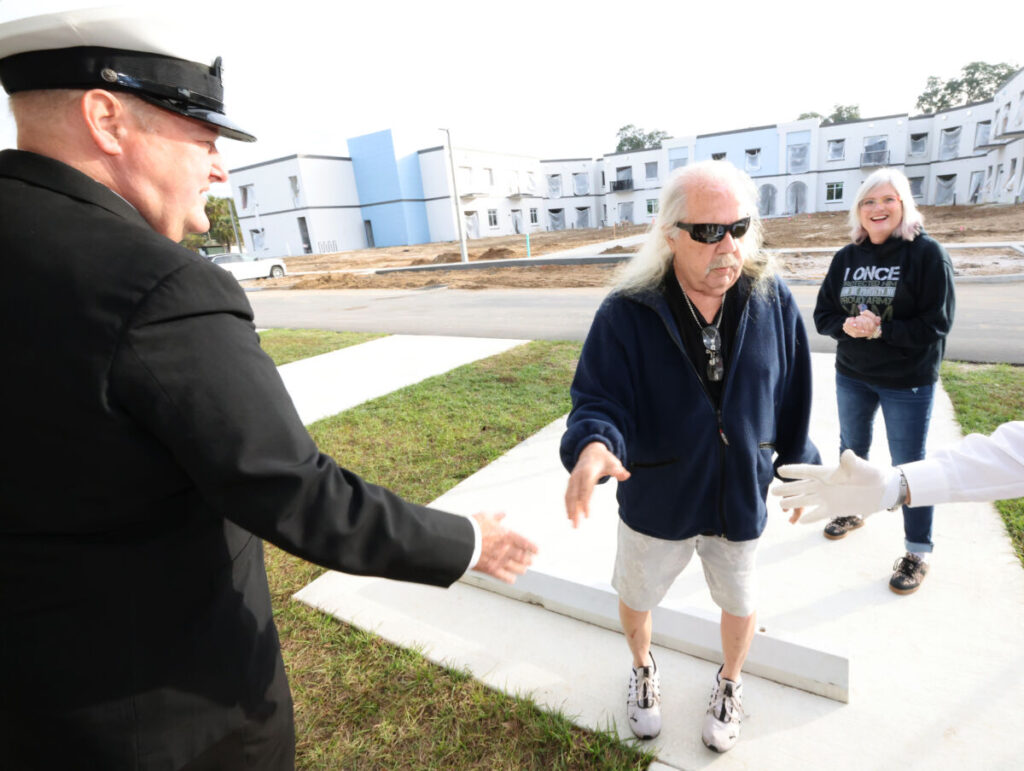
U.S. Air Force veteran Mark Davis, 75, is welcomed to his Mercy Village duplex apartment by Charles Calhoun, president of the Marion County Veterans Council and Penny Beehler, executive director of the local Continuum of Care member Saving Mercy, on Dec. 17, 2025. [Bruce Ackerman/Ocala Gazette file photo]
Leaders of local help agencies that aid the homeless — known together as the Continuum of Care — are reacting positively or with a wait-and-see outlook following policy and funding shift announcements by the U.S. Department of Housing and Urban Renewal (HUD).
Marion County nonprofits including C of C members Interfaith Emergency Services (IES), Project Hope and Saving Mercy could be impacted by the changes.
HUD Secretary Scott Turner announced $3.9 billion in HUD’s Fiscal Year 2025 Continuum of Care (CoC) Competition Notice of Funding Opportunity (NOFO) in a Nov. 13 press release.
HUD will “direct (the funding) toward transitional housing and supportive services” through “funding opportunities” for local Continuum of Care agencies and away from a “failed housing first” policy of the prior administration, the release stated.
“We are stopping the Biden-era slush fund that fueled the homelessness crisis, shut out faith-based providers simply because of their values, and incentivized never-ending government dependency,” Turner stated in the release.
The announcement was supported by the office of U.S. Department of Health and Human Services and the White House Faith Office, according to the release.
“This NOFO also ensures faith-based providers will no longer be penalized just because they are faith-based organizations. It encourages expansion of the pool of providers, including high-performing faith-based organizations, who can deliver outcomes in line with the priorities of this NOFO,” the release indicated.
The policy and funding shift stems from President Donald Trump’s Executive Order of July 24, “Ending Crime and Disorder on America’s Streets,” which states that 274,224 people were on the streets of America at a point “during the last administration” with most “addicted to drugs” or having a “mental health condition,” according to the press release.
In a follow up press release on Nov. 20, Turner stated in an “X” post that “HUD has made its intention clear when it comes to priorities for supporting homeless populations: historic funding, increased flexibility, new providers, expedited funding processes and results-oriented approaches. These reforms will help homeless Americans on a pathway to self-sufficiency while addressing the decades of failed ‘Housing First’ policy that warehoused our most vulnerable.”
The statements on “X” followed the Nov. 19 release of HUD’s Fiscal Year 2025 Notice of Funding Opportunity for nonprofit C of C members and local governments. Awards are competitive based upon program requirements.
The funds are awarded to helping end homelessness and… “quickly rehouse individuals and families experiencing homelessness, persons experiencing trauma or a lack of safety related to fleeing or attempting to flee domestic violence, dating violence, sexual assault and stalking, and youth experiencing homelessness…,” according to the Fiscal Year 2025 HUD NOFO application guidelines released Nov. 19, 2025.
The Nov. 19 NOFO lists $3, 918,000,000 in funds available in various categories under the HUD Community Planning and Development program and applications are due by Feb. 25, including $1.3 million for new permanent supportive housing projects. Awards are scheduled for March 31, 2026.
The Nov. 19 NOFO states the “Housing First” policy was touted 10 years ago as a method to reduce homelessness with permanent subsidize housing but calls the policy a “profound failure.” It also states that chronic homeless has “increased by 75%” during the last 10 years.
The McKinney-Vento Act considers people in transitional housing but not those in permanent supportive housing, which gave lower numbers but also made people “dependent” on permanent supportive housing, the Nov. 19 NOFO states.
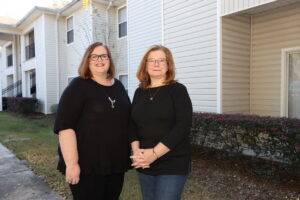
Project Hope CEO April McDonald and staff member Tami Webb are shown outside one of the nonprofit organization’s Hope Villas apartment units. Project Hope is a local Continuum of Care member. [Bruce Ackerman/Ocala Gazette file photo]
Project Hope, established in 2006, provides transitional housing for up to two years for homeless mothers with children and operates the 40-unit Hope Villas in northeast Ocala. The outreach currently is housing 84 mothers and children and has a waiting list of 166 women with an undetermined number of children each.
McDonald feels the HUD changes will allow Project Hope to “help more” moms and kids and perhaps open the door to more funding as a faith-based organization.
“We have been denied funding as a faith-based nonprofit on previous occasions,” McDonald said.
Karla Greenway, executive director of Interfaith Emergency Services, a leading local organization in aiding the homeless in Marion County, wrote via email that the Housing First approach needed to be reconsidered.
“I couldn’t be happier that the whole ‘Housing First’ era is over. While we agree that it’s easier for someone to get sober or get help if they are housed, versus on the streets, (HUD) mandated that these programs were operated with no accountability or demands on the clients being helped. They basically said, house them and then offer them services,’ but if they refused services, we had no leverage to help them better themselves and they would usually end up getting evicted for lease violations. (HUD appears to be) trying to get away from building dependence on federal funding and move clients towards self-sufficiency. This is how it was meant to be originally but it has become a way of life for so many; some who are able bodied and some who will honestly need assistance for the rest of their lives,” Greenway wrote.
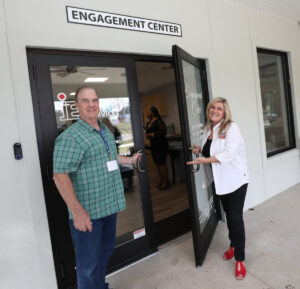
Karla Greenway, CEO of Interfaith Emergency Services, and Ned Giroux, manager of the Engagement Center, left, welcome people during an open house at the Continuum of Care member venue in Ocala on Nov. 13, 2024. [Bruce Ackerman/Ocala Gazette file photo]
Saving Mercy, a faith-based nonprofit in Ocala, operates Mercy Village, a nine-plus acre complex located 3601 W. Silver Springs Blvd.
The complex contains 10 recently completed duplexes funded by a locally handled grant and a 59-unit apartment building backed by the nonprofit Carrfour Supportive Housing of Miami, a provider of affordable housing with “on-site supportive services,” according to its website. A voice mail to Carrfour offices in Miami to inquire about any impact the HUD changes might have on the 59-unit building was not immediately returned.
Saving Mercy Executive Director Penny Beehler said the Mercy Village duplexes have two permanent supportive units and the Carrrfour apartment complex has 30.
“We will be applying (for the NOFO). Our focus will always be on the people who need housing the most. Programs like Mercy Village and our duplexes are designed to provide not just a roof, but stability, supportive services and opportunities for self-sufficiency,” Beehler wrote in an email.
“At this time, we do not anticipate any immediate disruptions to Saving Mercy’s operations. Like any organization that partners with federal agencies, we pay close attention to policy changes and adjust as needed. Our commitment remains the same: to serve individuals experiencing hardship with safe, stable and supportive housing. We stay adaptable, fiscally responsible and focused on meeting community needs, no matter how the funding landscape evolves,” Beehler wrote.
Marion County Community Services Director Cheryl Butler reacted to the initial HUD policy and funding shift announcement via email.
“HUD’s shift in funding strategy is intended to strengthen the overall effectiveness of the homelessness response system. Over the past five years, Marion County has deliberately positioned itself to address the largest gaps in our local continuum by expanding the infrastructure and supportive needs to house individuals experiencing homelessness, i.e. street outreach, Interfaith’s engagement center, Logos Lodge, Mercy Village, Wear Gloves, Project Hope and Brother’s Keeper,” Butler stated.
“This new federal direction aligns with the next phase of our long-term plan to increase coordination services among our funded providers. It supports a more comprehensive approach; one that incorporates transitional, supportive and permanent housing models allowing more partners to participate meaningfully across the entire continuum of care,” Butler wrote.
The national nonprofit Corporation for Supportive Housing stated in a Nov. 14 press release that the changes announced by HUD one day earlier “put more than 170,000 households at risk of losing stable housing and threaten billions in public and private investment.”
“Over the past several weeks, my team and I have spoken with housing and service providers, community leaders, business leaders and members of Congress from both parties, and we’re hearing strong concern about the impact of HUD’s changes nationwide,” Deborah DeSantis, president and CEO of CSH, is quoted as saying in the release.
“The concern centers on the speed and scale of the changes and the reality that most communities lack the infrastructure to manage members of 170,000 households returning to homelessness,” the release stated.
To learn more about the Ocala/Marion County Continuum of Care, go to marionflcoc.org/about-us/coc-overview
For information about the Department of Housing and Urban Development, visit hud.gov

Support community journalism
The first goal of the Ocala Gazette is to deliver trustworthy local journalism so corruption, misinformation and abuse are not hidden from the public or unchallenged.