
Paramedicine program renewed
The goal is to boost preventive healthcare and reduce emergency burdens.
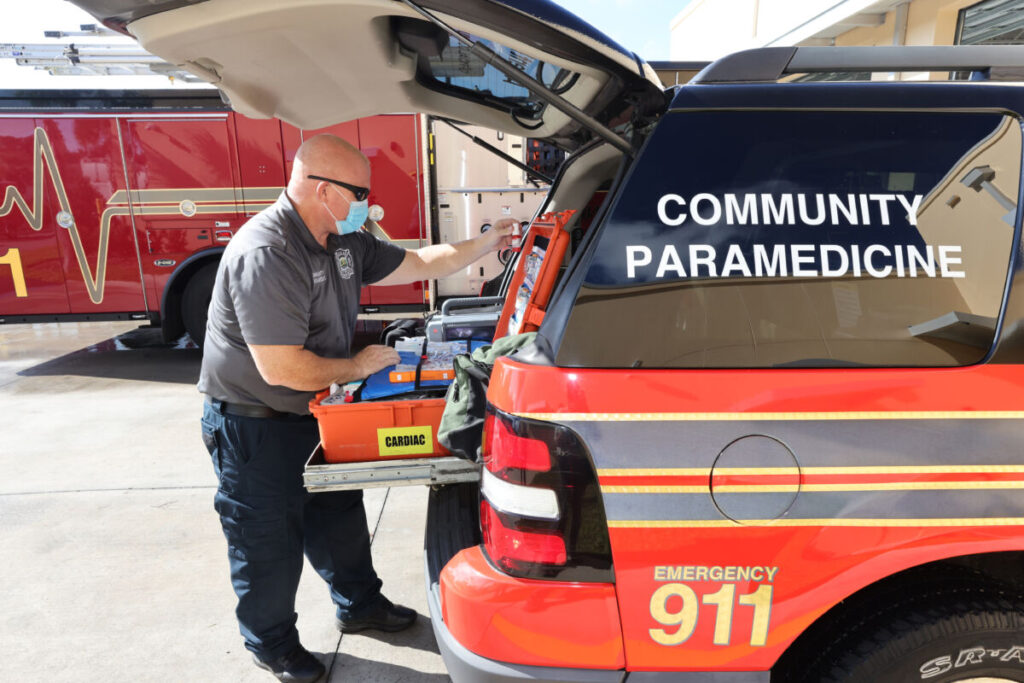
Capt. Chris Hickman checks on the inventory of medications in the Ocala Fire Rescue/AdventHealth Community Paramedicine unit at Ocala Fire Rescue Headquarters on Northwest Martin Luther King Avenue in Ocala on Sept. 15, 2021. [Bruce Ackerman/Ocala Gazette file photo]
The Ocala City Council has renewed a program that delivers proactive healthcare to vulnerable residents, aiming to decrease unnecessary emergency calls and hospital visits.
The program, sponsored by AdventHealth and facilitated through grants from the Community Foundation for Ocala/Marion County, focuses on in-home support for individuals with chronic diseases, cognitive decline or substance use disorders.
The council on Dec. 16 approved the fourth amendment to the Community Paramedicine Program Agreement with AdventHealth Ocala, extending the initiative begun in 2021 through August 2026.
EMS Capt. Jesse Blaire of Ocala Fire Rescue said the program serves between 200 and 400 patients a year who require services in one of three categories: chronic disease management, cognitive decline or substance use disorder.
“We receive referrals from law enforcement, all our hospitals, physicians’ offices, our 911 crews and many other community resources like the Salvation Army and Interfaith Emergency Services. So far, in 2025, we have responded to patients over 800 times,” Blaire stated.
“We know we have reduced the number of calls we respond to because we are providing proactive medical care to high system utilizers. We also know our CORE (Coordinated Opioid Recovery) Program has decreased the number of drug overdoses and deaths substantially, with the help of other community organizations and programs,” he continued.
Blaire explained that the program shares a common software system called JULOTA with Marion County’s program.
“It is a system designed to track patients and activities in a linear fashion, like a hospital’s reporting system. JULOTA allows a paramedic to see the whole picture at every visit, showing any progress the patient has made as well as any barriers to care the team is working through,” he said.
“In addition to the common software, both teams have a monthly interdisciplinary team meeting that brings together our medical director, representatives from both hospital systems, case workers, social workers and the leadership from both teams. As long as the patient signs the ROI form, we discuss best practices and problem solve together,” Blaire added.
The CORE program creates a comprehensive network of addiction care and opioid treatment, coordinating efforts among the Florida Department of Health, the Department of Children and Families and the Agency for Health Care Administration. It connects individuals experiencing an overdose to immediate stabilization, followed by long-term, sustainable care through specialized hospitals, outpatient practices, medication-assisted treatment, primary care, mental health support and patient navigation.
Blaire explained the funding ties with the Community Foundation.
“The Community Foundation facilitates AdventHealth funding our program through a grant,” Blaire noted.
The council approved a $100,000 grant from the Community Foundation and the corresponding budget resolution to support the program. Residents in Ocala can access the program through referrals from healthcare providers, emergency services or community organizations.
Discussing expansion and alignment with city goals, Blaire stated that OFR’s program is one of the most referenced programs in the state regarding innovation and efficiency.
“Ocala has helped many other Florida programs develop and launch successfully. From medical protocols to workflows and marketing strategies, Ocala Fire Rescue is a leader in Mobile Integrated Health, the new nomenclature for Community Paramedicine. We estimate the reduction in our 911 calls between 6-10%. Ocala Fire Rescue is also developing one of the first shared revenue models in the state, a new way to find sustainable funding for programs,” he said.
To clarify differences from the county’s program and access methods, Blaire detailed that the main difference between the program is how each of the participants’ needs are addressed.
“The Ocala Fire Rescue Program responds to its participants with a board-certified CP-C and a Crisis Behavioral Care Counselor. The CP-C is an international board certification for paramedics and we require our team to have that distinction. Our Crisis Behavioral Care Counselor functions as a social worker and case manager. The paramedic focuses on clinical medical interventions and the Crisis Behavioral Care Counselor, an employee of Marion Senior Services, focuses on connecting the person to resources,” he said.
“For example, a 60-year-old male who may be living alone without family does not realize he is struggling with cognitive decline,” he said. “A common scenario is he will start hallucinating, seeing people in his yard after the sun goes down. This scenario, referred to as ‘sundowners’ usually manifests in the person calling 911 for law enforcement to investigate. Our LEO has special training to evaluate each incident like this and refer it to our program.
“Once we receive the referral,” Blaire continued, “we respond and try to put services in place to stop the 911 calls and make the person struggling as safe as possible. Sometimes that requires connecting him back to a family that lives out of town. Sometimes that involves finding a long-term care facility for him to go to. Other times it is just making sure he has food to eat and some light housekeeping or companionship.”
OFR is also running several pilot programs focused on providing advanced clinical care.
“Many times, people are not sick enough to be in the hospital but are too sick to be at home without resources,” Blaire said. “For example, a person may have had a significant heart attack. They receive all the medical care they need and are on the road to recovery but might not understand all the different medications they need to take. We provide that medical literacy as well as medication reconciliations to keep that person safe at home. People who are not connected to our program may have a tendency to use 911 for those services,” Blaire explained.
“Ocala Fire Rescue is also running a number of pilot programs. We have what we are calling the Circulatory Support Program. With the help of AdventHealth and the ECMO and eCPR program, we are developing specialized protocols to help those people who are being discharged from the hospital after having been on heart, or lung or heart and lung bypass get better, faster,” Blaire said.
“We are running a pilot with AdventHealth’ s Congestive Heart Failure Program. We have established success in keeping this group of people from having to use the emergency room for their care. We can track the participants’ vital signs and look for trending in the wrong direction. If the person is trending poorly, we can intervene before a hospital stay is necessary. The last pilot we are running is for patients who have had a procedure called a TAVR (trans aortic valve replacement). These programs allow us to stay on the cutting edge of all other programs in Florida. Our multidisciplinary team allows the paramedic to focus on medical care and the other team members to focus on their area of expertise,” he continued.
According to Blaire, these initiatives position OFR at the forefront of similar efforts across Florida.
“Our multidisciplinary team allows the paramedic to focus on medical care and the other team members to focus on their area of expertise,” he said.

Support community journalism
The first goal of the Ocala Gazette is to deliver trustworthy local journalism so corruption, misinformation and abuse are not hidden from the public or unchallenged.