
Cool business move
DeConna Ice Cream has dipped into using solar energy at its distribution center in northwest Marion County.

Alex Khokhlov, left, and Jason Gonos, center, the co-founders of PPM Solar, talk with Nick DeConna, right, about an array of solar panels producing energy in a field at DeConna Ice Cream on West County Highway 318 in Reddick, Fla. on Tuesday, Nov. 18, 2025. This project is one of the largest privately owned solar systems of its kind in Marion County, a 794 kW ground-mount array built in Reddick. It is a major milestone for both DeConna Ice Cream and the region, bringing clean energy, local investment, and long-term savings together in one project. By harnessing the Florida sun, DeConna will offset approximately 64% of its facility’s electricity use, cutting costs by more than $10,000 each month and helping create a more resilient energy future. [Bruce Ackerman/Ocala Gazette] 2025.
On the bright and sunny afternoon of Nov. 18, things were chill at the DeConna Ice Cream distribution center in Reddick, in northwest Marion County, as the business owners hosted a celebration to show off their cool new solar energy installation.
The endeavor was a partnership with DeConna Ice Cream President Nick DeConna and his father, Vince DeConna, and Alex Khokhlov and Jason Gonos, co-founders of PPM Solar, based in Gainesville.
“We started in November of 2024 to build this project,” said Nick DeConna. “We were looking at the financial side of it and helping reduce our energy cost, and also the attractiveness of renewable energy, good for the environment, good for the Earth, and that’s when Jason put together a proposal. And now these solar panels power the building and we work with Duke Energy and they credit our account for any over-production.”
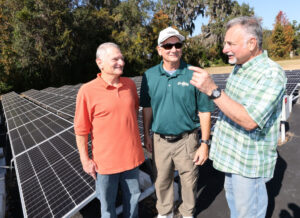
Mike Fehl and his cousins Vince DeConna and Bill DeConna talk in front of the array of solar panels.
When asked if he had noticed any differences between standard utility power and operating off of solar energy, Nick said, “No difference at all on the operating side, just a big savings our monthly energy bill.”
DeConna Ice Cream has been in business for 79 years and the current leadership team is continuing to expand the operation. The ice cream is made elsewhere and distributed from the Reddick campus and sites in Palm Bay and Tampa.
“We’re in 23 states and still expanding, and we also have done a lot of work with our product. In 2026, we will come out with a new pint of premium ice cream with no high fructose corn syrup and no artificial colors. It is going to be a great product to bring onto the market. I still work closely with my father, who is semi-retired, on product development, marketing and finances,” Nick noted.
On Tuesday, as guests, DeConna employees and representatives from PPM Solar enjoyed lunch —with ice cream for dessert, of course — Alex Khokhlov described some of the particulars of the solar energy project, sprawled out behind him in rows spilling down a hill behind the podium.
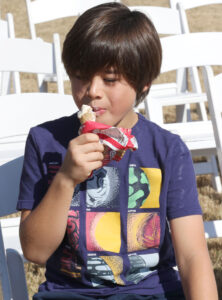
Francisco Gonos, 8, the son of Jason Gonos of PPM Solar, eats a DeConna Ice Cream cone.
“This solar system is about 800 kilowatts of about 2,500 solar panels here in this field. This project offsets approximately $10,000 to $13,000 a month in electric costs and will save over $4 million over its lifetime. But the savings is not the only incredible aspect. Through this project, we’ll see avoided emissions equivalent to 2,500 trees planted, 170,000 rail cars of coal not burnt, or an environmental equivalent of 60 tons of waste recycled instead of going into a landfill,” Khokhlov said.
“Why is this important? We are on the cusp of a major transformation. To give you an idea, two years ago Duke Energy owned approximately 350 megawatts of solar energy. In the last two years, they built more solar energy for themselves than the entire time in the industry. Next year, they’re adding over 700 megawatts of solar. By the end of next year, Duke Energy will operate over 1.7 gigawatts of solar energy capacity,” he noted.
“Why is this important? Well today the energy mix for the power that we receive here, the power that you originally came to this building, 11% is nuclear, as of today 8% is solar and the rest is fossil, which means that primarily natural gas is being burnt. In the process of developing fossil fuel energy, some things are happening that are good and some things that are not so good. It is scalable, it is fast, but it’s also not the most economical nor is it the cleanest. The array that we’re standing in front of will offset its entire environmental footprint to manufacture, to deliver, to assemble, to mobilize, to put in place in under one year, meaning that for nearly 30 years of useful life, it will create environmental benefit,” he added.
Khokhlov went on to explain that the Scandinavian solar panels were made from silicone glass and will be fully recycled at the end of their lifetime, estimated to be 30 years, and have a warranty of 25 years. The panels are on frames with a ballast ground mount and can withstand winds of up to 140mph. The geotechnical fabric underneath is fully water permeable, so the project maintains full water erosion control.
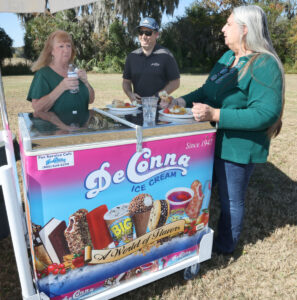
Gale Hayden, Nick DeConna and Toni Leiser, all of DeConna Ice Cream, talk by a cart as people gather for the celebration.
He said solar panels generate DC electricity and this system generates very, very high voltage that gets converted into usable power that is sent into the building. As part of the project, DeConna Ice Cream put in a high-speed DC car charger, which led to more powerful transformer being installed.
Gonos told those gathered that he and Nick DeConna had been talking about the project for years.
“The time was right. There were really good incentives. He and Vince wanted to do something really good, and I just want commend you guys for taking this leadership role for the community and for doing something really good for the world. This was a huge investment on your part, a huge show of trust and faith that you had our company do this for you,” Gonos said.
He said the incentives included a Rural Electrification for America program that is no longer available, a federal tax credit and some federal depreciation.
Khokhlov stepped back in to say that “typically, a system of the size will pay for itself in under five years, meaning that it has an annual ROI (return on investment) of about 20%.”
“This project paid for itself much quicker because of the additional local incentives that rural communities receive. But regardless, this type of project anywhere in Florida is a very high return on investment. For a business to invest in a project like this means they have to part with their money for about five years, and they will get about 20 years of free electricity after that. A system this size will size typically will cost just over $1 million and energy and incentives will offset about $300,000 a year,” he said.
Among those gathered for the event was Bill DeConna, the brother of Nick and Ray DeConna.
“Our father, Don DeConna, started DeConna Ice Cream in 1946. He grew up in Pennsylvania and his father died when he was 4 and he started working in the coal mines when he was 5. He started his own business when he was 8, so he didn’t go to school much. There was the Great Depression and then he went into the military in 1938. He was in Hawaii when they bombed Pearl Harbor. He was in the army and was supposed to get out in two weeks, but he stayed for the duration of the war,” Bill shared.
He said his father lived in various locations in the Pacific for seven years and when he returned to Pennsylvania after the war, it was too cold. A friend told him about a guy in Miami who rented out ice cream carts, so Don said, “Let’s go.”
He said his father wound up buying some ice cream carts and also started creating ice cream flavors that people wanted, such as Cuban and Italian. Eventually, Don moved his operation to Micanopy, in Alachua County, then to Gainesville and finally to the site in Reddick.
“This used to be an orange grove,” Bill said, sweeping his arm around the sprawling campus and noting that it was purchased from the widow of the renowned local citrus grower Buddy Huff.
“It’s amazing that Dad had the foresight to buy this much land. I mean look at how much space this thing takes up,” he added, pointing to the solar panel array.
Bill shared that while he had been involved in the family business since he was a kid, at one point he followed a long-held dream and went to seminary and pastored a church for about 30 years.
“But I like to stay in touch,” he added. “I like to say I’m the CTO — Chief Tasting Officer. When they get a new product, I come over and see if it gets a thumbs up.”
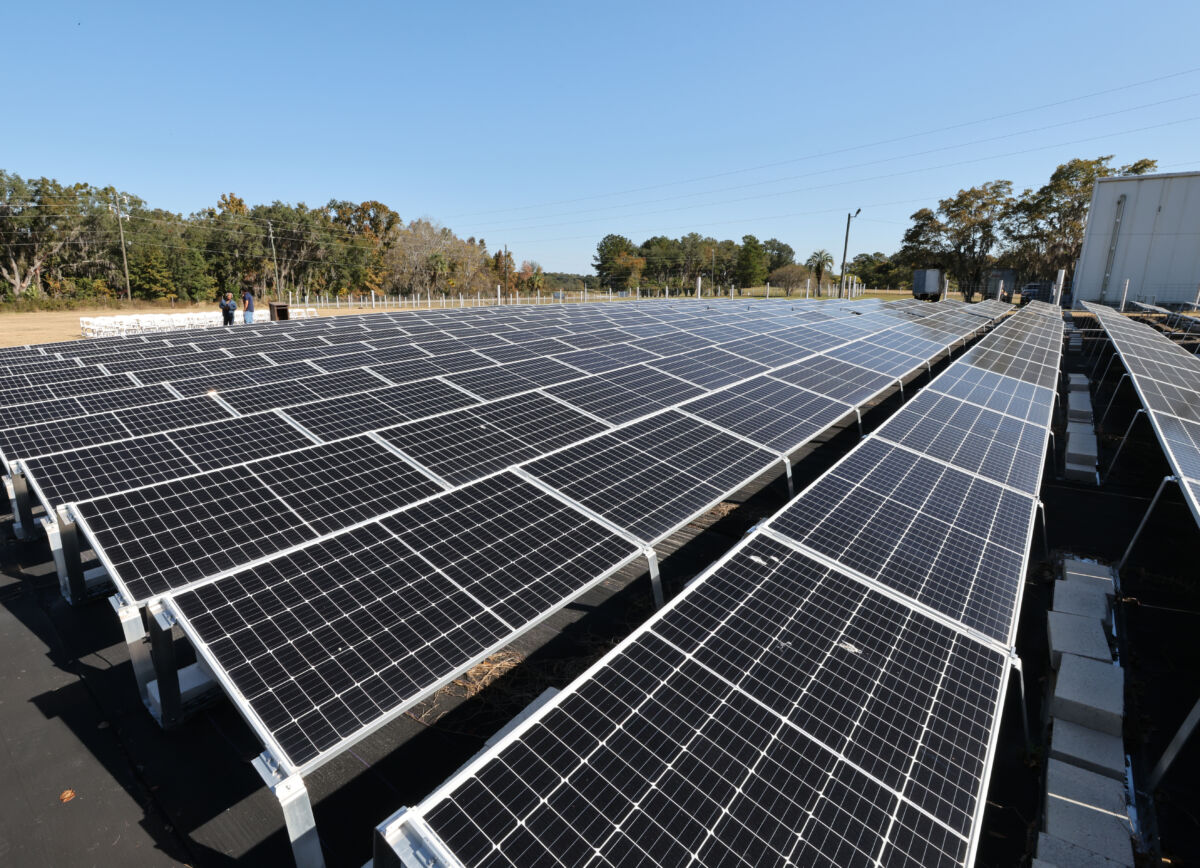
Part of an array of solar panels producing energy are shown in a field at DeConna Ice Cream in Reddick.

Support community journalism
The first goal of the Ocala Gazette is to deliver trustworthy local journalism so corruption, misinformation and abuse are not hidden from the public or unchallenged.